Wireless video receivers can simplify multi-camera production by sending one camera feed to several monitors, directors’ stations, confidence displays, or remote viewing points without running long HDMI cables.
This roundup compares 10 wireless HDMI systems by receiver capacity, transmission range, resolution, latency, connectivity, and setup practicality so you can choose the right solution for live events, classrooms, studios, streaming, and presentations.
Best 10 Wireless Video Receivers for Multi Camera Setups Picks for 2026
All-in-One Crew Monitoring
7-Inch Multi-Receiver HDMI System
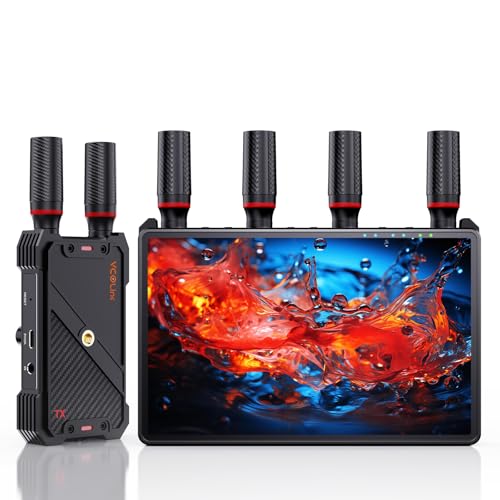
- Built-in 7-inch monitor with HDMI output
- Supports up to five receivers
- 1080p/60Hz with claimed 1,312-foot LOS range
Best For: Film crews and live-event teams needing shared monitoring
Flexible Multi-Screen Value

- Includes transmitter and two receivers
- Expandable to six receivers
- Includes several HDMI format adapters
Best For: Rooms with multiple TVs, projectors, or monitors
Professional Production Choice
Hollyland Pyro H Wireless System

- 4K30 input and 1080p60 transmission
- Expandable to four receivers
- Smart channel scan and UVC streaming
Best For: Film, live-streaming, and ENG/EFP production crews
Large-Scale Display Sharing

- Includes three receivers and supports up to six
- 4K input with 1080p output
- Plug-and-play dual-band transmission
Best For: Multi-display presentations and entertainment spaces
Portable Multi-Screen Pick

- One transmitter with four receivers
- 165-foot open-area range; 1080p at 60Hz
- Plug-and-play with heat-control technology
Best For: Portable presentations and multi-screen venues
Flexible Expansion Choice
WELUSOPU Multi-Display HDMI Kit

- Two receivers included; supports up to six
- 4K input with 1080p output
- Dual-band, 165-foot open-area transmission
Best For: Expandable home, classroom, and business installations
Four-Screen Performance Pick

- One transmitter with four receivers
- 1080p at 60Hz with stated 0.1-second latency
- Pre-paired operation with dual-band transmission
Best For: Four-display presentations and live-event installations
Flexible Multi-Display Pick
Vrriis 1300FT Wireless HDMI Kit

- Up to 1 TX and 5 RX support
- Loop-out plus dual HDMI receiver output
- 1080p/60Hz with multiple power options
Best For: Expandable camera monitoring and multi-screen setups
Two-Receiver Production Pick
PWAY W3302-2RX Wireless HDMI Kit

- Includes 1 transmitter and 2 receivers
- HDMI loop-out enables local monitoring
- Camera-friendly mounting and battery slots
Best For: Two-display production and professional AV monitoring
Simple Expansion Choice

- Expands to up to 5 receivers
- 1080p/60Hz with 0.05-second latency
- Loop-out, IR control, and plug-and-play setup
Best For: Expandable office, event, and camera monitoring systems
All-in-One Crew Monitoring – 7-Inch Multi-Receiver HDMI System
For teams comparing wireless video receivers for multi camera setups, this system stands out by combining a built-in 7-inch monitor with support for up to five receivers. It supports 1080p at 60Hz, offers claimed range up to 1,312 feet in line of sight, and includes HDMI loop-out for local monitoring.
Best For: Film crews, studios, and live-event teams that need multiple viewing points and an integrated on-set monitor.
Pros:
- One transmitter can broadcast to up to five receivers.
- Built-in 7-inch screen, HDMI output, headphone jack, and adjustable brightness and volume.
- Supports 1080p/60Hz, dual-band transmission, low claimed latency, and HDMI loop-out.
- Flexible power options include NP-F batteries, power banks, and USB-C.
Cons:
- External HDMI cable is not included.
- Smartphone and tablet compatibility requires a Type-C-to-HDMI cable.
- The large feature set may be more than a simple single-display setup needs.
The integrated monitor reduces the amount of extra equipment needed on set, while the expandable receiver design supports collaborative viewing. Its mounting and power options also make it practical for mobile production, though buyers should plan for compatible cables and power accessories.
Flexible Multi-Screen Value – Plug-and-Play HDMI Kit
This kit is a practical option for wireless video receivers for multi camera setups when the priority is sending one HDMI source to several displays. It includes two receivers, supports expansion to six receivers, and uses dual-band transmission with a claimed open-range distance of up to 165 feet.
Best For: Conference rooms, classrooms, home theaters, bars, restaurants, and other spaces using several TVs or projectors.
Pros:
- Includes two receivers and supports up to six total receivers with additional units.
- Plug-and-play design with 2.4GHz/5.8GHz dual-band transmission.
- Includes USB-C-to-HDMI, Micro HDMI, and Mini HDMI adapters.
- Compatible with cameras, laptops, game consoles, projectors, TVs, and other HDMI devices.
Cons:
- Claimed range drops substantially when signals pass through walls.
- It cannot transmit from one TV to another TV.
- Apple TV output must be set to 1080p/60Hz for use with the kit.
Its included adapters and expandable receiver capacity make it versatile for mixed source devices and multi-display installations. The shorter stated range than some production-focused systems makes it better suited to rooms and offices than large open-set coverage.
Professional Production Choice – Hollyland Pyro H Wireless System
For professional wireless video receivers for multi camera setups, the Hollyland Pyro H combines 4K30 input support, 1080p60 transmission, and a claimed 1,300-foot line-of-sight range. Its receiver network can expand to four units, while smart channel scanning is designed to help manage crowded wireless environments.
Best For: Film production, live streaming, ENG/EFP work, and crews that need coordinated monitoring with app support.
Pros:
- Supports video formats up to 4K/30 through HDMI and transmits up to 1080p/60.
- Expandable to four receivers for multi-person monitoring.
- Smart channel scan works across 2.4GHz and 5GHz bands.
- Includes HDMI loop-out and UVC support for plug-and-play computer streaming.
Cons:
- The listed kit includes only one transmitter and one receiver.
- Its claimed 60ms latency is higher than the sub-50ms claim of some competing kits.
- Full multi-user coverage requires purchasing additional compatible receivers.
The Pyro H is the most production-oriented choice in this group, with professional connectivity, a long stated range, and a workflow that supports both on-set monitoring and computer-based streaming. It is a strong fit for crews willing to expand the system as their monitoring needs grow.
Large-Scale Display Sharing – 5.8G HDMI Multi-Receiver Kit
This WELUSOPU kit is aimed at buyers who want wireless video receivers for multi camera setups or other multi-display installations without adding network configuration. It includes one transmitter and three receivers, supports up to six receivers, and claims up to 656 feet of open-space transmission.
Best For: Home theaters, conference rooms, classrooms, restaurants, bars, and presentations requiring synchronized displays.
Pros:
- Includes three receivers and supports up to six displays simultaneously.
- Uses 2.4GHz/5.8GHz dual-band transmission with automatic frequency hopping.
- Supports 4K input and 1080p output with stereo audio.
- Plug-and-play operation does not require Bluetooth, Wi-Fi, or an app for standard screen sharing.
Cons:
- Output is limited to 1080p even though 4K input is supported.
- Mobile-device monitoring requires the app and supports mirroring only.
- The stated 656-foot range applies to open spaces and may vary in real installations.
With three receivers included, this is a convenient starting point for installations that need several displays immediately. Its simple setup and receiver expansion are useful for presentation and entertainment environments, while camera users should confirm that their source output matches the system’s HDMI requirements.
Portable Multi-Screen Pick – G7R PRO Wireless HDMI Kit
For buyers comparing wireless video receivers for multi camera setups, the G7R PRO is a practical multi-display extender with one transmitter and four receivers. It supports up to four HDMI screens at once, with additional mobile mirroring available through the app, while dual-band operation and automatic cooling are designed for steady extended use.
Best For: Portable presentations, classrooms, churches, conference rooms, restaurants, and home setups that need video on several screens.
Pros:
- Includes four receivers for simultaneous multi-TV or monitor output.
- Offers a claimed 165-foot open-area range and approximately 50 feet through walls.
- Pre-paired plug-and-play setup requires no Wi-Fi, apps, or drivers for HDMI screen sharing.
- Supports 1080p at 60Hz with stated 0.1-second latency and includes a USB-C-to-HDMI adapter.
Cons:
- Open-area range is reduced by walls and large obstacles.
- Both transmitter and receivers require a 5V/1A USB power source.
- Mobile mirroring uses the TUTUPlay app and may be less direct than HDMI display sharing.
Its four included receivers make this a strong value when several displays are required immediately. The portable design and heat-control technology also suit temporary events, though buyers should plan power connections and account for obstacles between rooms.
Flexible Expansion Choice – WELUSOPU Multi-Display HDMI Kit
For wireless video receivers for multi camera setups, this WELUSOPU kit offers a flexible starting point with two receivers included and support for up to six receivers simultaneously. Its dual-band transmission, 4K input support, and 1080p output make it suitable for distributing a source to multiple displays without adding a conventional HDMI splitter.
Best For: Home theaters, conference rooms, classrooms, restaurants, bars, and users who may expand from two displays to as many as six.
Pros:
- Supports up to six receivers and simultaneous multi-display mirroring.
- Provides a claimed 165-foot open-area transmission range with 5.8G/2.4G dual-band operation.
- Accepts 4K input while delivering 1080p output with stereo sound.
- Works with many HDMI sources, including PCs, MacBooks, cameras, projectors, monitors, and streaming devices.
Cons:
- Only two receivers are included, so additional receivers are needed for larger installations.
- Output is limited to 1080p even though 4K input is supported.
- Smartphone and tablet use requires the app and supports mirroring only, without reverse control.
This is the most expansion-oriented option in the group. It makes sense for buyers who need two displays now but want a path to six later, provided 1080p output meets the requirements of the installation.
Four-Screen Performance Pick – G9R PRO HDMI Extender Kit
For buyers seeking wireless video receivers for multi camera setups, the G9R PRO pairs one transmitter with four receivers for simultaneous expansion across multiple TVs or monitors. It emphasizes low-latency 1080p video at 60Hz, dual-band transmission, and heat control for presentations, live events, and other extended sessions.
Best For: Conference rooms, classrooms, churches, restaurants, banks, live broadcasts, and other installations requiring four synchronized displays.
Pros:
- Includes four receivers for simultaneous output to four screens.
- Claims up to 165 feet in open areas and approximately 50 feet through walls or ceilings.
- Pre-paired plug-and-play operation needs no Wi-Fi, Bluetooth, apps, or drivers.
- Supports 1080p at 60Hz, stated 0.1-second latency, and includes a USB-C-to-HDMI adapter.
Cons:
- The transmitter supports 1080p output only, so the source may need to be set to 1080p.
- The transmitter cannot connect directly to a TV; it needs an HDMI-output source such as a laptop or TV box.
- Each unit requires a stable 5V/1A power supply.
The G9R PRO is well suited to fixed or semi-portable four-screen deployments where synchronized 1080p playback matters. Its source and power requirements are straightforward, but buyers should verify that their equipment provides HDMI output rather than relying on a TV as the source.
Flexible Multi-Display Pick – Vrriis 1300FT Wireless HDMI Kit
For shoppers comparing wireless video receivers for multi camera setups, the Vrriis WL082 offers a flexible point-to-point system with one transmitter, one receiver, transmitter loop-out, and dual HDMI output on the receiver. It supports up to 1080p at 60Hz and is designed for straightforward monitoring without added software.
Best For: Users who need local and remote monitoring, multiple receiver options, and flexible power choices for camera or event setups.
Pros:
- Supports up to 1 transmitter and 5 receivers, although range decreases as receivers are added.
- Transmitter loop-out and dual HDMI output on the receiver support multiple screens.
- Offers 1080p/60Hz transmission with stated 0.05-second latency.
- Supports NP-F batteries, USB-C power, adapters, and compatible portable power banks.
Cons:
- Its advertised 1300-foot range is based on an open field; walls, glass, brick, and metal can reduce coverage.
- Batteries are not included.
- Adding receivers can reduce transmission distance.
The Vrriis stands out when a setup may expand beyond a single remote display. Its loop-out, dual-output design, IR support, and several power options make it adaptable, while real-world range will depend heavily on the environment.
Two-Receiver Production Pick – PWAY W3302-2RX Wireless HDMI Kit
For wireless video receivers for multi camera setups that need two remote displays, the PWAY W3302-2RX pairs one transmitter with two receivers. It combines 1080p transmission, HDMI loop-out for local viewing, and mounting features suited to cameras, rigs, tripods, and on-location AV work.
Best For: Camera monitoring, events, churches, conference rooms, classrooms, and professional AV installations requiring two simultaneous remote displays.
Pros:
- Includes one transmitter and two receivers for sending one HDMI source to two displays.
- Provides HDMI loop-out for local monitoring while feeding both remote receivers.
- Supports 1080p video and is designed for transmission up to 1640 feet in open environments.
- Rear battery slots and threaded mounting holes support portable camera and rig installations.
Cons:
- The long-distance rating is specified for open environments, so obstacles may affect performance.
- The kit is configured for two receivers rather than the broader receiver expansion described by some alternatives.
This is the most purpose-built option here for a two-display production workflow. Its included receivers reduce the need for additional hardware, while the loop-out and mounting points make it practical for both fixed and mobile monitoring.
Simple Expansion Choice – 1300FT Wireless HDMI Extender
This wireless HDMI extender is a practical option for wireless video receivers for multi camera setups when you want plug-and-play operation and the ability to add receivers later. It supports 1080p at 60Hz, transmitter loop-out, IR remote control, and expansion to as many as five receivers.
Best For: Offices, conferences, church projections, home entertainment, and camera monitoring systems that may grow to multiple remote displays.
Pros:
- Supports up to 1 transmitter and 5 receivers, with the note that additional receivers reduce range.
- Transmitter HDMI output allows a local monitor to be used alongside remote viewing.
- Supports 1080p/60Hz video with stated 0.05-second latency.
- Plug-and-play setup and IR support simplify installation and source control.
Cons:
- The 1300-foot range applies to an open, interference-free field; walls and other materials can cause signal loss.
- The supplied notes do not specify included batteries or a multi-receiver bundle.
The key advantage is scalability: you can begin with a basic transmitter-and-receiver connection and add receivers as needed. It is a sensible fit for straightforward installations, provided the building layout and obstacles are considered before relying on the maximum range.
How We Picked the Best Wireless Video Receivers for Multi Camera Setups
We focused on systems designed to distribute video to multiple receiving points rather than ordinary one-to-one wireless HDMI kits. The selected products support multiple receivers, with several models offering four, five, or up to six receiver connections. We also considered stated range, supported resolution and refresh rate, latency, loop-out functionality, frequency bands, installation simplicity, and monitoring features such as included receiver displays.
Because wireless performance depends on walls, interference, antenna placement, and the source device, advertised range should be treated as an ideal maximum. A reliable system with practical placement flexibility can be more useful than a product with the longest published distance.
Quick Comparison
| Feature | What to Look For | Why It Matters |
|---|---|---|
| Receiver capacity | Two to six or more receivers | Determines how many displays can show the source simultaneously. |
| Resolution | 1080p or 4K-capable transmission | Matches camera output and display requirements. |
| Latency | Low-delay transmission | Important for live switching, monitoring, and interactive presentations. |
| Range | About 165 to 1,640 feet claimed | Helps determine whether the kit suits a room, venue, or outdoor layout. |
| Loop out | Transmitter HDMI loop-out | Lets you keep a local monitor or connect to another wired device. |
Key Buying Factors for Wireless Video Receivers for Multi-Camera Setups
Receiver Count and Expansion
Confirm whether the listed package includes the number of receivers you need or merely supports additional units. A two-receiver bundle may be cheaper initially, while a four- or five-receiver kit can reduce the cost and complexity of expanding later. Also check whether extra receivers are sold separately and whether all receivers can display the same source at the same time.
Resolution, Frame Rate, and Compatibility
Match the transmitter’s input requirements to your cameras, switcher, laptop, or DSLR. Many systems target 1080p, while some newer options advertise 4K input or 4K30 support. Verify HDMI version, supported refresh rates, HDCP behavior, and whether the system works with your camera’s clean HDMI output.
Range, Interference, and Latency
Shorter-range systems may work well in classrooms, conference rooms, and studios, but larger venues need stronger placement flexibility. Dual-band operation can help manage interference, although it does not guarantee uninterrupted performance. For live monitoring, prioritize low delay; for signage or casual viewing, a slightly higher delay may be acceptable.
Installation and Monitoring Features
Plug-and-play pairing, compact power supplies, IR support, and included antennas can make a significant difference during setup. Loop-out is especially useful when the camera operator or director needs a local screen while other receivers feed remote displays.
Who Should Buy Which Wireless Video Receivers for Multi Camera Setups?
Choose a compact one-transmitter, two-receiver system for small studios, classrooms, presentations, and basic event monitoring. Four- to six-receiver kits are better for venues needing simultaneous feeds to several TVs, confidence monitors, or production positions. Consider a 4K-capable dual-band system when preserving higher-resolution source material matters. For long venues or flexible outdoor layouts, prioritize range and antenna placement, but test the system in the actual environment before relying on it for a critical production.