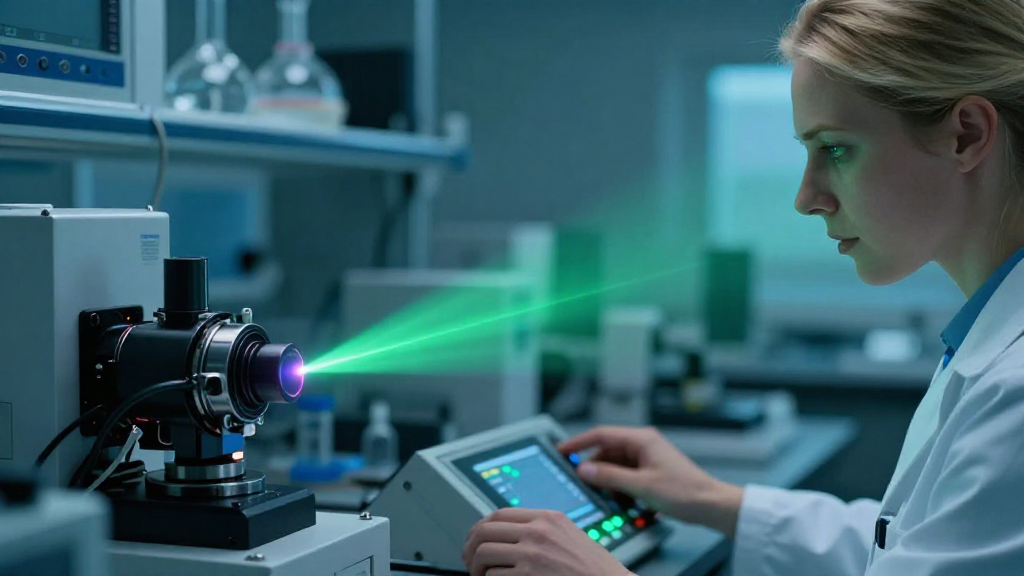
Beam divergence is a crucial concept in optics, particularly when discussing lasers and various types of light sources.
Understanding beam divergence is essential for applications ranging from laser cutting to telecommunications.
What Does Beam Divergence Mean?
Beam divergence refers to the measure of how much a beam of light spreads out as it travels away from its source.
It is typically quantified in angular terms, usually in milliradians (mRad) or degrees.
This phenomenon is particularly important in fields like:
- Optical engineering
- Laser applications
- Photonic systems
A beam with a smaller divergence angle remains more focused compared to one with a larger angle, which affects its effectiveness in various applications.
Why Is Beam Divergence Important in Lasers?
Lasers are designed to produce highly focused beams of light, making them invaluable in multiple industries.
The degree of beam divergence significantly impacts:
- The intensity of laser light at a distance
- The accuracy of laser-based applications
- The efficiency of energy transmission
In industrial settings, a low beam divergence is preferable because it ensures that the laser light maintains its intensity over longer distances.
For instance:
- A low-divergence laser is used in cutting and welding because it delivers more power to a small area.
- Conversely, a high-divergence laser might be more suitable for applications like laser projectors, where spread is more desirable.
How Is Beam Divergence Measured?
Beam divergence is often measured using the following formulas:
-
Standard Divergence:
[ \theta = \frac{2 \lambda}{\pi w_0} ]
Where:
– ( \theta ) is the divergence angle.
– ( \lambda ) is the wavelength of light.
– ( w_0 ) is the beam waist (the narrowest part of the beam). -
FWHM (Full Width at Half Maximum):
Some measurements use the FWHM of the beam profile to determine divergence, calculating how much the beam spreads at a particular distance. -
Practical Measurement:
One can also use a laser rangefinder or beam profiler to observe how the laser spot expands over a distance.
Understanding these measurements helps in selecting the right laser for a specific application while ensuring effective focus and energy delivery.
What Factors Affect Beam Divergence?
Several factors contribute to the degree of beam divergence:
1. Wavelength of Light
The wavelength is inversely proportional to divergence.
Longer wavelengths (like infrared light) will generally exhibit more divergence compared to shorter wavelengths (like blue light) for the same beam size.
2. Beam Diameter
A larger beam diameter at the aperture will yield lower divergence.
While small-diameter beams will diverge more quickly.
3. Optical Elements
The choice of lenses and mirrors can either collimate (reduce divergence) or magnify (increase divergence).
Choosing the right focusing lens is essential for controlling beam divergence in specific applications.
4. Medium Through Which the Beam Travels
Different mediums (like air, glass, or water) can influence how light behaves.
For instance, the beam might spread differently when it travels through air compared to traveling through fiber optics.
What Are the Applications of Controlling Beam Divergence?
Controlling beam divergence is critical in various fields, including:
1. Telecommunications
In fiber optics, beam divergence must be minimized to maintain the integrity of signals over long distances.
2. Medical Laser Treatments
Low-divergence beams are crucial for precision treatments in dermatology and surgery.
3. Industrial cutting and welding
The effectiveness of laser cutting technology relies heavily on the beam’s intensity.
A focused beam can cut through materials with precision.
4. Laser Projectors
In contrast, laser projectors benefit from higher divergence to fill a larger area with light.
5. Scientific Research
Experiments in physics and engineering often require controlled beam characteristics for accurate results.
How to Minimize Beam Divergence?
If you’re working with lasers and want to minimize beam divergence, consider:
- Choosing a Larger Aperture: Using a bigger beam diameter when possible.
- Using Collimating Lenses: This helps to shape and direct the beam effectively.
- Selecting the Right Wavelength: Opt for lasers with shorter wavelengths for applications requiring low divergence.
- Testing Regularly: Monitor your beam’s performance with beam profilers to make necessary adjustments.
Conclusion
In summary, beam divergence is a vital concept in the field of optics, specifically lasers and light source applications.
Understanding how to measure and influence this phenomenon can significantly enhance performance in various industries—from telecommunications to medical technology.
Whether you’re looking to improve energy transmission, accuracy, or overall effectiveness in a project, a grasp of beam divergence is essential.
Make sure to consider all factors influencing beam divergence for your specific application, and opt for technological solutions that best suit your needs.
By doing so, you harness the full potential of light-based technologies.