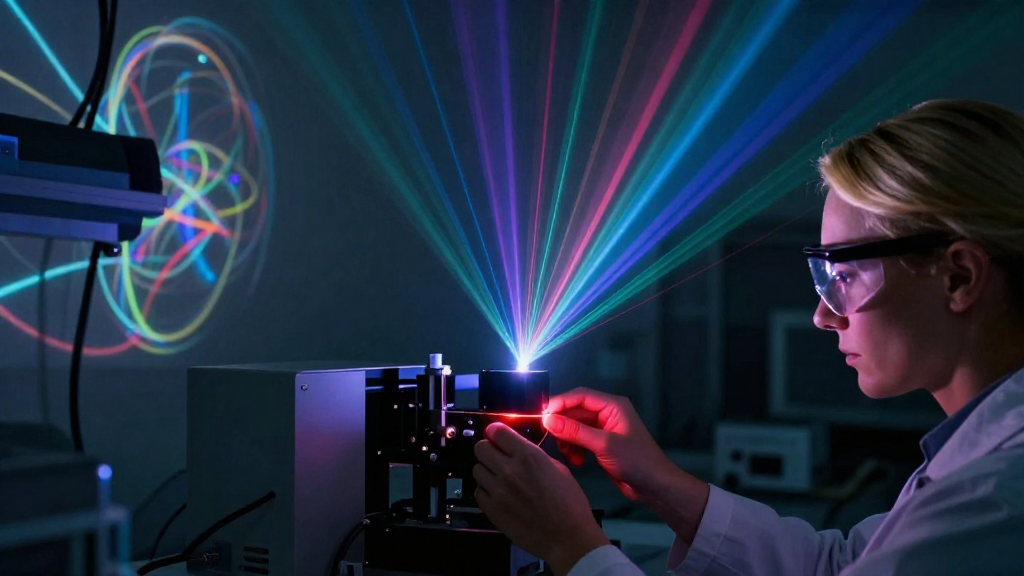
A beam scattering pattern is fundamental to understanding how light interacts with different materials.
In this article, we will delve into the intricacies of beam scattering patterns, their significance, and applications in various fields.
What is a Beam Scattering Pattern?
A beam scattering pattern refers to the distribution of light that is scattered when it encounters an object.
This scattering can be caused by several factors, including:
- Particle size
- Material composition
- Angle of incidence
- Wavelength of light
When light interacts with objects, it does not travel in a straight path. Rather, it is deflected in various directions, creating a unique scattering pattern.
The analysis of these patterns is crucial in fields such as optics, remote sensing, and imaging technologies.
How Does Scattering Occur?
To understand a beam scattering pattern, we first need to explore the concept of scattering.
Scattering occurs when a beam of light hits an object and interacts with its atoms or molecules.
There are mainly two types of scattering phenomena to consider:
-
Elastic Scattering
– The incident light retains its energy.
– The direction of light changes, but its wavelength remains the same. -
Inelastic Scattering
– The incident light changes its energy.
– This can lead to shifts in wavelength, as seen in phenomena like Raman scattering.
Understanding these types of scattering helps in analyzing how various materials interact with light and how this interaction shapes the resulting beam scattering pattern.
Why Are Beam Scattering Patterns Important?
Beam scattering patterns are vital in a multitude of applications across various disciplines.
Here are some key areas where these patterns are critically analyzed:
-
Optical Communication: Scattering can impact signal integrity in fiber optics. Understanding these patterns helps in optimizing data transmission.
-
Environmental Monitoring: In remote sensing, analyzing beam scattering patterns can provide valuable information about atmospheric conditions and particulate matter.
-
Biomedical Imaging: Techniques such as ultrasound and microscopy rely on scattering patterns to capture detailed images of cellular structures.
-
Material Characterization: The study of beam scattering patterns helps in identifying the properties of materials, leading to advancements in fields like nanotechnology.
How Can Beam Scattering Patterns Be Measured?
Measuring a beam scattering pattern involves various techniques and instruments.
Some common methods include:
- Laser Scattering
- Using lasers to create a concentrated beam of light.
-
The light interacts with a sample, and detectors measure the intensity and distribution of scattered light.
-
CCD (Charge-Coupled Device) Cameras
- Capturing images of scattering patterns.
-
Ideal for analyzing small-scale scattering.
-
Dynamic Light Scattering (DLS)
- This technique estimates the size of particles by measuring fluctuations in scattered light intensity.
- Widely used in colloidal and polymer research.
The choice of measurement technique often depends on the specific application and the size of the particles involved.
What Factors Affect a Beam Scattering Pattern?
Several variables influence the formation and characteristics of a beam scattering pattern.
These include:
-
Particle Size: Smaller particles scatter light differently than larger ones.
-
Wavelength: The wavelength of the incident light affects the scattering angles and intensities.
-
Material Composition: Different materials have different refractive indices and absorption characteristics, influencing how scattered light behaves.
-
Angle of Incidence: The angle at which light strikes an object can dramatically change the scattering pattern.
Common Applications of Beam Scattering Patterns
The analysis of beam scattering patterns is not just academic; it has real-world applications across several fields:
1. Astronomy
Astronomers use beam scattering patterns to analyze light from distant stars and galaxies. The scattered light can reveal information about celestial bodies, including their composition and distance.
2. Medical Diagnostics
In medical imaging, analyzing scattering patterns can provide insights into tissue structures. Techniques such as optical coherence tomography (OCT) utilize beam scattering for early detection of diseases.
3. Agriculture
Agronomists utilize beam scattering patterns to study plant health by analyzing how light is scattered by plant leaves. This helps in assessing crop conditions and optimizing agricultural practices.
4. Nanotechnology
In nanotechnology, the unique properties of materials at the nanoscale are revealed through their scattering patterns. This understanding is critical for developing new nanoscale devices.
Challenges in Analyzing Beam Scattering Patterns
Analyzing a beam scattering pattern can present several challenges:
-
Complexity of Samples: Biological samples, for example, can have intricate structures that complicate scattering analysis.
-
Instrument Limitations: The resolution and sensitivity of instruments can affect measurements, leading to potential inaccuracies.
-
Environmental Factors: External factors like temperature, humidity, and vibrations can influence measurements and must be controlled during experiments.
Future Trends in Beam Scattering Pattern Research
As technology progresses, research surrounding beam scattering patterns is expected to evolve, opening new doors for exploration. Some promising trends include:
-
Enhanced Imaging Techniques: The development of new imaging technologies may allow for higher resolution analysis of scattering patterns, further benefiting fields like biomedical imaging.
-
Machine Learning and AI: Incorporating machine learning algorithms to analyze scattering patterns may reveal patterns and correlations not easily seen by the human eye.
-
Integration with Other Techniques: Combining beam scattering analysis with other techniques, like fluorescence spectroscopy, may yield richer datasets, enhancing our understanding of materials.
Conclusion
In summary, a beam scattering pattern is a vital concept in optics and numerous scientific disciplines.
Understanding how light interacts with various materials is not merely academic but has far-reaching applications in technology, medicine, and environmental science.
By analyzing scattering patterns, researchers can gain insight into the properties and behaviors of materials, paving the way for exciting advancements in the years to come.
Whether you’re a professional in the field or simply intrigued by the phenomena of light, exploring beam scattering patterns offers a lens through which to view the world in a new light.