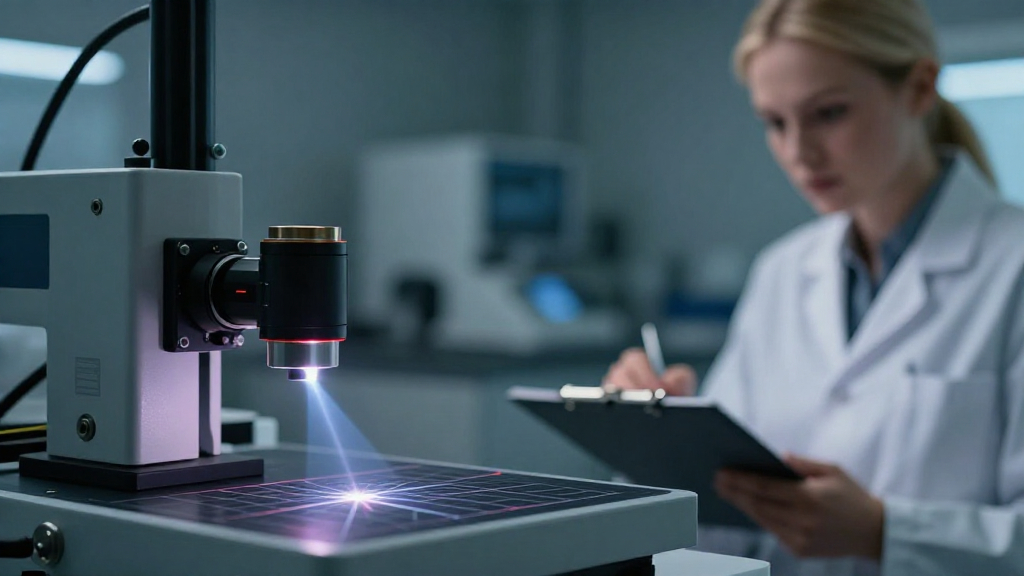
Measuring beam spot size is essential in various applications, from laser processing to optical imaging.
Understanding how to accurately determine the beam spot size is crucial for optimizing performance and ensuring precision.
What Is Beam Spot Size?
Beam spot size refers to the diameter of the area where the majority of the light energy is concentrated.
When it comes to lasers, the beam spot size typically defines how focused the beam is, impacting everything from cutting capacity to imaging resolution.
Here are some critical aspects to keep in mind regarding beam spot size:
-
Tight Focus: A smaller beam spot size allows for more focused energy, which can enhance cutting, engraving, and imaging capabilities.
-
Energy Density: The energy density increases as the beam spot size decreases, making it vital for applications like laser welding or material processing.
-
Applications: Beam spot size plays a critical role in applications such as microscopy, laser surgery, and telecommunications.
Understanding what beam spot size entails is the first step; now, let’s dive into how you can accurately measure it.
Why Is Measuring Beam Spot Size Important?
Measuring beam spot size is important for various reasons:
-
Performance Optimization: Accurate measurement helps fine-tune optical systems for optimal energy delivery.
-
Quality Control: Ensures that devices maintain desired specifications, essential in industries that require high precision.
-
Safety: Incorrect beam spot sizes can lead to equipment damage or unsafe operating conditions.
-
Process Improvement: Understanding beam spot size can help in better material processing techniques, shaving off costs and time.
Now, how do you measure beam spot size effectively?
How Can You Measure Beam Spot Size?
There are various methods for measuring beam spot size, each with its strengths and weaknesses.
Here are some common techniques:
1. Knife-Edge Method
This popular technique involves using a knife-edge to slice through the beam profile.
- Procedure:
- Position the beam so that it passes a knife-edge.
- Move the knife edge in and out of the beam path.
-
Measure the intensity variation that occurs as the beam is interrupted.
-
Pros:
- Relatively simple to set up and execute.
-
Provides accurate measurements for Gaussian beams.
-
Cons:
- May require additional equipment for calibration.
2. Beam Profiling Cameras
These specialized cameras capture the entire beam profile and can analyze the size.
- Procedure:
- Direct the beam onto the camera sensor.
-
The software analyzes the captured image and generates a beam profile.
-
Pros:
- Provides comprehensive data on beam shape and size.
-
Can generate plots that illustrate beam distribution.
-
Cons:
- More expensive than other methods.
- Requires software for analysis.
3. Spotsize Calculators and Software
Online tools and software can estimate beam spot size based on input parameters.
- Procedure:
- Enter key values such as wavelength, beam divergence, and distance.
-
The tool calculates and displays the expected beam spot size.
-
Pros:
- Quick and easy to use.
-
No specialized equipment needed.
-
Cons:
- Estimates may not be as accurate for complex beam profiles.
4. Optical Far-Field Measurement
This method uses diffraction and interference patterns to measure the beam spot size.
- Procedure:
- Project the beam onto a screen.
-
Analyze the resulting diffraction pattern.
-
Pros:
-
Can be used for high-precision applications.
-
Cons:
- More challenging to set up and requires understanding of optics.
5. Interferometry
Interferometry is a highly precise method involving interference patterns.
- Procedure:
- Split the beam using a beam splitter.
-
Recombine the beams on a detector to observe interference patterns.
-
Pros:
-
Extremely accurate measurements can be obtained.
-
Cons:
- Needs an in-depth understanding of optics.
- Complex setup and equipment.
What Factors Affect Beam Spot Size?
Several factors can influence beam spot size. Understanding these factors can aid in achieving desired outcomes regardless of the method you choose for measurement.
-
Wavelength: The wavelength of the light being used affects the diffraction and therefore the final beam spot size.
-
Focal Length: Shorter focal lengths generally lead to tighter spots, while longer focal lengths result in larger sizes.
-
Lens Type: The quality and design of lenses used will impact how effectively a beam is focused.
-
Collimation: A well-collimated beam can produce a smaller beam spot size.
How to Optimize Beam Spot Size?
To achieve the best performance, consider the following optimization strategies:
-
Use High-Quality Lenses: Invest in lenses that minimize aberrations and effectively focus light.
-
Adjust Focal Lengths: Experiment with different focal lengths to identify the most suitable parameters for your specific application.
-
Fine-Tune Collimation: Ensure that your beam is well-collimated before focusing, as this directly impacts the beam spot size.
-
Operate at Optimal Wavelength: Depending on your application, using a specific wavelength can yield a tighter beam spot size.
Conclusion
Measuring beam spot size is vital for ensuring optimal performance in various applications.
From the knife-edge method to beam profiling cameras, you have various options to obtain accurate measurements.
By understanding the factors affecting beam spot size and employing effective optimization strategies, you can maximize the efficiency of your optical systems.
With these techniques and insights, you should be well-equipped to tackle any challenges when measuring beam spot size in your projects.
Whether you’re in research, manufacturing, or development, precise measurement of beam spot size will always lead to enhanced quality and performance.