A camera slider with wireless controller can add smooth, repeatable movement to interviews, product videos, time-lapses, and cinematic B-roll without requiring a dedicated operator at the rail.
These 10 motorized sliders vary in travel length, payload support, control options, battery design, and portability. The right choice depends on your camera setup, shooting style, and how much automation you need.
Best 10 Camera Slider with Wireless Controller Picks for 2026
Best Overall
GVM 32-Inch Motorized Wireless Camera Slider

- Six programmable shooting modes
- iOS and Android app control
- Carbon-fiber rail with multi-angle mounting
Best For: Versatile studio, location, and time-lapse shooting
Best for DJI Pocket
KONOVA DS3 Wireless Motorized Slider

- Three-in-one slider, monopod, and selfie stick
- Wireless remote with magnetic storage
- Manual, auto, and time-lapse modes
Best For: DJI Pocket 3 and 4 travel content
Best for Quiet Operation
Accsoon Toprig S60 Motorized Slider

- Button and Bluetooth app controls
- Quiet brushless motor below 30 dB
- Up to 8.81-pound horizontal load
Best For: Quiet product, interview, and cooking videos
Best Compact Dolly
NEEWER DL400 App-Controlled Slider

- App control for manual and time-lapse modes
- Included NP-F750 battery
- Quiet dual motors and adjustable ball head
Best For: Compact DSLR and mirrorless dolly shots
Feature-Rich Remote Control Pick
GVM 48-Inch Motorized Carbon Fiber Slider
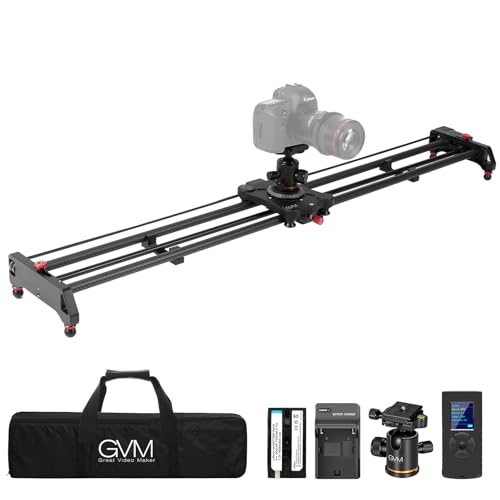
- Remote control offers detailed motion and time-lapse settings
- Supports tracking, horizontal, and 120° panoramic shooting
- Includes six shutter cables and an extension cable
Best For: Creators needing extensive remote-controlled shooting adjustments
Quiet App-Controlled Pick
KONOVA G1 Motorized Camera Slider

- Bluetooth app control works on iOS and Android
- Stores A/B points for repeatable camera movements
- Quiet motor supports video and extended time-lapse speeds
Best For: Users wanting quiet smartphone-controlled motion programming
App-Controlled Versatility Pick

- Controls motion through an iOS or Android app
- Supports tracking, panoramic, time-lapse, and video modes
- Adjustable legs and ports enable several shooting angles
Best For: Mobile creators seeking flexible app-controlled camera movement
Best Remote-Controlled All-Rounder
GVM 31-Inch Motorized Carbon Fiber Slider

- Remote control offers extensive motion and time-lapse settings
- Carbon fiber build with adjustable legs and quiet operation
- Includes six shutter cables plus an extension cable
Best For: Creators needing detailed wireless motion programming
Best Long-Rail Option
NEEWER ER1 47.2-Inch Motorized Slider

- 120cm rail provides an extended movement range
- Supports app control and optional 2.4G remote control
- Includes a 4400mAh NP-F750 battery
Best For: Wide camera moves and longer product-shot traverses
Best Compact NEEWER Choice
NEEWER ER1-80 31.5-Inch Motorized Slider

- Compact 80cm rail with app-based wireless control
- Silent motor supports video and time-lapse modes
- Includes a 4400mAh battery; charger sold separately
Best For: Portable video and time-lapse shooting
Best Overall – GVM 32-Inch Motorized Wireless Camera Slider
The GVM 32-inch is a strong all-around camera slider with wireless controller functionality through its iOS and Android app. It combines programmable movement, a carbon-fiber rail, multiple mounting points, and included shutter-release cables for creators who want more control over cinematic moves and time-lapse sequences.
Best For: Videographers, YouTubers, and photographers who need versatile app-controlled motion in studio or on-location setups.
Pros:
- Offers six shooting modes, including tracking, panoramic, time-lapse, and video.
- App control lets you set start and end points, speed, dwell time, and pause intervals.
- Carbon-fiber construction, adjustable legs, and a carry bag support portable use.
- Multiple 1/4-inch and 3/8-inch ports allow horizontal, vertical, and 45-degree setups.
Cons:
- At 5 pounds, it is less lightweight than compact camera sliders.
- The broader feature set may be more than beginners need for simple tracking shots.
Choose the GVM when programmable app operation and multi-angle flexibility matter more than having the smallest possible rig. Its included cables and durable carbon-fiber design make it particularly practical for varied camera work.
Best for DJI Pocket – KONOVA DS3 Wireless Motorized Slider
The KONOVA DS3 is a compact camera slider with wireless controller support designed around DJI Pocket 3 and Pocket 4 cameras. Its motorized extension also works as a monopod or selfie stick, making it a useful choice for travel creators who want several shooting options in one lightweight tool.
Best For: DJI Pocket users, vloggers, and travel creators seeking a portable wireless motion system.
Pros:
- Combines a motorized slider, monopod, and telescopic selfie stick.
- Wireless remote control provides distance operation and stores magnetically on the unit.
- Manual, auto, and time-lapse modes support repeatable creative movement.
- Five speed settings and a low-noise motor provide adjustable motion.
Cons:
- Its 30 cm travel is much shorter than that of full-size camera rails.
- It is primarily designed for DJI Pocket 3 and Pocket 4 rather than larger cameras.
The DS3 is best viewed as a specialized, highly portable accessory rather than a conventional long-rail slider. Its compact design and three-in-one construction make it especially convenient for handheld-style content and travel production.
Best for Quiet Operation – Accsoon Toprig S60 Motorized Slider
The Accsoon Toprig S60 is a 24-inch motorized camera slider with wireless controller and physical button controls. Its dedicated app supports time-lapse, loop, and A-B point sequences, while the brushless motor operates below 30 dB for shots where unwanted motor noise could be distracting.
Best For: Product videos, interviews, cooking content, and creators who need quiet, adjustable motion.
Pros:
- Provides both onboard button controls and Bluetooth app operation.
- Speed adjusts from 0.1 cm/s to 5 cm/s for fine motion control.
- Brushless motor runs below 30 dB and supports smooth movement.
- Supports up to 8.81 pounds horizontally and includes a carrying bag.
Cons:
- NP-F batteries and the DC adapter are not included.
- Vertical load capacity is lower than the horizontal rating.
- Support arms and other multi-angle accessories may need to be purchased separately.
The Toprig S60 is a well-rounded option when quiet operation and dual control methods are priorities. Its universal 1/4-inch mount suits many cameras and phones, while the interchangeable NP-F battery approach offers flexible field power.
Best Compact Dolly – NEEWER DL400 App-Controlled Slider
The NEEWER DL400 is a compact motorized camera dolly with wireless app control for manual, live video, and time-lapse work. Its included NP-F750 battery, dual motors, non-slip wheels, and adjustable movement make it a practical option for creators who prefer a mobile dolly-style setup over a long rail.
Best For: DSLR and mirrorless creators who want a compact app-controlled dolly with included battery power.
Pros:
- NEEWER App supports manual, live video, and time-lapse modes.
- Included NP-F750 battery provides up to five hours of runtime.
- Dual motors operate below 30 dB for quieter shooting.
- Includes a ball head with 360-degree rotation and 90-degree tilt.
Cons:
- Time-lapse photography requires a separately purchased shutter cable.
- The stated maximum load is 6.6 pounds, limiting heavier camera setups.
- Starting at the fastest speed while moving uphill can cause shaking.
The DL400 makes sense for creators who want app-based control without carrying a full-length rail. Its built-in battery and ball head add convenience, though users should account for the separate shutter cable and follow the speed guidance on inclines.
Feature-Rich Remote Control Pick – GVM 48-Inch Motorized Carbon Fiber Slider
If you want a camera slider with wireless controller functionality for repeatable video and time-lapse work, this 120cm GVM model offers detailed remote adjustments and several creative movement modes. Its carbon-fiber rail supports horizontal, tracking, and 120-degree panoramic shooting.
Best For: Creators who want extensive remote-controlled time-lapse and motion settings across a range of camera setups.
Pros:
- Remote control adjusts start and end points, speed, dwell time, pause time, shot count, and looping.
- Supports tracking, horizontal, 120-degree panoramic, video, and time-lapse modes.
- Includes six shutter cables plus an extension cable for broad camera compatibility.
- Multiple 1/4-inch and 3/8-inch ports support different tripod configurations.
Cons:
- At 5.42kg, it is relatively heavy for transporting to location shoots.
- It is not water resistant.
This is a strong choice when remote programming depth matters more than portability. The automatic back-and-forth operation and high time-lapse shot capacity make it especially useful for planned, repeatable sequences.
Quiet App-Controlled Pick – KONOVA G1 Motorized Camera Slider
The KONOVA G1 is a practical camera slider with wireless controller alternative for users who prefer Bluetooth app control. Its integrated motor, saved A/B points, quiet operation, and broad speed range suit repeatable video moves, stop motion, and long time-lapse sequences.
Best For: Videographers who want quiet, programmable motion control through a smartphone app or onboard buttons.
Pros:
- Bluetooth app control works with iOS and Android devices.
- Integrated motor simplifies setup by eliminating external motor and belt assembly.
- Remembers A/B positions even after power is turned off.
- Operates below 30dB and supports speeds from 26 seconds to 24 hours per meter.
Cons:
- Shutter cable compatibility should be confirmed by providing the camera model after purchase.
- Vertical capacity is limited to 2.2 pounds, below its horizontal 11-pound rating.
Choose this slider if quiet performance and repeatability are priorities. The app adds advanced programming, while the onboard controls provide a faster option for straightforward tracking moves.
App-Controlled Versatility Pick – GVM 48-Inch Motorized Slider
This GVM model delivers a flexible camera slider with wireless controller setup through an iOS or Android app. The 120cm carbon-fiber rail supports tracking, panoramic, time-lapse, and video capture, while adjustable legs and multiple mounting ports help with varied shooting angles.
Best For: Mobile creators who want app-based control and flexible horizontal, vertical, or 45-degree mounting options.
Pros:
- App control works through a smartphone or tablet instead of a hardwired controller.
- Offers adjustable speed, interval, stop time, shot count, motor torque, and auto-loop settings.
- Multiple 1/4-inch and 3/8-inch ports support horizontal, vertical, and 45-degree shooting.
- Includes a carry bag, six shutter cables, and an extension cable.
Cons:
- Battery life is listed at approximately two hours.
- It is not water resistant.
- App operation requires a compatible iOS or Android phone or tablet.
This slider stands out for users who want broad positioning flexibility without giving up programmable motion control. Its included bag also makes it more practical for outdoor transport than a bare rail system.
Best Remote-Controlled All-Rounder – GVM 31-Inch Motorized Carbon Fiber Slider
If you want a camera slider with wireless controller functionality and extensive motion settings, the GVM 31-inch model is a versatile option. Its remote lets you configure tracking, panoramic, video, and time-lapse movements, including start and end points, speed, dwell time, and looping.
Best For: Creators who want detailed remote-controlled motion programming in a relatively portable slider.
Pros:
- Remote control supports tracking, panoramic, video, time-lapse, and auto-loop modes.
- Carbon-fiber construction, adjustable legs, and a quiet motor support smooth movement.
- Multiple 1/4-inch and 3/8-inch mounting ports allow horizontal, vertical, and 45-degree setups.
- Includes six shutter cables and an extension cable for compatibility with many cameras.
Cons:
- It is not water resistant.
- The remote-controlled system may require time to configure because it offers many adjustable parameters.
The GVM stands out when control flexibility matters more than a minimal setup. Its 15-pound maximum recommended load and included camera cables make it suitable for a broad range of supported camera rigs.
Best Long-Rail Option – NEEWER ER1 47.2-Inch Motorized Slider
The NEEWER ER1 is a camera slider with wireless controller support through an optional 2.4G remote, while also offering app control. Its 47.2-inch carbon-fiber rail provides a long travel path for smooth product shots, video movement, and time-lapse work.
Best For: Videographers who need a longer rail and flexible app-or-remote control options.
Pros:
- Long 120cm rail supports broad camera movement for professional-looking shots.
- Offers manual, video, and time-lapse modes with adjustable speed, interval, and exposure settings.
- Includes a 4400mAh NP-F750 battery for extended operation.
- Supports horizontal loads up to 11 pounds and 45-degree tilted loads up to 5.5 pounds.
Cons:
- The 2.4G remote and charger are not included.
- Minor shaking may occur during macro photography.
- The longer rail weighs 2.5kg, which may be less convenient for travel.
This model is a strong fit when travel distance is a priority. Before buying, account for the separately sold charger and remote if you prefer physical wireless control over the included app option.
Best Compact NEEWER Choice – NEEWER ER1-80 31.5-Inch Motorized Slider
The NEEWER ER1-80 combines a compact 80cm rail with app control and support for an optional 2.4G remote, making it a practical camera slider with wireless controller capability. It supports constant-speed video, slow starts and stops, and programmable time-lapse movement.
Best For: Outdoor creators who want a shorter, lighter slider with app-based wireless control and a capable battery system.
Pros:
- App control supports motion settings for video and time-lapse shooting.
- Silent stepper motor provides smooth, precise, and quiet movement.
- Includes a 4400mAh NP-F750 battery and can also use 5V 2A USB-C power.
- Supports horizontal, 45-degree tilt, tracking, and 120-degree panoramic shooting angles.
Cons:
- The 2.4G RT-08 remote and charger are not included.
- The 80cm travel length is shorter than the 47.2-inch NEEWER model.
- It is not water resistant.
The ER1-80 offers a useful balance of portability and automation. It is especially appealing if app control meets your workflow, but budget separately for a charger or optional physical remote.
How We Picked the Best Camera Slider with Wireless Controller
We compared these models by looking at the features that matter most in real shoots: wireless control methods, motion consistency, rail length, camera compatibility, time-lapse support, battery capacity, portability, and setup flexibility. We also considered whether each slider supports DSLR and mirrorless cameras, compact systems such as DJI Osmo Pocket cameras, or heavier professional rigs.
Because motorized sliders can serve very different purposes, the list includes compact 80cm-class models, longer 120cm options, and specialized designs that combine slider movement with monopod or telescopic-stick functionality.
Quick Comparison
| What to Compare | Best For | Why It Matters |
|---|---|---|
| 80cm travel | Portable shooting and smaller spaces | Easier to pack and position indoors |
| 120cm travel | Long cinematic moves | Creates more visible camera movement |
| App control | Programmable shots and time-lapse | Provides speed, timing, and repeatability controls |
| Physical remote | Fast operation on set | Useful when you want simple control without a phone |
| Large battery | Extended production days | Reduces charging interruptions |
Key Buying Factors for a Camera Slider with Wireless Controller
Travel Length and Transport
An 80cm slider is generally easier to carry and works well on tabletops, in studios, and in tighter rooms. A 120cm rail provides a longer, more dramatic move but needs more space, support, and transport capacity.
Control and Motion Modes
Look for the control method that matches your workflow. App-controlled models typically offer adjustable speed, start and end points, time-lapse programming, loop modes, and panoramic movement. A dedicated wireless remote may be faster for basic starts, stops, and speed changes. Some models provide both options.
Camera and Payload Compatibility
Check the manufacturer’s payload rating and mounting hardware before buying. A slider may handle a lightweight mirrorless body comfortably but perform differently with a cinema camera, long lens, cage, or fluid head. Always account for the complete rig rather than the camera body alone.
Power and Battery Life
Built-in batteries offer convenience, while removable or higher-capacity battery systems may be better for long shoots. Confirm charging requirements, runtime expectations, and whether the slider can operate while connected to external power.
Stability and Setup
Longer rails benefit from sturdy tripods or multiple support points. A motorized slider cannot compensate for a flexing support system, uneven surface, or poorly balanced camera. For repeatable motion, level the rail and secure every connection before recording.
Who Should Buy Which Camera Slider with Wireless Controller?
Choose a compact 80cm model if portability, indoor work, and quick setup matter most. Select a 120cm slider for wider spaces, longer lateral moves, and more noticeable cinematic motion. App-focused models suit filmmakers and time-lapse photographers who want programmable movement, while remote-controlled options are convenient for straightforward operation during interviews or product shoots.
Traveling creators using compact cameras should consider a lightweight, compatible design such as the KONOVA Osmo Pocket-oriented model. For DSLR and mirrorless users, prioritize payload capacity, battery endurance, and the control system you are most likely to use consistently. The best Camera Slider with Wireless Controller is the one that fits your camera rig, available space, and shooting routine without adding unnecessary setup complexity.