The best lightweight camera sliders make controlled camera movement easier without adding the bulk of a full studio rig. This roundup compares compact manual dollies, carbon-fiber rails, and motorized sliders for cameras, phones, and action cameras.
Whether you need a travel-friendly setup, smoother product footage, or programmable time-lapse motion, the right slider depends on payload, track length, control options, and how quickly you need to set up.
Best 10 Lightweight Camera Sliders Picks for 2026
Best Lightweight Carbon-Fiber Slider

- 24-inch carbon-fiber rail
- Weighs about 654g
- Multiple mounting and shooting angles
Best For: Travel creators using compact cameras and phones
Best Motorized Mini Slider

- Motorized, smooth camera movement
- 15.7-inch compact track
- Supports gear up to 2.4lb
Best For: Phone and action-camera creators seeking automated moves
Best Portable Phone-and-Camera Slider
NEEWER CS1M Carbon-Fiber Slider

- 615g portable carbon-fiber design
- Includes phone and action-camera mounts
- Adjustable legs and 360-degree ball head
Best For: Hybrid shooters using phones, action cameras, and cameras
Best Heavy-Duty Skater Dolly
Vidpro SK-22 Professional Dolly
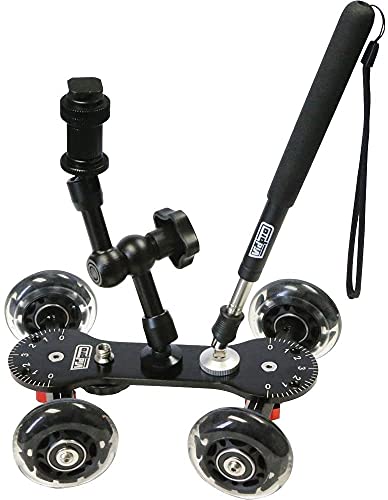
- 25-pound load capacity
- Supports straight, curved, and 360-degree paths
- Includes handle and articulated magic arm
Best For: Heavier DSLR or camcorder rigs and low-level panning
Best Motorized Pick
NEEWER ER1 31.5-inch Motorized Slider

- App, remote, video, and time-lapse controls
- Carbon-fiber rail with multiple mounting threads
- Supports horizontal and 45-degree tilt shots
Best For: Automated content, product videos, and time-lapse work
Best Pocket Option
NEEWER SD001 Compact Camera Dolly

- Weighs about 7.76 ounces
- Moves in straight lines or circles
- Includes ball head and rotatable phone clamp
Best For: Portable smartphone and tabletop video
Best Full-Length Rail
GVM 27-inch Motorized Camera Slider

- Automated video, time-lapse, and round-trip modes
- Supports horizontal, vertical, and 45-degree shooting
- Adjustable feet and tripod mounting points
Best For: DSLR interviews and planned motorized setups
Best Compact Motorized Slider

- 1.9-pound aluminum build fits in a 20L backpack
- Five shooting modes and eight programmable points
- Up to seven hours of battery life
Best For: Travel filmmakers and compact camera setups
Best High-Capacity Table Dolly
NEEWER Scaled Camera Table Dolly

- Supports up to 22 pounds of equipment
- Adjustable rods create straight, curved, or circular paths
- Smooth rubber wheels work on flat surfaces
Best For: Tabletop product videos and heavier camera setups
Best Lightweight Carbon-Fiber Slider – Zecti 24-Inch Camera Slider
For creators comparing lightweight camera sliders, the Zecti offers a full 24-inch tracking path while weighing about 654g. Its carbon-fiber rail, adjustable legs, bubble level, and broad mounting options make it a practical choice for travel setups and small cameras.
Best For: Travel videographers using smartphones, action cameras, or compact cameras who want a longer manual slide.
Pros:
- 24-inch/60cm rail provides useful travel distance for camera moves.
- Lightweight 654g design includes a scratch-resistant carrying bag.
- Supports horizontal, vertical, diagonal, and sideways operation.
- Multiple 1/4-inch and 3/8-inch mounting holes improve setup flexibility.
Cons:
- Manual movement may become noisy or rough if the screws are overtightened.
- Maximum recommended load is 4.4 pounds.
- It is not water resistant.
The Zecti is a strong pick when portability and a longer rail matter more than motorized control. Be prepared to fine-tune the tension for smooth operation.
Best Motorized Mini Slider – IFOOTAGE Shark Slider Pico
The IFOOTAGE Shark Slider Pico stands out among lightweight camera sliders for its motorized design and compact 15.7-inch format. It is built to help produce smooth, cinematic moves with phones, action cameras, DJI Osmo Pocket models, and cameras up to 2.4 pounds.
Best For: Mobile creators who want automated, stabilized slider movement without carrying a full-size rail system.
Pros:
- Motorized operation helps create consistent, smooth camera moves.
- Compatible with smartphones, action cameras, DJI Osmo Pocket 3/4, and select cameras.
- Supports equipment up to 2.4 pounds.
- Compact 15.7-inch track suits smaller shooting setups.
Cons:
- Its 15.7-inch travel is shorter than the 24-inch manual sliders in this roundup.
- Lower 2.4-pound payload limits camera and accessory choices.
- The supplied information does not specify the slider’s weight or carrying case.
This is the most convenient option here for repeatable motion and small cameras. Choose it over a manual slider when automation is more important than maximum payload or rail length.
Best Portable Phone-and-Camera Slider – NEEWER CS1M Carbon-Fiber Slider
The NEEWER CS1M is one of the more versatile lightweight camera sliders, combining a 16-inch carbon-fiber rail with adjustable legs, a ball head, phone clamp, and action-camera mount. At 615g, it is easy to carry while still supporting up to 4.4 pounds horizontally.
Best For: Hybrid shooters who switch between cameras, phones, GoPros, and Insta360 cameras in indoor or outdoor locations.
Pros:
- Lightweight 615g construction includes a carrying bag.
- Adjustable legs and bubble level help with uneven surfaces.
- Includes a 360-degree ball head, phone clamp, and action-camera mount.
- Supports horizontal, vertical, and 45-degree tilted shooting.
Cons:
- Payload drops to 2.2 pounds at a 45-degree tilt or vertically.
- The 16-inch rail offers less travel than a 24-inch slider.
- It is not water resistant.
The CS1M is a well-rounded travel option when accessory compatibility matters. Its adjustable support and included mounts make it especially useful for creators working with several small camera formats.
Best Heavy-Duty Skater Dolly – Vidpro SK-22 Professional Dolly
The Vidpro SK-22 takes a different approach from rail-style lightweight camera sliders: its rolling skater-dolly design is made for low-level tracking and panning. The aluminum chassis, rubber wheels, adjustable axles, and 25-pound capacity make it suited to heavier DSLR and camcorder setups.
Best For: Filmmakers needing low-angle tracking, broad curves, or 360-degree panning with heavier camera rigs.
Pros:
- Supports up to 25 pounds, substantially more than the compact rail sliders.
- Rubber wheels with stainless steel ball bearings provide rolling mobility.
- Adjustable axles allow straight lines, curves, and full 360-degree circles.
- Includes seven 1/4-inch mounting points, a 27-inch handle, and an articulated magic arm.
Cons:
- At 2 pounds, it is heavier than the 615g and 654g rail sliders.
- It is a rolling dolly rather than a conventional carbon-fiber track slider.
- Performance depends on a suitable rolling surface.
The SK-22 is the practical choice when payload and curved movement outweigh compactness. It is less backpack-friendly than the rail models but offers substantially more capacity and panning flexibility.
Best Motorized Pick – NEEWER ER1 31.5-inch Motorized Slider
For creators who want automated movement without giving up portability, the NEEWER ER1 is a capable option among lightweight camera sliders. Its carbon-fiber construction, app control, time-lapse support, and included 4400mAh battery make it suited to repeatable camera moves in studio or outdoor setups.
Best For: Content creators, product videos, time-lapse photography, and smooth automated tracking shots.
Pros:
- App-controlled manual, video, and time-lapse shooting modes.
- Silent stepper motor and included 4400mAh NP-F750 battery support extended filming.
- Supports horizontal, 45-degree tilt, tracking, and up to 120-degree panoramic movements.
- Carbon-fiber build with 1/4-inch and 3/8-inch mounting threads.
Cons:
- At 8.7 pounds, it is less portable than compact manual dollies.
- Maximum load drops to 5.5 pounds when tilting up 45 degrees.
- Minor shake may occur during macro photography.
The ER1 is a strong choice when programmable movement matters more than minimum carry weight. Its longer rail and multiple shooting angles add creative flexibility, while the battery-powered motor helps simplify repeatable shots.
Best Pocket Option – NEEWER SD001 Compact Camera Dolly
The NEEWER SD001 is a practical choice when portability is the priority. This pocket-sized manual dolly weighs about 7.76 ounces and can travel in straight lines or circles, making it one of the more convenient lightweight camera sliders for tabletop and outdoor shooting.
Best For: Smartphone creators, tabletop product footage, compact cameras, and portable panoramic shots.
Pros:
- Compact 3.9-by-3.3-by-0.8-inch design for easy transport.
- Adjustable wheels enable linear or circular movement.
- Soft rubber wheels roll smoothly and quietly across floors, tables, and sliders.
- Includes an adjustable ball head and rotatable phone clamp with a cold shoe.
Cons:
- Not suitable for telephoto lenses.
- Manual operation does not provide automated or programmable movement.
- Its maximum recommended load is 6.6 pounds.
Choose the SD001 if you need a small, flexible movement tool rather than a powered rail. Its circular tracking capability and phone-friendly accessories make it especially useful for quick tabletop productions and mobile video setups.
Best Full-Length Rail – GVM 27-inch Motorized Camera Slider
The GVM 27-inch motorized slider offers a longer rail and several automated shooting modes for interview, photography, and video work. Its aluminum-alloy construction, adjustable feet, and tripod mounting options make it a versatile pick among lightweight camera sliders, although its 2.36-kilogram weight is better suited to planned setups than ultralight travel.
Best For: DSLR interviews, time-lapse sequences, round-trip camera moves, and tripod-based shooting.
Pros:
- Supports time-lapse, video, and automatic round-trip shooting.
- Works horizontally, vertically, and at 45-degree angles.
- Adjustable non-slip feet help with leveling and stability.
- Multiple 1/4-inch and 3/8-inch screw holes support ground or tripod use.
Cons:
- At 2.36 kilograms, it is heavier than compact slider options.
- The maximum recommended load is 2.5 kilograms.
- Its 26.8-inch folded length may be less convenient for small bags.
The GVM is a sensible middle ground for shooters who want motorized movement and a substantial rail without moving to a larger professional system. Its flexible mounting and angle options are useful, but travelers should account for its weight and folded size.
Best Compact Motorized Slider – iFootage Shark Slider PICO
For creators seeking lightweight camera sliders with automated movement, the iFootage Shark Slider PICO combines a 15.8-inch track with app-based control and broad compatibility. Its 1.9-pound aluminum build fits in a 20L backpack, while the quiet motor and multiple shooting modes support both video and time-lapse work.
Best For: Travel filmmakers, smartphone users, and DJI Pocket owners who want programmable motion in a compact setup.
Pros:
- Supports DJI Pocket 3/4 and Action 5/6, plus smartphones.
- Offers five modes, including video, time-lapse, stop motion, panorama, and multi-target.
- Stores up to eight programmable points for repeatable movements.
- Runs for up to seven hours and supports 30W PD 3.0 fast charging.
Cons:
- Its 2.4-pound payload limits heavier camera setups.
- Its 15.8-inch screen/track length is better suited to compact shots than long tracking moves.
The PICO is a strong choice when portability, quiet operation, and repeatable automated movement matter more than supporting a full-size cinema rig.
Best High-Capacity Table Dolly – NEEWER Scaled Camera Table Dolly
This NEEWER dolly is a practical option among lightweight camera sliders for tabletop and ground-level work. Rather than using a powered rail, it rolls on adjustable aluminum rods with rotating rubber wheels, letting you create straight, curved, or circular camera paths while supporting up to 22 pounds.
Best For: Product videos, tabletop tracking shots, and filmmakers who need a high load capacity on flat surfaces.
Pros:
- Supports cameras and gear weighing up to 22 pounds.
- Adjustable rods allow straight, curved, and complete-circle paths.
- Rotatable rubber wheels and fluid roller bearings promote quiet, smooth movement.
- Includes 1/4-inch and 3/8-inch mounting options with four additional 1/4-inch screw holes.
Cons:
- Designed for flat surfaces rather than elevated rail-style operation.
- It is manually operated, so it does not provide motorized or remote-controlled movement.
- At 10.2 x 7.2 x 2.8 inches folded, it is less compact than smaller dolly designs.
Choose this model if load capacity and flexible rolling paths are priorities. It is especially useful for controlled tabletop shots, though it requires a suitable flat surface and hands-on operation.
Best Budget Motorized Dolly – NEEWER DL100 Wireless Video Dolly
The NEEWER DL100 offers a compact motorized alternative for shoppers comparing lightweight camera sliders. At 1.1 pounds, it uses three adjustable wheels to travel in straight or circular routes, while a wireless remote lets you change speed, direction, or pause movement from up to 19.7 feet away.
Best For: Small cameras, smartphones, action cameras, and creators who want simple remote-controlled movement.
Pros:
- Lightweight 1.1-pound design measures 5.31 inches square when folded.
- Remote control provides three speeds, direction changes, and pause control.
- Adjustable wheel angles support straight-line and circular movement.
- Built-in 1800mAh battery offers up to six hours of operation.
Cons:
- Its 6.6-pound maximum load is lower than the NEEWER table dolly’s capacity.
- Movement speed tops out at 3.0 cm/s, which may be slow for some shots.
- Accessories such as smartphone holders and camera adapters are not included.
The DL100 is a convenient pick for compact gear and repeatable rolling shots. Its small footprint and remote control are useful for solo creators, but heavier camera packages will need a higher-capacity dolly.
How We Picked the Best Lightweight Camera Sliders
We evaluated these Lightweight Camera Sliders by focusing on practical shooting needs: portability, construction, usable track length, supported camera weight, movement smoothness, and setup complexity. We also considered whether each model is manual or motorized, how well it suits phones and action cameras, and whether features such as app control, time-lapse modes, ball heads, clamps, or adjustable wheels add meaningful flexibility.
A compact slider is not automatically the best choice for every camera. A small tabletop dolly may be ideal for product clips, while a longer carbon-fiber rail can create more noticeable parallax for interviews, landscapes, and cinematic B-roll.
Quick Comparison
| Slider type | Best for | Main advantage | What to check |
|---|---|---|---|
| Manual rail slider | Fast, quiet camera moves | Simple operation and low maintenance | Track length and payload |
| Motorized slider | Repeatable moves and time-lapse | Programmable speed and direction | Battery life, app support, and noise |
| Tabletop dolly | Low-angle product and desk shots | Highly portable setup | Surface condition and wheel adjustment |
| Phone or action-camera slider | Lightweight creator setups | Low weight and quick mounting | Mount compatibility and stability |
Key Buying Factors for Lightweight Camera Sliders
Payload and Mounting Compatibility
Check the combined weight of the camera, lens, battery, cage, microphone, and head. A slider rated close to your actual load may show more vibration or wear, especially during motorized moves. Confirm whether the package includes a standard 1/4-inch or 3/8-inch mount, ball head, phone clamp, or action-camera adapter.
Track Length and Portability
Short sliders pack easily and work well on desks or small tripods, but they create limited travel. Longer rails provide a more visible camera move yet require more room and stronger support. Carbon fiber usually helps reduce carrying weight, while aluminum can offer a sturdy, cost-conscious option.
Manual Versus Motorized Movement
Manual sliders are generally faster to deploy and can be quieter for dialogue or live shooting. Motorized models are more useful for repeatable moves, stop-motion, and time-lapse sequences. Look for adjustable speed, forward and reverse travel, round-trip modes, and dependable app or remote controls if automation matters.
Stability and Surface Requirements
Rail sliders should be supported evenly and leveled before shooting. Tabletop dollies need a smooth, reasonably flat surface; rubber wheels and adjustable wheel angles can improve tracking but cannot eliminate rough floors or seams. For heavier cameras, prioritize rigid support points and a slider with a comfortable capacity margin.
Who Should Buy Which Lightweight Camera Sliders?
Choose a compact manual or tabletop model if you shoot product videos, social content, tabletop reviews, or travel footage and value quick setup. A carbon-fiber rail is a better fit for creators who need a longer move without carrying a heavy studio slider. Pick a motorized model if repeatability, automated motion, or time-lapse work is central to your workflow.
Phone and action-camera users should favor included clamps and adapters, while DSLR and mirrorless users should verify payload and head compatibility first. If portability is your top priority, choose the smallest slider that provides enough travel for your compositions rather than paying for features or length you will rarely use.