Choosing the right network cable tester can shorten installation checks, speed up fault isolation, and reduce the risk of leaving unreliable links in service. The best option depends on whether your team needs basic wire mapping, advanced copper diagnostics, PoE verification, or fiber measurements.
We compared 10 practical testers for data-center technicians, network installers, and IT teams, focusing on diagnostic capability, supported cable types, portability, remote testing, and value for routine maintenance.
Best 10 Network Cable Testers for Data Centers Picks for 2026
Advanced Network Analysis

- Tests copper performance up to 10GBASE-T
- Diagnoses switches, VLANs, and network links
- Verifies PoE class, power, and load
Best For: High-speed link, switch, and PoE validation
Versatile Cable Identification
Klein Tools VDV501-851 Scout Pro 3
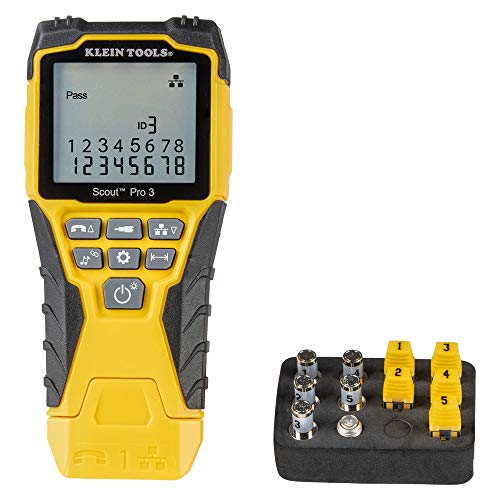
- Tests RJ11/12, RJ45, and coax cables
- Measures length up to 2,000 feet
- Includes LanMap and CoaxMap remotes
Best For: Mixed-cable verification and identification
Compact Copper Verification
Fluke Networks MS2-100 MicroScanner2

- Shows key cable results on one screen
- Tests RJ11, RJ45, and coax cabling
- Supports 10/100/1000Base-T and VoIP
Best For: Portable copper troubleshooting
Full-Color Multi-Cable Testing
Klein Tools VDV501-770 Scout Pro Max

- Tests data, voice, and coax cabling
- Adds PoE, network detection, and hub blink
- Includes 20 LanMap and 20 CoaxMap remotes
Best For: Broad cable testing and remote mapping
Long-Run Diagnostic Pick
NOYAFA NF-8209 Network Cable Tester

- Measures CAT5/CAT6 runs from 2.5–200m
- Tests POE, faults, wire maps, and port links
- Includes tracing kit with rechargeable transmitter
Best For: Multi-function Ethernet troubleshooting and cable tracing
Simple Pocket Tester
LAN Explorer Cable Tester with Remote

- Tests RJ11, RJ12, and RJ45 cables
- LEDs show common wiring faults
- Compact body stores the remote
Best For: Portable pass/fail testing of voice and data cables
Display-Friendly Fault Finder
Klein Tools VDV526-200 LAN Scout Jr

- Backlit LCD shows pin-to-pin wiremaps
- Detects opens, shorts, split pairs, and shields
- Compact tester includes remote and batteries
Best For: Readable RJ45 fault diagnosis in dim work areas
Fiber-Ready Field Tester

- Combines copper, PoE, and fiber diagnostics
- Measures seven optical wavelengths
- Includes VFL, port flashing, and 200m length testing
Best For: Mixed copper-and-fiber troubleshooting
Multi-Cable Diagnostic Kit

- Tests eight cables simultaneously
- Supports copper, coaxial, and telephone lines
- Measures up to 300m with wiring-fault detection
Best For: High-volume copper cable testing
Fiber Troubleshooting Specialist

- Combines fiber and copper network testing
- Measures six optical wavelengths
- Adds 650nm VFL and PoE diagnostics
Best For: Fiber-focused data-center maintenance
Advanced Network Analysis – Fluke Networks LIQ-100 LinkIQ
For data centers that need more than basic continuity checks, the Fluke Networks LIQ-100 LinkIQ combines cable performance testing up to 10GBASE-T with network diagnostics and PoE verification. It can report cable length, wire map, and distance to an open or short, while LinkWare PC supports result management and report printing.
Best For: Data-center technicians validating high-speed copper links, switch connections, and PoE availability.
Pros:
- Tests cable performance up to 10GBASE-T using frequency-based measurements.
- Provides IPv4 and IPv6 ping plus nearest-switch details such as port, VLAN, and advertised rates.
- Verifies PoE class and power, including a load test of available PoE.
- Supports result management and printed reports through LinkWare PC.
Cons:
- Its broader feature set may be more than needed for simple cable identification.
- The listed weight is 3.5 pounds, making it less lightweight than compact verifiers.
The LIQ-100 is the strongest fit here when link qualification, switch visibility, and PoE validation matter alongside cable testing.
Versatile Cable Identification – Klein Tools VDV501-851 Scout Pro 3
The Klein Tools VDV501-851 is a practical choice for teams needing one tester for RJ11/12, RJ45, and coaxial connections. It checks unenergized Ethernet cables for opens, shorts, miswires, and split pairs, and measures cable length up to 2,000 feet—useful capabilities when organizing network cable testers for data centers.
Best For: Installers and maintenance teams testing mixed voice, data, and video cabling with included remote identifiers.
Pros:
- Supports voice, data, and coax cable testing.
- Measures cable length up to 2,000 feet.
- Detects open, short, miswire, and split-pair faults.
- Includes five LanMap and five CoaxMap locator remotes plus a backlit display.
Cons:
- It is not designed to test PoE.
- The analog probe required for cable tracing is sold separately.
- Testing is specified for unenergized Ethernet cables.
This starter set covers core verification and identification tasks efficiently, but facilities that require PoE testing will need a different or additional tool.
Compact Copper Verification – Fluke Networks MS2-100 MicroScanner2
The Fluke Networks MS2-100 MicroScanner2 provides a compact way to troubleshoot RJ11, RJ45, and coaxial cabling. Its single-screen display shows cable length, wire map, cable ID, and distance to fault, making it a straightforward option among network cable testers for data centers.
Best For: Technicians who want portable copper verification for Ethernet, voice, coax, and VoIP-related cabling.
Pros:
- Displays length, wire map, cable ID, and distance to fault on one screen.
- Supports RJ11, RJ45, and coax connections.
- Tests 10/100/1000Base-T and VoIP cabling.
- Includes a wiremap adapter, batteries, and carrying case.
Cons:
- The supplied notes do not list PoE testing capabilities.
- It offers fewer stated network-diagnostic features than the LIQ-100.
Choose the MicroScanner2 when portability and clear copper fault information are priorities rather than advanced switch or PoE analysis.
Full-Color Multi-Cable Testing – Klein Tools VDV501-770 Scout Pro Max
The Klein Tools VDV501-770 Scout Pro Max is a comprehensive kit for testing data, voice, and coaxial cabling. It adds PoE testing, network detection, hub blink, report generation, and cable tracing to core wiremap and length checks, with measurement capability up to 2,000 feet.
Best For: Data-center and field teams needing broad cable testing, remote identification, and network troubleshooting in one kit.
Pros:
- Tests RJ11/12, RJ45, and F-connector cables.
- Includes wiremap, PoE, network detection, hub blink, and POTS testing.
- Measures cable length up to 2,000 feet and detects distance to fault.
- Includes 20 LanMap and 20 CoaxMap remotes, cables, batteries, and carrying case.
Cons:
- The digital probe required for digital toning is sold separately.
- At 3.7 pounds, the complete kit is less compact than a basic tester.
- The supplied notes do not specify advanced 10GBASE-T performance testing.
The Scout Pro Max is a strong all-around kit when multiple cable types, remote mapping, PoE checks, and reporting are more important than specialized high-speed link qualification.
Long-Run Diagnostic Pick – NOYAFA NF-8209 Network Cable Tester
For buyers comparing network cable testers for data centers, the NOYAFA NF-8209 is a feature-rich option for tracing, mapping, and checking Ethernet runs. It supports CAT5/CAT6 cable testing, POE checks, port flashing, and length measurement up to 200 meters.
Best For: Technicians who need cable tracing, POE verification, wire mapping, and run-length measurements in one kit.
Pros:
- Measures CAT5/CAT6 cable length from 2.5 to 200 meters.
- Tests open circuits, shorts, miswiring, continuity, and shielded cables.
- Supports standard and non-standard 5–60V POE testing plus port flash/link testing.
- Includes anti-interference tracing, NCV detection, rechargeable transmitter, receiver, and accessories.
Cons:
- Its larger feature set may be more than needed for basic pass/fail checks.
- The receiver uses a separate 9V battery, while the transmitter is rechargeable.
The NF-8209 stands out when troubleshooting requires more than wire mapping. Its length, POE, NCV, and tracing functions make it a versatile choice for structured-cabling maintenance.
Simple Pocket Tester – LAN Explorer Cable Tester with Remote
For straightforward network cable testers for data centers, this compact LAN Explorer focuses on fast verification of RJ11, RJ12, and RJ45 voice and data cables. A single-button test and quick LED responses make it practical for routine cable checks.
Best For: Installers and support technicians who need a lightweight tester for CAT3, CAT5e, CAT6, and CAT6A cables.
Pros:
- Tests RJ11, RJ12, and RJ45 terminated cables.
- Identifies pass, miswire, open-fault, short-fault, and shield conditions.
- Compact 4-ounce design fits easily in a pocket.
- Remote stores securely in the tester body and auto power-off helps conserve the included 9V battery.
Cons:
- Does not list cable-length, POE, or voltage-testing functions.
- LED responses are less detailed than a backlit display.
The LAN Explorer is a focused choice for basic continuity and wiring checks. Its small size and simple operation suit technicians who value portability over advanced diagnostics.
Display-Friendly Fault Finder – Klein Tools VDV526-200 LAN Scout Jr
Among network cable testers for data centers, the Klein Tools VDV526-200 offers clear wiremap results on a large backlit LCD. It tests RJ45-terminated CAT5e, CAT6, and CAT6A cables and identifies several common wiring faults.
Best For: Technicians who want readable pin-to-pin results and detailed fault identification in low-light work areas.
Pros:
- Backlit LCD displays pin-to-pin wiremap results.
- Detects opens, shorts, miswires, split pairs, crossover, and shield conditions.
- Compact design includes a remote and two batteries.
- Offers solid or warble tone generation for individual wires, pairs, or all eight conductors.
Cons:
- The compatible VDV500-123 tone probe is sold separately.
- It is designed for RJ45 data cables rather than RJ11 or RJ12 connections.
The VDV526-200 is a strong fit for structured-cabling work where clear on-screen results matter. Its fault coverage is broader than a basic continuity tester, while its compact format remains easy to carry.
Fiber-Ready Field Tester – NOYAFA NF-8508
For network cable testers for data centers, the NOYAFA NF-8508 stands out when copper troubleshooting and basic fiber checks need to happen with one handheld tool. It combines continuity, cable scanning, port flashing, length measurement, PoE testing, optical power measurement, VFL, and non-contact voltage testing.
Best For: Network engineers and contractors handling mixed copper and fiber troubleshooting, maintenance, and cabling projects.
Pros:
- Measures seven optical wavelengths from 850nm to 1650nm, with a -70 to +10 dBm range and FC/SC/ST connector support.
- Tests PoE polarity and voltage up to 60VDC, while measuring cable lengths up to 200 meters.
- Includes port flashing, visual fault location, non-contact voltage detection, and up to 10 hours of battery life.
Cons:
- Its 200-meter cable-length range may be limiting for longer data-center runs.
- The listed 0.59 kg weight is higher than some compact cable testers.
The NF-8508 is a versatile choice for technicians who want copper, PoE, and fiber-oriented diagnostics in a single instrument rather than carrying separate tools.
Multi-Cable Diagnostic Kit – 8-Remote Network Tester
Among network cable testers for data centers, this model is designed for teams that need to check multiple installed runs efficiently. It supports Cat5e, Cat6, coaxial, and telephone lines, combining length measurement, fault localization, wiring diagnostics, and eight remote testers.
Best For: Data-center technicians, contractors, and IT teams testing several cables in server rooms and wiring closets.
Pros:
- Tests up to eight cables simultaneously using the included RJ45 remote units.
- Measures cable length up to 300 meters and identifies open circuits, shorts, crossovers, reversals, and crosstalk.
- Offers a 97% stated accuracy, auto-calibration, saved calibration data, and more than 50 hours of standby battery life.
Cons:
- The supplied notes do not indicate optical-fiber testing or an optical power meter.
- Its multiple remotes are useful for batch testing but add components to organize and carry.
This is a practical productivity-focused kit for structured cabling work, especially when testing many copper runs is more important than fiber diagnostics.
Fiber Troubleshooting Specialist – NOYAFA NF-8518
The NOYAFA NF-8518 is a strong option among network cable testers for data centers when technicians need copper-network checks alongside fiber troubleshooting. Its nine functions include continuity, scanning, port flashing, length measurement, PoE testing, optical power measurement, VFL, and NVC functionality.
Best For: Fiber and network engineers maintaining data-center links, PoE equipment, and mixed cabling installations.
Pros:
- Measures optical signals at six wavelengths from 850nm to 1625nm across a -70 to +10 dBm range.
- Uses a 650nm visual fault locator to help identify fiber breaks, poor connections, bends, and cracks.
- Tests PoE polarity, voltage, and supply status up to 60VDC, and measures network, telephone, and BNC cable lengths up to 200 meters.
Cons:
- FC/SC/ST connectors are noted as requiring separate purchase.
- The 200-meter length-testing limit may not cover every large-scale cable run.
The NF-8518 suits users who prioritize fiber-link visibility while still needing everyday copper, PoE, port-location, and cable-length functions in the same tester.
How We Picked the Best Network Cable Testers for Data Centers
We evaluated these testers by looking at the tasks data-center teams perform most often: verifying copper pinouts, identifying open or shorted pairs, locating faults, checking cable length, tracing hidden runs, and confirming link or PoE conditions. We also considered support for common RJ45 and coax connections, remote identifiers, display usability, ruggedness, and the learning curve for technicians.
Higher-end tools generally provide deeper network diagnostics and clearer fault information, while entry-level testers can be more efficient for basic continuity checks and cable mapping. Fiber-capable models were considered separately because optical power measurement and visual fault locating require different hardware than copper testing.
Quick Comparison
| Best For | Look For |
|---|---|
| Link and network troubleshooting | LinkIQ-style diagnostics, switch information, and performance checks |
| Everyday copper verification | Wire mapping, continuity testing, split-pair detection, and remote IDs |
| Tracing difficult cable runs | Tone generation, compatible probes, and multiple remote units |
| PoE troubleshooting | PoE presence, voltage information, and pinout detection |
| Fiber maintenance | Optical power meter and, ideally, a visual fault locator |
Key Buying Factors for Network Cable Testers for Data Centers
Copper Testing Depth
At minimum, choose a tester that identifies opens, shorts, reversals, and crossed or split pairs. For dense patching environments, length estimates and distance-to-fault readings are especially useful because they can point technicians toward the correct ceiling, tray, or patch-panel location.
Network and PoE Diagnostics
If the tool will be used on active infrastructure, check whether it can report link speed, advertise network details, or detect PoE. These features can distinguish a bad cable from a switch-port, negotiation, or power-delivery issue and may prevent unnecessary cable replacement.
Tracing, Remotes, and Compatibility
Multiple remote identifiers help map many wall ports or patch-panel connections efficiently. Tone tracing is valuable when cables are bundled, unlabeled, or routed through crowded racks. Confirm that the tester supports the connectors and cable categories used in your facility.
Fiber Features and Field Usability
Copper verification does not replace fiber testing. For mixed networks, an optical power meter or VFL can add meaningful maintenance capability, but verify connector compatibility and the wavelength range required by your fiber plant. Also consider display readability, battery life, protective design, and whether results can be documented.
Who Should Buy Which Network Cable Testers for Data Centers?
Choose an advanced network-aware tester if you manage active links, PoE devices, or frequent intermittent faults. A straightforward wire mapper is often the better value for installers who mainly certify patch cables and identify ports. Teams working across large facilities should prioritize remote sets, tone tracing, and distance-to-fault measurements. If your environment includes both copper and fiber, select a model with optical measurement features or pair a copper tester with a dedicated fiber tool. Before buying, match the tester’s capabilities to your workflow rather than paying for diagnostics your team will rarely use.