Finding the right network cable tester can make cable installation, maintenance, and troubleshooting much faster. The best models quickly identify wiring faults, verify connections, and help locate problems before they become costly service calls.
This roundup compares 10 network cable testers ranging from straightforward continuity tools to advanced testers with tone generation, Power over Ethernet detection, cable-length measurement, and optical testing features.
Best 10 Network Cable Testers Picks for 2026
Best Compact RJ45 Tester

- Tests CAT 5e, CAT 6, and CAT 6A RJ45 cables
- Backlit display shows wiremap results
- Detects multiple common wiring faults
Best For: Portable RJ45 cable and patch-cord testing
Best Diagnostic Network Tester

- Shows cable length and distance to fault
- Supports RJ11, RJ45, and coax
- Tests Gigabit Ethernet and VoIP connections
Best For: Detailed multi-cable troubleshooting
Best Multi-Cable Testing Kit
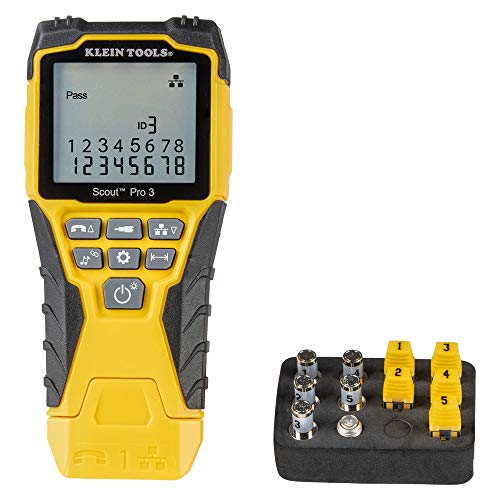
- Tests voice, data, and coax cables
- Measures cable runs up to 2,000 feet
- Includes LANMap and CoaxMap locator remotes
Best For: Mixed-cable installations and long runs
Best Simple Pocket Tester

- One-button testing for RJ11, RJ12, and RJ45
- Fast LEDs identify common cable faults
- Compact body stores the remote securely
Best For: Quick basic cable checks on the go
Best for Cable Tracing

- Digital and analog cable tracing modes
- Continuity, polarity, and wire mapping tests
- Works with Ethernet, phone, coax, and other cables
Best For: Technicians tracing and identifying varied cable runs
Best Multifunction Tester

- Tests copper cables, PoE, length, and port status
- Includes optical power meter and visual fault locator
- Up to 200m cable measurement and 10-hour battery life
Best For: Mixed copper-and-fiber network troubleshooting
Best Compact RJ45/RJ11 Tester

- Tests RJ45 and RJ11 cable faults
- Detachable remote supports long cable runs
- Compact design with one-button LED operation
Best For: Home wiring, LAN maintenance, and structured-cabling checks
Simple Remote Tester

- Tests RJ45 Cat5–Cat7 and RJ11 lines
- Detects shorts, opens, miswiring, and shielding
- Uses detachable master and remote units
Best For: Basic Ethernet and telephone wiring checks
Rechargeable Length-Test Kit

- Measures cable runs from 2.5–200 m
- Tests continuity, length, PoE, and wire mapping
- Includes rechargeable transmitter and tool bag
Best For: Field installation and detailed network diagnostics
Best Compact RJ45 Tester – Klein Tools LAN Scout Jr
For straightforward network cable testers that are easy to carry, the Klein Tools LAN Scout Jr checks RJ45-terminated data cables and patch cords, including CAT 5e, CAT 6, and CAT 6A. Its backlit display shows pin-to-pin wiremap results and helps identify several common wiring faults.
Best For: Portable testing of unenergized RJ45 network cables and patch cords.
Pros:
- Detects opens, shorts, miswires, split pairs, crossover, and shield issues.
- Backlit LCD is practical for low-light work areas.
- Compact 4.32-ounce design includes a remote and two batteries.
- Offers solid and warble tone-generator styles.
Cons:
- Designed for RJ45 cables rather than RJ11 or coax connections.
- Probe for tone tracing is sold separately.
The LAN Scout Jr is a focused option for installers and home users who mainly need clear RJ45 wiremap and continuity checks without a larger multifunction tester.
Best Diagnostic Network Tester – Fluke Networks MicroScanner2
Among network cable testers, the Fluke Networks MicroScanner2 is suited to more detailed troubleshooting. It can work with RJ11, RJ45, and coax connections while displaying cable length, wiremap, cable ID, and distance to a fault on one screen.
Best For: Technicians who need cable verification and fault-location information across several cable types.
Pros:
- Displays length, wiremap, cable ID, and distance to fault together.
- Supports RJ11, RJ45, and coax troubleshooting.
- Tests 10/100/1000Base-T and VoIP connections.
- Includes IntelliTone toning, a wiremap adapter, batteries, and carrying case.
Cons:
- Its listed weight is 363 grams, making it less pocket-oriented than compact testers.
- Uses batteries rather than a rechargeable power source.
The MicroScanner2 is the strongest fit here when basic pass/fail testing is not enough and you want more information for tracing and diagnosing cable runs.
Best Multi-Cable Testing Kit – Klein Tools Scout Pro 3
The Klein Tools Scout Pro 3 is one of the more versatile network cable testers for mixed installations. It tests voice, data, and video cables, measures runs up to 2,000 feet, and reports wiremap, cable ID, length, and common wiring faults on its backlit LCD.
Best For: Installers working with RJ11/12, RJ45, and coax cabling in larger or mixed-cable jobs.
Pros:
- Tests RJ11/12, RJ45, and coax F-connector cables.
- Measures cable lengths up to 2,000 feet or 610 meters.
- Detects opens, shorts, miswires, and split pairs.
- Includes five LANMap and five CoaxMap locator remotes.
Cons:
- Not designed to test PoE.
- Analog probe for tone tracing is sold separately.
- At 1.1 pounds, it is heavier than pocket-sized testers.
Choose the Scout Pro 3 when cable variety and long-run measurement matter more than minimal size. Its included locator remotes also make it practical for identifying multiple connections.
Best Simple Pocket Tester – LAN Explorer Cable Tester
For quick everyday checks, this LAN Explorer is a simple network cable tester with one-button operation. It tests RJ11, RJ12, and RJ45 cables, supports CAT3 through CAT6/6A, and uses fast LED responses to show pass, miswire, open, short, or shield conditions.
Best For: Home users and technicians who want quick, pocket-sized testing with minimal controls.
Pros:
- Tests voice and data cables with RJ11, RJ12, and RJ45 terminations.
- Supports CAT3, CAT5e, and CAT6/6A cables.
- Single-button operation and fast LED status indications.
- Remote stores securely inside the tester body.
Cons:
- LED indicators provide less display detail than a backlit LCD.
- Does not list cable-length or distance-to-fault measurement.
This tester is a practical pick for basic cable verification on the go. Its compact size, included 9V battery, and built-in remote keep routine checks simple.
Best for Cable Tracing – Klein Tools VDV500-920
The Klein Tools VDV500-920 is a versatile choice among network cable testers when tracing cables matters as much as checking them. It supports digital and analog tracing for Ethernet, telephone, speaker, coax, video, and data cabling, while its LEDs show continuity and polarity results.
Best For: Technicians who need cable tracing, wire mapping, and RJ45/RJ11/RJ12 testing in one battery-powered kit.
Pros:
- Digital mode can trace cables on an active network.
- Analog mode helps isolate individual wire pairs across several cable types.
- Supports continuity, polarity, pin-to-pin wire mapping, and shield detection.
- Includes ABN clips for tracing unstripped wires and a 60Hz filter for cleaner results.
Cons:
- Its 1.4-pound kit is less compact than a basic continuity tester.
- Battery-powered operation requires a 9-volt battery source.
This is a strong fit for cable identification and troubleshooting jobs that extend beyond simple Ethernet pass/fail checks. Choose it when tracing and mapping capabilities are priorities.
Best Multifunction Tester – NOYAFA NF-8508
The NOYAFA NF-8508 stands out among network cable testers for combining copper-cable diagnostics with fiber-testing tools. It measures cable length up to 200 meters, checks PoE, supports port flashing, and adds an optical power meter, visual fault locator, and non-contact voltage function.
Best For: Network engineers and maintenance teams handling mixed copper and fiber troubleshooting, PoE checks, and field diagnostics.
Pros:
- Combines continuity, cable scanning, port flashing, length measurement, and PoE testing.
- Optical power meter supports seven wavelengths and FC/SC/ST connectors.
- Visual fault locator helps find fiber breaks, poor connections, bends, and cracks.
- Built-in 1500mAh battery provides up to 10 hours of use and charges via USB-C.
Cons:
- Its broad feature set may be more than needed for basic RJ45 continuity testing.
- The optical power meter and VFL add complexity compared with simpler cable testers.
For users working across copper and fiber networks, the NF-8508 offers unusually broad coverage in one handheld device. It is especially practical for installation, fault localization, and equipment maintenance.
Best Compact RJ45/RJ11 Tester – TESMEN TLP-123A
The TESMEN TLP-123A is a straightforward option among network cable testers for checking common RJ45 and RJ11 wiring faults. Its LED indicators and one-button operation help identify continuity, shorts, opens, miswiring, and shielding status across several Ethernet cable categories.
Best For: Home users, installers, and IT technicians who want a portable tester for LAN, telephone, and structured-cabling checks.
Pros:
- Supports RJ45 and RJ11 connections for LAN and telephone testing.
- Detects open circuits, short circuits, miswiring, connectivity, and shielding status.
- Detachable main and remote units can test both ends of long or wall-mounted cables.
- Compact housing, adjustable test speed, and clear LED results simplify operation.
Cons:
- It focuses on basic cable maintenance rather than advanced length, PoE, or fiber testing.
- Operation depends on two AAA batteries.
The TLP-123A is a sensible pick when portability and easy fault identification matter more than advanced network measurements. Its detachable remote is particularly useful for installed or long cable runs.
Versatile PoE Tracing Pick – NOYAFA NF-8209S
For shoppers comparing network cable testers, the NOYAFA NF-8209S stands out when cable length, PoE detection, port identification, and interference-resistant tracing are all important. It measures runs from 1 to 500 meters and supports RJ45 Ethernet, Cat5, Cat6, and telephone cables.
Best For: Installers and home repair users who need length measurement, PoE checks, and network-port locating in one tester.
Pros:
- Measures cable length from 1 to 500 meters without calibration.
- Offers normal, anti-interference, and PoE scanning modes.
- Tests PoE pins and voltage, flashes 10M/100M/1000M switch ports, and includes an LED light.
- Includes a wire-crimping function for checking crystal-head connections.
Cons:
- Its broader feature set may be more than needed for basic continuity checks.
- The listed operating temperature range is limited to 32°F–122°F.
The NF-8209S is a strong all-around choice for network troubleshooting when you want more than wire mapping. Its combination of long-range measurement, PoE testing, NCV detection, and port flashing makes it especially practical for installation and maintenance work.
Simple Remote Tester – HT812A RJ45/RJ11 Cable Tester
If you need network cable testers for straightforward wiring checks, the HT812A focuses on fast continuity and fault detection. It supports RJ45 cables from Cat5 through Cat7 as well as RJ11 telephone lines, with LED indicators on the master and remote units.
Best For: Home repair, office maintenance, and technicians testing long or wall-installed Ethernet and telephone cable runs.
Pros:
- Checks continuity, shorts, open wires, miswiring, and shielding status.
- Supports RJ45 Cat5/Cat5e/Cat6/Cat6A/Cat7 and RJ11 lines.
- Detachable remote unit helps test both ends of longer cable runs.
- Fast and slow scan modes make LED wire-order readings easier to inspect.
Cons:
- It is designed for continuity and wiring diagnosis rather than cable-length or PoE measurement.
- The supplied notes do not list advanced port-flashing or NCV functions.
The HT812A is a practical, compact option when your main goal is confirming correct pin order and identifying common wiring faults. Its separate remote unit is particularly useful for structured cabling and telephone-line checks.
Rechargeable Length-Test Kit – NOYAFA NF-8209
The NOYAFA NF-8209 is one of the more capable network cable testers for users who want continuity, cable-length, PoE, and wire-tracing functions together. It measures Cat5/Cat6 runs from 2.5 to 200 meters and includes a transmitter, receiver, remote adapter, accessories, and carrying bag.
Best For: Network installers and repair users who need length measurement, live-cable tracing, PoE identification, and a supplied rechargeable transmitter.
Pros:
- Provides normal, anti-interference, and PoE tracing modes with NCV detection.
- Measures twisted-pair cable length from 2.5 to 200 meters in meters, feet, or yards.
- Tests continuity, shorts, opens, miswiring, shielding, and 8-pin or 9-pin cables.
- Identifies PoE standards, voltage, polarity, and power method while supporting port flashing.
Cons:
- Its 200-meter length range is shorter than the NF-8209S’s listed 500-meter range.
- The receiver uses a 9V battery, while the transmitter has a rechargeable battery.
The NF-8209 offers a well-equipped field kit for diagnosing both passive wiring problems and powered network connections. Choose it when the included accessories, rechargeable transmitter, and detailed PoE and length measurements are more valuable than maximum measurement distance.
How We Picked the Best Network Cable Testers
We focused on the functions that matter most during real-world cable work: wiring and continuity verification, connector compatibility, fault identification, ease of use, durability, and the usefulness of included remotes or probes. We also considered the needs of different users, from homeowners checking an Ethernet run to technicians troubleshooting structured cabling in commercial installations.
The selection includes basic RJ45 and RJ11 testers, more capable copper cable verifiers, tone-and-probe kits, and advanced models with features such as PoE detection, non-contact voltage sensing, cable-length measurement, and optical power testing.
Quick Comparison
| Best For | Features to Look For |
|---|---|
| Home networks | Simple continuity testing, clear LEDs, and a remote unit |
| IT and installation work | Detailed wiring maps, multiple cable types, and durable construction |
| PoE troubleshooting | PoE detection, voltage awareness, and length measurement |
| Cable tracing | Tone generation and a sensitive probe |
| Fiber-related work | Optical power measurement in addition to copper testing |
Key Buying Factors for Network Cable Testers
Supported Cable Types
Confirm that the tester supports the connections you actually service. RJ45 is essential for Ethernet, while RJ11 support helps with telephone wiring. Coax compatibility is useful for installers working across older video and broadband systems. Also check whether the tester handles shielded and unshielded twisted-pair cable.
Testing Depth
A basic continuity tester can reveal open, shorted, crossed, or incorrectly ordered wires. More advanced Network Cable Testers may identify split pairs, measure cable length, detect PoE, trace individual cables, or help locate faults at a distance. Choose features based on the problems you regularly encounter rather than paying for functions you will never use.
Remote Units and Portability
A detachable remote makes it possible to test installed cables when both ends are in different rooms. Multiple numbered remotes are especially helpful for patch-panel work. For field use, prioritize a compact design, protected ports, a readable display, and a case or accessories that keep the kit organized.
Ease of Reading Results
Clear LED indicators are often enough for occasional checks, while professionals may prefer a screen with wiring maps and precise fault information. A tester that explains the fault clearly can save significant time during troubleshooting.
Who Should Buy Which Network Cable Testers?
Home users and occasional DIYers should choose a straightforward RJ45/RJ11 continuity tester with a remote. It provides the essential confirmation that a cable is wired correctly without adding unnecessary complexity.
IT technicians and network installers will benefit from a professional copper verifier with detailed wire mapping, support for several cable types, and reliable fault diagnosis. A tone-and-probe kit is a useful addition when cables must be identified inside walls, racks, or crowded wiring closets.
PoE and field-service technicians should prioritize models with PoE detection, NCV functionality, and cable-length measurement. These features can help distinguish cabling faults from power or port-related issues.
Structured-cabling and fiber professionals may want an advanced tester that combines copper diagnostics with optical power measurement. Before buying, verify connector support, measurement ranges, included adapters, and whether the tool fits the standards used on your jobs.