The best powered studio monitors make it easier to hear balance, detail, and tonal problems without adding unnecessary complexity to your setup. This roundup compares compact desktop pairs and larger near-field options for producers, musicians, editors, and serious listeners.
We selected models across several sizes, price points, and feature sets, including Bluetooth-equipped speakers and monitors designed primarily for accurate near-field work.
Best 10 Powered Studio Monitors Picks for 2026
Compact Yamaha Control
Yamaha HS4 Powered Studio Monitor Pair

- Compact 4.5-inch 2-way monitor pair
- Room Control and High Trim adjustments
- XLR/TRS, RCA, and stereo-mini inputs
Best For: Desktop production and video editing
Wide Sweet Spot JBL
JBL 305P MkII Powered Studio Monitor Pair

- 5-inch 2-way monitor pair
- Image Control Waveguide for broad listening
- Boundary EQ and HF Trim controls
Best For: Production, podcasting, and sound design
Balanced Yamaha Reference
Yamaha HS5 Powered Studio Monitor Pair

- 5-inch 2-way near-field monitor pair
- 70-watt bi-amped system per monitor
- XLR and TRS balanced or unbalanced inputs
Best For: Neutral music production monitoring
Flexible Desktop Value
Edifier MR4 Powered Studio Monitors
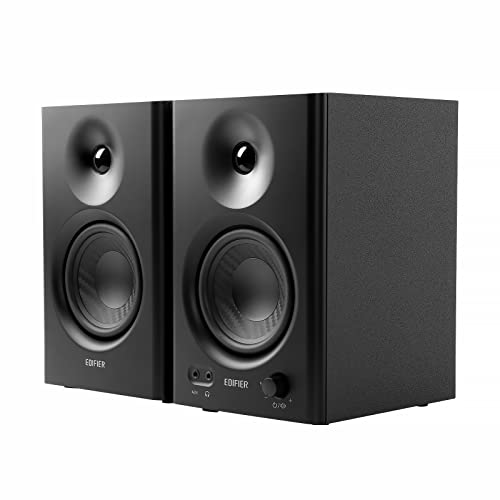
- 4-inch near-field monitor pair
- Monitor and Music listening modes
- TRS, RCA, AUX, and headphone output
Best For: Home production and everyday desktop audio
Best Connected Pick
Ortizan C7 Powered Studio Monitors

- USB DAC plus Bluetooth 5.3
- Balanced TRS and multiple analog inputs
- Compact 3.5-inch two-way design
Best For: Flexible desktop audio, content creation, and casual listening
Best for Larger Rooms
KRK Classic 7 Powered Studio Monitor

- 7-inch active monitor with 73 watts
- Bi-amped Class A/B amplification
- Front port and room-tuning controls
Best For: Recording and mixing setups needing a larger wired monitor
Best Compact Pair

- Pair of compact 3.5-inch monitors
- Tone Knob and Location Switch
- Includes pads and connection cables
Best For: Desks, small studios, and multimedia setups
Flexible Hi-Res Pick

- Hi-Res response rated from 52Hz to 40kHz
- Balanced TRS, RCA, AUX, Bluetooth, and headphone output
- Selectable modes with app-based EQ control
Best For: Flexible home studio and desktop listening
Desk-Friendly Studio Value

- 50 watts of built-in amplification in a stereo pair
- Acoustic controls for high- and low-frequency adjustment
- TRS, RCA, AUX, and headphone connections
Best For: Compact desktop production and multimedia audio
Premium Compact Monitor
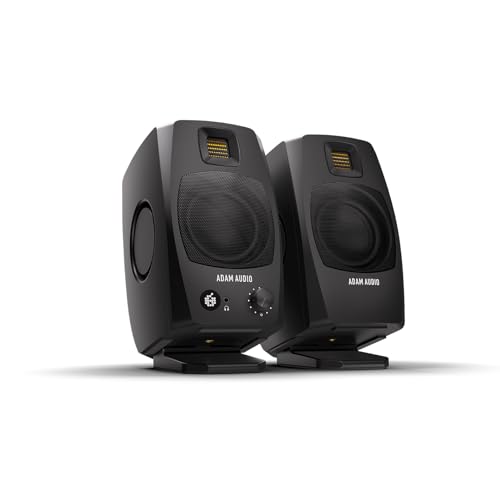
- D-ART tweeter with 80 watts of amplification
- USB-C and balanced 1/4-inch connectivity
- Includes angled stands and DSP placement controls
Best For: Detailed computer-based production in compact spaces
Compact Yamaha Control – Yamaha HS4 Powered Studio Monitor Pair
The Yamaha HS4 is a compact pair of powered studio monitors for music production, video editing, and desktop DAW workstations. Its 4.5-inch woofer, 1-inch dome tweeter, room-control and high-trim adjustments, and multiple input options make it practical for smaller setups.
Best For: Desktop music production and video editing where space and flexible connectivity matter.
Pros:
- Pair includes two 2-way bass-reflex monitors.
- Room Control and High Trim controls help adapt the response to the room.
- Accepts XLR/TRS combo, RCA, and stereo-mini connections.
- Includes speaker and stereo-mini-to-RCA cables plus anti-slip pads.
Cons:
- The 4.5-inch woofer and 26-watt output are more suited to compact setups than high-volume monitoring.
- These monitors are corded and not water resistant.
The HS4 is a sensible choice when you want Yamaha’s studio-monitor approach in a smaller, ready-to-use pair. Its included accessories and broad analog connectivity simplify a desktop installation.
Wide Sweet Spot JBL – JBL 305P MkII Powered Studio Monitor Pair
The JBL 305P MkII pair combines 5-inch woofers with Image Control Waveguides for precise imaging and a wide sweet spot. These powered studio monitors also provide Boundary EQ and HF Trim controls, making them useful for production, podcasting, and sound-design work.
Best For: Producers, podcasters, and creators who want a wide listening area and room-adjustment controls.
Pros:
- Pair includes two 5-inch, 2-way powered reference monitors.
- Image Control Waveguide is designed for precise imaging and a wide sweet spot.
- Dual 41-watt Class-D amplifiers support dynamic range and bass response.
- Boundary EQ, HF Trim, XLR, and 1/4-inch TRS connections add flexibility.
Cons:
- The cabinets are larger than compact 4-inch-class desktop monitors.
- Connectivity is wired through XLR and 1/4-inch TRS inputs.
- They are not water resistant.
With its imaging-focused waveguide and useful tuning controls, the 305P MkII is a strong option for listeners who need consistent monitoring across a broader workspace. The included pair is ready for stereo use.
Balanced Yamaha Reference – Yamaha HS5 Powered Studio Monitor Pair
The Yamaha HS5 pair is designed for near-field studio monitoring with an emphasis on a clean, uncolored presentation. Each powered studio monitor uses a 5-inch woofer, 1-inch dome tweeter, bi-amplification, and balanced or unbalanced XLR and TRS inputs.
Best For: Music production and studio monitoring when a neutral, detailed reference is the priority.
Pros:
- Pair includes two 5-inch, 2-way bass-reflex monitors.
- Bi-amped 45-watt LF and 25-watt HF system provides 70 watts of amplification per monitor.
- Designed to emphasize the original sound without added coloration.
- XLR and TRS inputs accept balanced or unbalanced signals.
Cons:
- The HS5 has less low-frequency extension than a larger monitor, with a listed response starting at 54 Hz.
- It uses wired connections rather than a wireless studio workflow.
- Its larger cabinet may require more desk or stand space.
The HS5 is a focused monitoring tool for creators who value a neutral reference over extra consumer-oriented features. Its bi-amped design and flexible analog inputs suit a conventional production setup.
Flexible Desktop Value – Edifier MR4 Powered Studio Monitors
The Edifier MR4 is a compact 4-inch active near-field pair aimed at creators who need powered studio monitors for both production and everyday listening. Its composite woofer, silk-dome tweeter, dual listening modes, front headphone output, and separate high and low controls make it adaptable to a desktop setup.
Best For: Home creators and computer users who want production monitoring plus convenient daily listening.
Pros:
- 4-inch composite woofer and 1-inch silk-dome tweeter are tuned toward a responsive, nearly flat curve.
- Monitor and Music modes support production and casual listening.
- Offers balanced TRS, RCA, AUX, and a front headphone output.
- Separate high- and low-frequency controls provide basic tonal adjustment.
Cons:
- The 4-inch woofer is intended for near-field use rather than deep, room-filling bass.
- The listed 42-watt maximum output is more suitable for personal desktop listening than large spaces.
- It is a corded, wired speaker system.
The MR4 stands out for versatility: it can function as a straightforward monitoring pair while remaining convenient for everyday computer audio. Its connection options and front headphone jack are especially useful in a personal workspace.
Best Connected Pick – Ortizan C7 Powered Studio Monitors
The Ortizan C7 is a versatile pair of powered studio monitors for compact music setups, gaming, movies, and general listening. USB audio with a 24-bit DAC, Bluetooth 5.3, RCA, AUX, and 6.35mm TRS balanced input give you plenty of ways to connect equipment.
Best For: Creators and listeners who want flexible wired and wireless connectivity in a compact monitor pair.
Pros:
- Includes USB, Bluetooth 5.3, RCA, AUX, and balanced TRS connectivity.
- 3.5-inch carbon-fiber mid-bass driver and 0.75-inch silk-dome tweeter provide detailed two-way sound.
- 24-bit DAC supports direct digital audio through USB.
- Front headphone output makes private monitoring convenient.
Cons:
- Compact 3.5-inch woofers may not deliver the low-end presence of larger monitors.
- Bluetooth and other convenience features may be unnecessary for a strictly wired studio workflow.
With its broad input selection and stated flat-response tuning, the C7 is a practical choice when one pair of powered studio monitors needs to serve several roles without adding separate equipment.
Best for Larger Rooms – KRK Classic 7 Powered Studio Monitor
The KRK Classic 7 is a single, self-powered professional monitor built around a 7-inch woofer and 73 watts of output. Its bi-amped Class A/B design, front-firing port, and room-adjustment controls make it well suited to studio recording and mixing.
Best For: Studio users who need a larger monitor with dedicated low- and high-frequency adjustment controls.
Pros:
- 7-inch active monitor with 73 watts of speaker power.
- Matched amplifiers and custom bi-amped Class A/B circuitry avoid the need for an external amplifier.
- Front-firing port allows more flexible placement near walls.
- Dedicated low- and high-frequency controls help adapt the response to the room.
Cons:
- Sold as one monitor rather than a pair, so stereo use requires two units.
- Larger cabinet may be less suitable for a small desktop.
- Wired only, with no wireless communication technology.
The Classic 7 emphasizes output, driver size, and placement flexibility. It is a sensible powered studio monitor for a more substantial mixing setup, provided you account for the single-unit packaging.
Best Compact Pair – Mackie CR3.5 Studio Monitors
The Mackie CR3.5 is a compact pair of powered studio monitors designed for desks, small studios, and multimedia setups. A front-facing Tone Knob, Location Switch, and included isolation pads make it easy to tailor placement and listening without navigating menus.
Best For: Desktop producers, streamers, and listeners who want a ready-to-use monitor pair for a small workspace.
Pros:
- Sold as a pair with 3.5-inch woofers and 50 watts of maximum output power.
- Tone Knob provides quick voicing adjustment from the desk.
- Location Switch helps correct bass response against a wall or in open placement.
- Includes isolation pads and the necessary speaker and audio cables.
Cons:
- Small 3.5-inch woofers offer less scale than larger studio monitors.
- Limited to RCA and TRS connectivity.
- Designed for compact spaces rather than high-output monitoring.
The CR3.5 keeps the setup straightforward: connect the included cables, place the monitors on their pads, and adjust the tone or location setting as needed. It is an accessible option for smaller workstations.
Flexible Hi-Res Pick – Edifier MR3
The Edifier MR3 is a versatile choice among powered studio monitors, combining balanced TRS connectivity with RCA, AUX, and Bluetooth options. Its selectable listening modes and app-based EQ make it practical for home studios, video editing, and everyday desktop listening.
Best For: Home studio users who want flexible wired and wireless connectivity.
Pros:
- Hi-Res Audio certification with a stated 52Hz–40kHz flat response.
- Offers balanced TRS, RCA, AUX, Bluetooth multipoint, and a headphone output.
- Music, Monitor, and Custom modes support different listening needs.
- 3.5-inch drivers, 1-inch tweeters, and 36 watts RMS provide substantial desktop output.
Cons:
- Bluetooth and app features may be unnecessary for a strictly wired monitoring setup.
- The compact 3.5-inch woofer may not satisfy listeners seeking substantial low-end extension.
The MR3 stands out when convenience matters as much as monitoring flexibility. It is a strong fit for mixed-use desks, though dedicated producers may prefer a more focused studio configuration.
Desk-Friendly Studio Value – PreSonus Eris 3.5
The PreSonus Eris 3.5 is a straightforward pair of powered studio monitors for desks, small workspaces, and multimedia systems. With 50 watts of built-in amplification, acoustic tuning controls, and several common inputs, it balances studio-oriented features with everyday usability.
Best For: Buyers wanting a compact stereo pair for music production, gaming, movies, and desktop audio.
Pros:
- Sold as a complete stereo pair with 50 watts of built-in amplification.
- 3.5-inch woven-composite woofers and 1-inch silk-dome tweeters provide balanced full-range sound.
- High- and low-frequency controls help tailor the monitors to the room.
- Includes balanced TRS, RCA, front AUX, and front headphone connections.
Cons:
- The stated 80Hz–20kHz range offers less low-frequency extension than some larger monitors.
- Its compact drivers are better suited to near-field listening than filling a large room.
The Eris 3.5 is an accessible entry point into powered studio monitors, especially for users who need one pair for both creative work and entertainment. Its tuning controls are useful when desk placement or room acoustics are less than ideal.
Premium Compact Monitor – ADAM Audio D3V
The ADAM Audio D3V is a compact pair of powered studio monitors designed for detailed desktop monitoring. Its D-ART tweeter, 80-watt amplification, USB-C connectivity, passive radiators, and included angled stands make it especially well suited to computer-based production and focused near-field listening.
Best For: Songwriters, producers, and listeners seeking advanced desktop monitoring in a compact system.
Pros:
- D-ART tweeter is designed for precise, low-fatigue high-frequency reproduction.
- 80-watt amplification and dual-sided passive radiators extend response down to a stated 45Hz.
- Supports direct USB-C computer and mobile-device connections plus balanced 1/4-inch inputs.
- Includes 15-degree detachable stands and DSP-powered placement controls.
Cons:
- Its specialized feature set may be more than casual desktop listeners need.
- Connectivity is centered on USB-C and 1/4-inch inputs rather than a broad range of analog options.
The D3V is a compelling choice when desktop space is limited but monitoring detail and placement flexibility remain priorities. Its integrated stands and DSP controls help make a compact setup more practical for serious work.
How We Picked the Best Powered Studio Monitors
We compared these Powered Studio Monitors by evaluating their intended use, driver size, connectivity, controls, format, and overall suitability for near-field listening. We also considered whether each pair is better suited to mixing, casual music playback, desktop use, or a hybrid setup.
Because monitor performance depends heavily on room placement and listening distance, no single model is ideal for everyone. Compact speakers can work well on a desk, while larger monitors generally provide more output and deeper bass but need more space and careful positioning.
Quick Comparison
| Best For | What to Look For |
|---|---|
| Mixing and production | Neutral voicing, useful room controls, and balanced inputs |
| Desktop listening | Compact cabinets, front-panel controls, and convenient connectivity |
| More bass and output | Larger woofers and sufficient listening distance |
| Streaming and casual use | Bluetooth, tone controls, or multiple input options |
Key Buying Factors for Powered Studio Monitors
Woofer Size and Room Placement
Three- to four-inch monitors are usually easier to place on a desk and can sound balanced at close range. Five- to seven-inch models typically deliver stronger low-end extension and higher volume, but they require more desk or stand space and may be excessive in a small room.
Accuracy Versus Added Features
For mixing, prioritize a consistent, revealing presentation over extra coloration. Bluetooth and tone controls are convenient for general listening, but they should not replace proper positioning and acoustic treatment when accuracy is the goal.
Inputs, Controls, and Power
Check whether the speakers offer the connections your interface, computer, or other sources require. Balanced inputs can help reduce noise in studio setups. Also confirm how volume is controlled and whether the pair has adjustable high- or low-frequency response for adapting to the room.
Size, Listening Distance, and Output
Choose monitors that match your listening position. Desktop users generally sit close to the speakers, while larger models are more appropriate on stands or a wider workstation. Leave room behind rear-ported cabinets and avoid placing either speaker directly against a wall.
Who Should Buy Which Powered Studio Monitors?
Choose a compact pair if you need speakers for a small desk, bedroom studio, editing station, or general computer listening. These models are typically easier to position and less demanding on the room.
Choose a five-inch pair if you want a versatile balance of bass response, detail, and manageable size for music production or serious listening. This is often the most flexible category for home studios.
Choose larger monitors if you need greater headroom, more substantial low-end, or a wider listening area. Use stands, maintain symmetry, and account for room acoustics before turning up the volume.
Choose Bluetooth-equipped monitors if convenience matters as much as studio workflow. For critical mixing, connect through a suitable audio interface whenever possible and treat wireless playback as an additional listening option.