A widescreen projector setup can look dramatically better with the right screen. The best projector screens for cinemascope help preserve image detail, improve contrast, and create a more convincing theater-style presentation without forcing you to compromise on room layout.
This roundup compares 10 options across fixed-frame, motorized, floor-rising, and portable designs. Consider screen size, aspect ratio, gain, installation, ambient light, and projector compatibility before choosing.
Best 10 Projector Screens for Cinemascope Picks for 2026
Premium Fixed-Frame Choice
AWOL VISION 120-Inch Matte Screen

- 4K/8K and active 3D ready
- 170-degree viewing angle
- Compatible with standard and UST projectors
Best For: Dedicated home theaters with a permanent wall installation
Motorized Theater Pick
Elite Screens 125-Inch Electric Screen

- Motorized retractable operation
- 180-degree viewing angle
- Includes IR and RF remotes
Best For: Standard-throw home theaters requiring a retractable screen
Portable Movie-Night Option
PropVue 100-Inch Tripod Screen
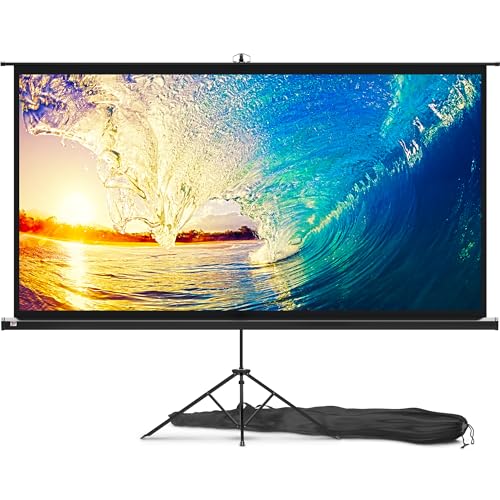
- Adjustable tripod setup
- Indoor and outdoor compatible
- Includes carrying bag and straps
Best For: Portable movie nights, presentations, and events
Large-Format Electric Pick
SiliBamb 200-Inch Motorized Screen

- Extra-large 200-inch display
- Electric rise and drop controls
- Wall or ceiling installation
Best For: Large rooms and screenings needing a very expansive image
Laser Cinema Choice
Valerion PureVision 100-Inch Fixed Frame

- Reduces laser speckle for smoother laser-projected images
- 1.0 gain and PET matte surface support accurate color
- Flat, 8K-ready design with a 170° viewing angle
Best For: Dedicated laser-projector home theaters
Flexible Motorized Pick

- Retracts automatically for multipurpose rooms
- 1.2 gain, black backing, and 4K/3D readiness
- Includes RF remote and wall-or-ceiling mounting kit
Best For: Retractable home theaters and presentation spaces
Lightweight Fixed-Frame Value

- Tailored to select XGIMI long-throw projectors
- Lightweight 5.4 kg modular construction
- Slim profile with a narrow black frame
Best For: Simple XGIMI-based home theater installations
Best Motorized Option
NothingProjector 100-Inch Floor-Rising Screen
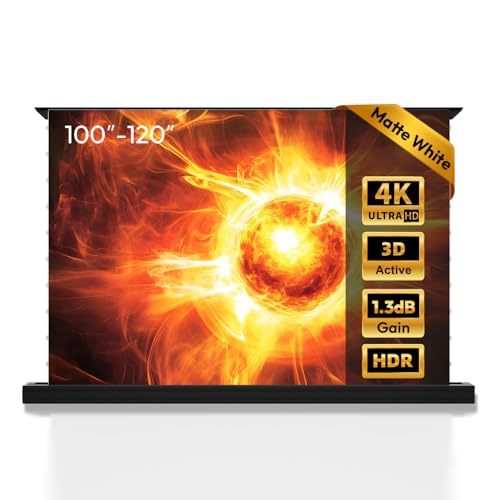
- Motorized floor-rising operation with USB projector sync
- 1.3 gain matte-white PVC supports bright 4K/8K images
- 170° viewing angle and black backing
Best For: Dedicated home theaters needing automatic screen deployment
Best Portable 120-Inch Pick

- 120-inch 16:9 screen with 4K HD support
- Includes stakes, ropes, and sandbags for outdoor use
- Front/rear projection and 160° viewing angle
Best For: Portable backyard, camping, and indoor movie setups
Premium Fixed-Frame Choice – AWOL VISION 120-Inch Matte Screen
For dedicated theaters seeking projector screens for cinemascope-style movie viewing, the AWOL VISION MW-120 emphasizes a clean fixed-frame installation, broad seating coverage, and compatibility with high-resolution projection. Its PVC matte white surface is designed for 4K, 8K, and active 3D content.
Best For: Dedicated home theaters using standard, short-throw, or ultra-short-throw projectors.
Pros:
- Supports 4K/8K and active 3D projection.
- Offers a 170-degree viewing angle for wide seating arrangements.
- Tensioning-rod assembly is designed for quick setup.
- Matte surface can be cleaned with mild soap and water.
Cons:
- Fixed-frame wall mounting is less portable than a tripod screen.
- The listed 120-inch size may not suit smaller rooms.
This is a strong theater-oriented option when image presentation and permanent installation matter more than portability. Its universal projector compatibility also makes it flexible for different room layouts.
Motorized Theater Pick – Elite Screens 125-Inch Electric Screen
The Elite Screens ELECTRIC125H2 is a convenient choice among projector screens for cinemascope-focused home theater setups when you want the screen to retract after viewing. Its 125-inch 16:9 format, motorized operation, and included controls support a polished wall- or ceiling-mounted installation.
Best For: Home theaters needing a retractable, plug-and-play screen for standard UHD or HD projectors.
Pros:
- Motorized drop-down design includes IR and RF remotes.
- MaxWhite 2 material offers a 1.1 gain and 180-degree viewing angle.
- Includes wall and ceiling installation hardware.
- Programmable drop position and 12-volt trigger support add control flexibility.
Cons:
- Not compatible with short-throw or ultra-short-throw projectors.
- 16:9 framing may not fill a wider cinemascope-style image without unused screen area.
Choose this model if retractability and remote operation are priorities. Verify your projector is a standard throw model before buying, since the supplied notes specifically exclude short-throw and ultra-short-throw compatibility.
Portable Movie-Night Option – PropVue 100-Inch Tripod Screen
For flexible setups, the PropVue 100-inch screen is one of the more practical projector screens for cinemascope-style movie nights away from a dedicated theater. Its tripod stand, adjustable height, carrying bag, and indoor/outdoor design make it easy to move between rooms and venues.
Best For: Portable indoor or outdoor movie viewing, presentations, classrooms, and events.
Pros:
- Tripod design supports quick setup and adjustable height.
- Includes tight straps and a fitted carrying bag.
- Suitable for indoor and outdoor use.
- 160-degree viewing angle and 1.1 gain support broad viewing areas.
Cons:
- Portable tripod construction is less suited to a permanent cinema installation.
- Its 100-inch 16:9 format may be limiting for large dedicated theaters.
This screen makes the most sense when portability is central to the purchase. It can serve movie nights as well as presentations and events, though its 16:9 format is better suited to general-purpose viewing than a specialized wide-screen theater.
Large-Format Electric Pick – SiliBamb 200-Inch Motorized Screen
The SiliBamb 200-inch motorized model is designed for viewers who want a very large display among projector screens for cinemascope-style home theater use. Its 16:9 matte-white surface, electric drop and rise controls, and wall- or ceiling-mountable metal casing suit large indoor viewing spaces.
Best For: Large home theaters, offices, classrooms, and outdoor screenings that need a 200-inch electric screen.
Pros:
- Provides a 200-inch diagonal viewing area.
- Electric operation includes an integrated switch and radio-frequency remote.
- 1.1 gain matte PVC surface offers a 160-degree viewing angle.
- Dual-purpose casing supports wall or ceiling installation.
Cons:
- The large 16:9 screen requires substantial installation space.
- Its 160-degree viewing angle is narrower than some listed alternatives.
- The supplied notes do not identify compatibility with short-throw or ultra-short-throw projectors.
This is the size-focused option in the group, offering convenient motorized control for large-scale viewing. Measure the installation area carefully and confirm projector placement before committing to its substantial dimensions.
Laser Cinema Choice – Valerion PureVision 100-Inch Fixed Frame
For projector screens for cinemascope-style home theaters, the AWOL Valerion PureVision emphasizes accurate color, a flat presentation, and compatibility with both long-throw and ultra-short-throw laser projectors. Its PET matte surface is designed for detailed 4K and 8K-ready viewing.
Best For: Dedicated home theaters using premium laser projectors.
Pros:
- Engineered to reduce laser speckle and preserve natural color.
- 1.0 gain maintains balanced brightness, contrast, and color accuracy.
- Supports up to 8K resolution with a precision-tensioned flat surface.
- 170° viewing angle and slim fixed-frame design suit group viewing.
Cons:
- Fixed-frame installation is less flexible than a retractable screen.
- The 100-inch size may not suit larger rooms seeking a bigger image.
This is the most cinema-focused option of the three, particularly for laser-projector owners who prioritize uniformity, wide seating coverage, and a clean fixed installation.
Flexible Motorized Pick – Kayle 120-Inch Electric 16:9
Among projector screens for cinemascope-style movie setups, the Kayle offers a convenient motorized format with a large 120-inch viewing area. Its 16:9 ratio, wireless remote, and wall-or-ceiling mounting make it practical for rooms that need a retractable screen.
Best For: Home theaters, presentations, and indoor or outdoor movie viewing where retractable operation is useful.
Pros:
- Motorized retractable operation includes an RF remote and detachable three-way wall switch.
- 1.2 gain and a three-layer black-backed screen support brighter viewing.
- 180° stated viewing angle and compatibility with 4K Ultra HD and active 3D projection.
- Arrives assembled with wall- and ceiling-mount installation hardware.
Cons:
- The 16:9 aspect ratio is not a native cinemascope format.
- Motorized hardware requires access to a suitable power connection.
Choose this model when convenient storage and a larger image matter more than a fixed-frame presentation. Its retractable design is especially adaptable for multipurpose spaces.
Lightweight Fixed-Frame Value – XGIMI 100-Inch HD 16:9
For shoppers comparing projector screens for cinemascope-style viewing, the XGIMI 100-inch fixed-frame screen is a streamlined choice for select long-throw projectors. Its lightweight modular construction and thin black frame are aimed at straightforward installation in home theaters or presentation rooms.
Best For: XGIMI long-throw projector owners who want a lightweight, minimalist fixed screen.
Pros:
- Designed for an expansive, uniform image with select XGIMI long-throw projectors.
- Claims up to 1.3× higher projection brightness.
- At 5.4 kg, the modular screen can be assembled by one person in under 20 minutes.
- Ultra-thin profile and narrow black frame create a clean appearance.
Cons:
- Its stated compatibility is tailored to select XGIMI long-throw projectors.
- The 16:9 format is not designed as a dedicated widescreen cinemascope ratio.
- The glossy finish may not be ideal for every room-lighting condition.
This model stands out for easy handling and understated styling. It is a sensible fit when lightweight installation and XGIMI projector pairing are higher priorities than broad compatibility.
Best Motorized Option – NothingProjector 100-Inch Floor-Rising Screen
For a permanent home-theater setup, this motorized model is a practical choice among projector screens for cinemascope-style viewing. Its 100-inch matte-white PVC surface, black backing, 1.3 gain, and 170° viewing angle are designed for bright, consistent images in dark rooms.
Best For: Home theaters that prioritize automatic operation, a clean installation, and compatibility with standard, short-throw, and UST projectors.
Pros:
- Motorized floor-rising design includes USB projector-sync control.
- 1.3 gain supports brighter, sharper 4K/8K UHD and Active 3D images.
- Black-backed PVC helps block light penetration and maintain a smooth surface.
- Quiet motor includes soft start/stop, position memory, and overheat protection.
Cons:
- Floor-mounted design needs dedicated space in front of or below the viewing area.
- The 100-inch size may be limiting for viewers seeking a very large cinema presentation.
This is the most installation-friendly option in the group, especially if you want the screen to deploy automatically. Its fixed 100-inch format and floor-rising enclosure make it better suited to a dedicated room than frequent transport.
Best Portable 120-Inch Pick – ZUVMITG Outdoor/Indoor Screen
This 120-inch stand-mounted model is a versatile choice for projector screens for cinemascope-style movie nights indoors or outside. Its portable frame, washable milk-silk fabric, front/rear projection support, and included windproof accessories make it convenient for changing locations.
Best For: Backyard screenings, camping, tailgating, and indoor users who need a large screen that can be packed into a carry bag.
Pros:
- 120-inch screen supports a large 16:9 viewing area with 4K HD compatibility.
- Includes four stakes, two ropes, and two sandbags for outdoor stability.
- Supports front and rear projection with a 160° viewing angle.
- Portable, foldable design includes a dedicated storage bag.
Cons:
- Stand setup requires securing the included accessories when used outdoors.
- At 12.5 pounds, it is portable but less compact than a small tabletop screen.
Choose this screen when flexibility matters more than a permanent installation. The reinforced base and windproof kit add confidence outdoors, while the rear-projection capability gives you more setup options in larger spaces.
Best Extra-Large Screen – FvcDmik 150-Inch Portable Cinema Screen
For viewers who want maximum image size, this 150-inch foldable screen stands out among projector screens for cinemascope-style home and outdoor cinema setups. The wrinkle-free polyester surface, sturdy iron frame, carry bag, ground nails, and rigging ropes support a large presentation that can be moved between locations.
Best For: Large backyard movie nights, home-theater events, sports viewing, gaming, presentations, and other situations where screen size is the priority.
Pros:
- Extra-large 150-inch screen creates an immersive cinema-style presentation.
- Anti-crease polyester is designed to fold or compress without leaving wrinkles.
- Iron frame assembles without tools and packs into the included heavy-duty bag.
- Ground nails and rigging ropes help stabilize the screen outdoors.
Cons:
- The very large footprint requires substantial setup and viewing space.
- Outdoor stability accessories are intended for light winds, not severe weather.
- Its listed dimensions are 150 by 150 inches, so verify the intended aspect and available space before buying.
This is the strongest fit for buyers who value a dramatic, oversized image and still need portability. Measure your venue carefully before choosing it, since the large frame can be more demanding to position than the smaller alternatives.
How We Picked These Projector Screens for Cinemascope
We selected models that cover the main home-cinema and presentation needs: permanent fixed-frame installations, retractable motorized screens, floor-rising designs, and portable screens for indoor or outdoor use. We also considered the listed screen size, 16:9 format, advertised 4K/8K readiness, gain, setup requirements, portability, and included accessories such as remotes, stands, carry bags, or sandbags.
Because a screen cannot correct a projector with insufficient brightness or poor placement, treat manufacturer specifications as starting points. Check the exact dimensions, mounting hardware, return policy, and compatibility with your projector before ordering.
Quick Comparison
| Screen type | Best for | Main advantage | Trade-off |
|---|---|---|---|
| Fixed frame | Dedicated theaters | Flat, stable viewing surface | Requires permanent wall space |
| Motorized drop-down | Multi-use rooms | Retracts when not in use | Needs power and careful installation |
| Floor-rising | Flexible rooms | Minimal wall mounting | Requires clear floor space |
| Portable stand | Outdoor movies and travel | Easy to move and store | Less rigid than fixed frames |
Key Buying Factors for Projector Screens for Cinemascope
Aspect Ratio and Image Size
Most selections here use a 16:9 aspect ratio, which suits HDTV, streaming, gaming, and many projectors. If your projector or content uses a wider cinemascope format, confirm how it handles letterboxing and whether the visible image will match the screen’s proportions. Measure viewing distance and wall width before choosing a 100-, 120-, 150-, or 200-inch screen.
Gain, Material, and Ambient Light
Gain describes how much light a screen reflects toward viewers. A higher-gain surface can help a dimmer projector appear brighter, but it may narrow viewing angles or emphasize hotspots. Matte white surfaces generally offer broader viewing angles and are a practical choice for shared seating. In rooms with windows or lights, reducing ambient light often matters more than selecting a larger screen.
Installation and Portability
Fixed-frame screens typically provide the most consistently flat surface, while motorized and floor-rising models preserve room flexibility. Portable screens are useful for patios, temporary rooms, and presentations, but stands must be weighted and positioned on level ground. For outdoor use, plan for wind, power access, and safe anchoring.
Projector Compatibility
Check throw distance, brightness, resolution, mounting position, and lens shift. A 4K- or 8K-ready screen does not upgrade a lower-resolution projector; it simply indicates that the surface is intended to display detailed images. Ultra-short-throw projectors may require a specially compatible screen surface, so verify this before purchase.
Who Should Buy Which Projector Screens for Cinemascope?
Choose a fixed-frame AWOL VISION, AWOL Valerion, or XGIMI model for a dedicated theater where a permanently stretched, clean surface is the priority. A motorized Elite Screens, Kayle, or 200-inch screen is better for a multipurpose room where you want the display hidden between uses. The NothingProjector floor-rising design suits renters or rooms where wall mounting is inconvenient.
For backyard films, presentations, or frequent travel, choose a stand-based 100-, 120-, or 150-inch model. Smaller portable screens are easier to stabilize and transport, while larger versions create a more immersive image but demand more setup space and stronger anchoring. Before buying any of these Projector Screens for Cinemascope, prioritize the screen’s usable dimensions and installation requirements over the biggest advertised diagonal.