The best studio monitors with built-in DSP can improve monitoring accuracy by applying digital room correction, tuning options, and placement compensation directly in the speaker. That makes them especially useful when your room is untreated or your listening position is less than ideal.
Our 2026 roundup covers compact desktop pairs, affordable near-field monitors, and larger professional speakers so you can match output, connectivity, and calibration features to your workspace.
Best 10 Studio Monitors with Built in Dsp Picks for 2026
Powerful Room-Filling Choice

- 8-inch woofer reaches down to 35 Hz
- 140W biamplification delivers up to 105 dB SPL
- Acoustic Tuning controls help adapt to room placement
Best For: Music production and mixing in larger rooms
Compact Yamaha Classic
Yamaha HS3 Powered Monitor Pair

- Compact 3.5-inch woofer suits small desks
- Room Control and High Trim adjustments included
- Pair offers XLR/TRS, RCA, and stereo mini inputs
Best For: Small-room and desktop monitoring
Wide-Sweet-Spot Mixer

- 6.55-inch woofer delivers deep lows
- EBM waveguide provides a broad sweet spot
- Level, filter, trim, and Acoustic Space controls
Best For: Home studios needing flexible room tuning
Wireless Desktop Pick

- Compact 3.5-inch glass aramid woofer
- Bluetooth supports wireless audio streaming
- Multiple inputs suit varied studio and home devices
Best For: Compact desks needing wired and wireless playback
Affordable Room-Tuning Starter

- 5.25-inch woofer and silk-dome tweeter
- Acoustic tuning controls for room adjustment
- 80-watt Class AB amplification
Best For: Compact home studios wanting adjustable wired monitoring
App-Controlled DSP Value
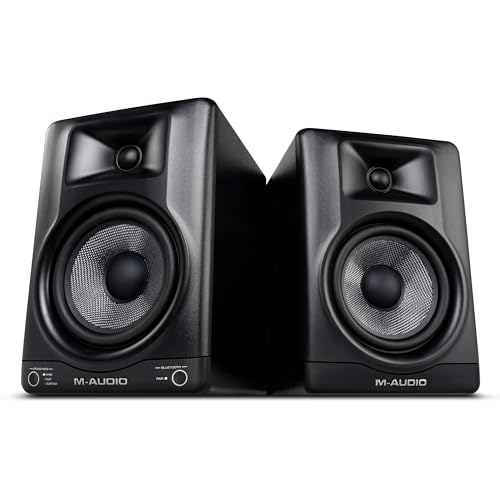
- Built-in DSP with three reference modes
- Five-band EQ and presets through an app
- Bluetooth 5.0 plus TRS connectivity
Best For: Creators wanting flexible DSP tuning and wireless playback
Large-Driver Analog Alternative

- 7-inch powered two-way monitor
- 73-watt Class AB bi-amplification
- Manual low- and high-frequency controls
Best For: Mixing setups prioritizing larger drivers and analog tuning
Compact Desk Pick

- 50 watts of built-in amplification
- High- and low-frequency acoustic tuning
- TRS, RCA, aux, and headphone connections
Best For: Small desks, gaming, and entry-level music production
Large-Room Power Pick
Rockville APM8D 8-inch DSP Monitors

- ADAU1701 DSP with bi-amped Class-D amplification
- 8-inch woofer for extended low end
- USB, XLR, TRS, and RCA inputs
Best For: High-output studio, DJ, and content-creation setups
Balanced Mid-Size Pick

- 4.5-inch woofer with 50 watts of Class AB power
- Room-tuning controls for high and low frequencies
- Balanced TRS, RCA, aux, and headphone output
Best For: Home studios and multimedia desks needing fuller sound
Powerful Room-Filling Choice – PreSonus Eris Studio 8
The PreSonus Eris Studio 8 is a strong option for shoppers seeking studio monitors with built in dsp-style room-adjustment controls. Its 8-inch woven-composite woofer, 1.25-inch silk-dome tweeter, and 140W biamplification are designed for detailed, powerful monitoring, while Acoustic Tuning controls help compensate for wall or corner placement.
Best For: Music production, mixing, and larger desktop or studio setups that need extended bass and high output.
Pros:
- 8-inch woofer provides extended low-end response down to 35 Hz.
- EBM waveguide creates a wide sweet spot and supports stereo imaging.
- Offers HF, midrange, highpass, and Acoustic Space adjustments.
- Includes balanced XLR, balanced TRS, and unbalanced RCA inputs.
Cons:
- The large 8-inch cabinet may be excessive for compact desks or small rooms.
- This is a wired monitor with no wireless communication technology.
The Eris Studio 8 stands out when output, bass extension, and placement flexibility matter most. Its tuning controls are useful for adapting the monitor to a room, though buyers should allow sufficient desk or stand space.
Compact Yamaha Classic – Yamaha HS3 Powered Monitor Pair
The Yamaha HS3 is a compact pair for shoppers comparing studio monitors with built in dsp-style adjustment features. Each 2-way powered monitor uses a 3.5-inch woofer and 0.75-inch tweeter, with Room Control and High Trim response controls for basic tailoring in a desktop setup.
Best For: Small desks, bedrooms, portable workstations, and entry-level music production or studio recording.
Pros:
- Compact 3.5-inch design fits space-conscious desktop setups.
- Includes Room Control and High Trim response controls.
- Provides XLR/TRS combo, RCA, and stereo mini inputs.
- Pair includes speaker cable, stereo mini-to-RCA cable, and anti-slip pads.
Cons:
- 70 Hz–22 kHz response offers less low-end extension than larger monitors.
- 26W output is better suited to nearfield listening than loud, large-room monitoring.
The HS3 makes a practical choice when desk space and connectivity are more important than deep bass or high output. Its included accessories and adjustment controls simplify a compact workstation setup.
Wide-Sweet-Spot Mixer – PreSonus Eris E7 XT
PreSonus Eris E7 XT 2-Way Active Studio Monitor with EBM Waveguide (Pack of 1)
Check Price On AmazonThe PreSonus Eris E7 XT is a 6.5-inch active monitor for buyers seeking studio monitors with built in dsp-style acoustic adjustment. Its EBM waveguide is designed for a broad listening area, while the rear controls provide level, highpass, LF Trim, HF Trim, and Acoustic Space adjustments for room-specific tuning.
Best For: Home studios and producers who want a wide sweet spot, flexible placement controls, and substantial nearfield bass.
Pros:
- 6.55-inch woven-composite driver provides deep low-frequency output.
- 100° horizontal by 60° vertical EBM waveguide supports wide listening coverage.
- Multiple acoustic tuning controls help tailor the monitor to the room.
- Includes XLR, TRS, and RCA connectivity.
Cons:
- Sold as a single monitor, so a stereo pair requires purchasing two units.
- Its larger cabinet may require dedicated stands or more desktop space.
The Eris E7 XT offers a useful middle ground between compact monitors and larger 8-inch models. It is particularly appealing for producers who share monitoring duties across a wider listening position or need several placement adjustments.
Wireless Desktop Pick – KRK Kreate 3
The KRK Kreate 3 is a compact powered pair for buyers exploring studio monitors with built in dsp-style convenience and wireless playback. Its 3.5-inch glass aramid woofer, 1-inch textile dome tweeter, Bluetooth input, and multiple audio inputs make it suitable for both focused monitoring and everyday listening.
Best For: Desktop producers, audio engineers, gamers, and listeners who want compact monitors with Bluetooth connectivity.
Pros:
- Compact 3.5-inch woofer works well in desktop environments.
- Textile dome tweeter is designed for clear high-frequency reproduction.
- Bluetooth enables wireless audio streaming from compatible devices.
- Supports music production, studio monitoring, and audio engineering use.
Cons:
- Small drivers are unlikely to provide the bass extension of larger monitors.
- The supplied notes do not specify room-calibration or dedicated acoustic-tuning controls.
The Kreate 3 is the most flexible everyday option in this group for users who want monitoring plus wireless playback. Choose it for convenience and compactness, rather than maximum low-end reach or advanced room correction.
Affordable Room-Tuning Starter – PreSonus Eris E5
The PreSonus Eris E5 is a practical entry point for anyone seeking studio monitors with built in DSP alternatives for nearfield mixing. While it does not include built-in DSP, its acoustic tuning controls let you contour the response to suit your room, while the 5.25-inch woven composite woofer and 1-inch silk-dome tweeter provide balanced monitoring.
Best For: Home studios and producers who want adjustable nearfield monitoring with flexible wired connections.
Pros:
- Acoustic tuning controls help adapt the monitor to its environment.
- 80-watt Class AB bi-amplification provides useful volume and headroom.
- Balanced XLR and 1/4-inch inputs plus unbalanced RCA connectivity.
- Front-firing port supports bass reproduction and flexible placement.
Cons:
- It lacks the built-in DSP and app-based room correction found on newer monitors.
- The 5.25-inch woofer may offer less low-end authority than larger monitors.
The Eris E5 is a sensible choice when manual acoustic adjustments and dependable analog connectivity matter more than digital processing. It offers a straightforward monitoring upgrade for compact workspaces.
App-Controlled DSP Value – M-AUDIO BX5BT
The M-AUDIO BX5BT is a strong fit for shoppers specifically looking for studio monitors with built in DSP. Its DSP crossover, selectable FLAT, HYPE, and CUSTOM modes, five-band EQ, and Studio Control App give creators several ways to tailor the sound to a room or workflow.
Best For: Modern producers, editors, podcasters, and streamers who want DSP customization, Bluetooth playback, and a compact pair of monitors.
Pros:
- Built-in DSP offers FLAT, HYPE, and CUSTOM reference modes.
- App control provides five-band EQ adjustment and custom presets.
- Bluetooth 5.0 supports wireless streaming with a stated 100-foot range.
- 240 watts of bi-amplified power and TRS inputs suit varied desktop setups.
Cons:
- Bluetooth and enhanced voicing options may be unnecessary for strictly traditional mixing setups.
- The 5-inch woofer is compact compared with larger professional monitors.
Among these options, the BX5BT most directly addresses the built-in DSP requirement. Its combination of app-based EQ, presets, room-oriented voicing, and wireless playback makes it especially versatile for creators with changing listening needs.
Large-Driver Analog Alternative – KRK Classic 7
The KRK Classic 7 is a larger powered monitor for buyers comparing studio monitors with built in DSP but who may prefer direct analog control. It does not include DSP; instead, dedicated low- and high-frequency level adjustments let you match its response to room acoustics and personal preference.
Best For: Studio recording and mixing setups that need a 7-inch driver, high headroom, and flexible analog connections.
Pros:
- 7-inch woofer provides a larger monitoring platform than the compact models here.
- 73-watt bi-amplified Class AB design is matched to the drivers.
- Dedicated low- and high-frequency controls support manual room adjustment.
- Front-firing port allows more flexible placement near walls.
Cons:
- It lacks built-in DSP, app control, and wireless connectivity.
- Its larger enclosure may be less suitable for small desktop spaces.
- The listing is for one monitor, so a stereo setup requires two units.
The Classic 7 is worth considering when driver size and conventional analog tuning take priority over digital room processing. It delivers a substantial, self-powered monitoring format while keeping the controls simple and physical.
Compact Desk Pick – PreSonus Eris 3.5
If you want studio monitors with built in dsp for a compact desk, the PreSonus Eris 3.5 is a practical stereo pair with adjustable high- and low-frequency acoustic tuning. Its 3.5-inch woven-composite woofers, silk-dome tweeters, and 50 watts of built-in amplification suit music production, gaming, streaming, and general desktop listening.
Best For: Small desks, casual music production, gaming, and buyers who need flexible inputs and a front headphone jack.
Pros:
- Complete stereo pair with 50 watts of built-in amplification.
- High- and low-frequency controls help tailor sound to the room.
- Balanced TRS, RCA, front aux, and headphone connections support varied setups.
Cons:
- 3.5-inch woofers offer less low-end reach than larger monitors.
- Best suited to desktop or near-field listening rather than filling a large room.
The Eris 3.5 is an easygoing entry point for a compact workstation. It offers useful room adjustment and broad connectivity without requiring extra gear, though listeners wanting stronger bass or higher output may prefer a larger model.
Large-Room Power Pick – Rockville APM8D 8-inch DSP Monitors
The Rockville APM8D is a larger option for shoppers comparing studio monitors with built in dsp and wanting substantial output. Its ADAU1701 DSP, bi-amped Class-D design, 8-inch woofer, and 1.5-inch silk-dome tweeter are geared toward detailed monitoring with extended bass and multiple connection options.
Best For: Larger studio or desktop setups, producers and content creators who need high output, and systems requiring USB, XLR, TRS, or RCA inputs.
Pros:
- ADAU1701 DSP and bi-amped Class-D amplification support precise response.
- 8-inch woofer and rear-firing port provide stronger low-end capability.
- USB audio input joins XLR, TRS, and RCA connectivity.
- Adjustable bass and treble controls allow further tonal tuning.
Cons:
- The pair is substantially larger and heavier than compact near-field monitors.
- Its 500-watt peak rating may be excessive for a small desk or quiet room.
- It has no wireless communication technology.
The APM8D stands out when DSP features, bass extension, and connectivity matter more than a small footprint. Confirm that your room and desk can accommodate its size before choosing this powerful pair.
Balanced Mid-Size Pick – PreSonus Eris E4.5
For buyers seeking studio monitors with built in dsp in a moderately sized desktop format, the PreSonus Eris E4.5 offers a useful middle ground. Its 4.5-inch woven-composite woofer, 1-inch silk-dome tweeter, and 50 watts of Class AB amplification are designed for accurate monitoring, multimedia, and personal listening.
Best For: Home studios and multimedia desks that need more low-end presence than compact 3.5-inch monitors without moving to a large speaker.
Pros:
- 4.5-inch woofer delivers a fuller low end while remaining relatively compact.
- High- and low-frequency tuning controls help adapt the monitors to the room.
- Balanced TRS, RCA, and front aux inputs support professional and consumer sources.
- Front headphone output includes an integrated headphone amplifier.
Cons:
- Class AB amplification provides 50 watts total, less than larger high-output designs.
- The pair uses one active and one passive monitor, rather than two independently amplified speakers.
- Bluetooth is listed in the specifications, but the supplied connectivity details emphasize wired inputs.
The Eris E4.5 is a sensible compromise for a home studio: larger and fuller than the Eris 3.5, yet still desk-friendly. Its tuning controls and headphone output add flexibility for everyday production and listening.
How We Picked the Best Studio Monitors with Built in Dsp
We evaluated this selection around the factors that matter most in real production environments: DSP functionality, frequency balance, usable output, cabinet size, connectivity, placement flexibility, and overall value. We also considered whether each monitor suits a desktop, small project studio, home mixing room, or larger control space.
Because DSP features vary widely, check the manufacturer’s specifications carefully. Some speakers provide onboard EQ or boundary controls, while others support more advanced room calibration through software, measurement microphones, or companion apps. A monitor marketed as “active” or “powered” is not automatically DSP-equipped.
Quick Comparison
- Small desktop setups: PreSonus Eris 3.5, PreSonus Eris E4.5, and Yamaha HS3 are easier to place near a computer or compact workstation.
- Affordable near-field mixing: PreSonus Eris E5, M-Audio BX5BT, and KRK Kreate 3 offer a practical balance of size, output, and cost.
- More low-end and headroom: PreSonus Eris Studio 8, PreSonus Eris E7 XT, KRK Classic 7, and Rockville APM8D are better suited to larger rooms and louder listening.
- Professional monitoring: Prioritize accurate response, reliable calibration, balanced inputs, and sufficient acoustic treatment over extra consumer-oriented features.
Key Buying Factors for Studio Monitors with Built-In DSP
Room Size and Monitor Placement
Choose monitor size according to your room, not just your desired bass response. Large 7- or 8-inch speakers can overwhelm a small untreated room, while compact 3.5- or 4.5-inch models may lack the headroom needed for a larger space. Place monitors symmetrically, form an equilateral triangle with your listening position, and keep tweeters near ear level.
DSP and Room Correction
DSP can compensate for boundary effects and certain room-response problems, but it cannot replace acoustic treatment or correct every reflection. Look for adjustable EQ, placement filters, calibration presets, and—if needed—measurement-based correction. Confirm whether the controls are available on the speaker, through software, or through additional hardware.
Inputs, Output, and Listening Distance
Balanced XLR or TRS inputs are preferable for studio interfaces because they help reduce noise over longer cable runs. RCA, Bluetooth, or auxiliary inputs can be useful for desktop playback, but they should not be the deciding factor for critical mixing. Near-field monitors should be selected for the distance and volume at which you normally work.
Pair Configuration and Accessories
Some listings include a matched pair, while others contain a single monitor. Verify the package before ordering. You may also need isolation pads, monitor stands, balanced cables, and a calibration microphone to get the best performance from your setup.
Who Should Buy Which Studio Monitors with Built in Dsp?
Choose compact models if you produce in a bedroom, office, or desktop setup and need controlled volume and easy placement. Choose 5- to 7-inch monitors for general music production, mixing, and near-field listening in a modest studio. Choose 8-inch models only when your room has enough space, listening distance, and acoustic control to support their additional bass and output.
If accurate mixing is the priority, favor balanced connections, reliable response, and useful calibration controls. If you also need casual playback, Bluetooth or auxiliary connectivity may add convenience, but treat those features as secondary to placement, room correction, and tonal accuracy.