The best studio monitors help you hear recordings more accurately, whether you are mixing in a dedicated room or producing at a compact desktop setup. The right pair balances frequency response, size, connectivity, and listening distance.
Our roundup includes dependable near-field options from JBL, Yamaha, PreSonus, M-Audio, Edifier, and Mackie, ranging from compact 3.5-inch models to larger monitors suited to more demanding mixes.
Best 10 Studio Monitors Picks for 2026
Wide-Sweet-Spot Precision

- Wide Image Control Waveguide sweet spot
- Dual 41W Class-D amplification
- Boundary EQ and HF Trim controls
Best For: Music production, podcasting, and cinematic sound design
Uncolored Monitoring

- Designed for sonic purity
- Bi-amplified 70W system
- XLR and TRS inputs
Best For: Music production and accurate studio monitoring
Expanded Low-End Workspace

- 6.55-inch woven composite driver
- Wide EBM waveguide sweet spot
- Extensive acoustic tuning controls
Best For: Larger-room production and deeper low-frequency monitoring
Compact Desktop Flexibility

- 3.5-inch Kevlar woofers
- Multiple RCA, TRS, and auxiliary inputs
- Front headphone access and included cables
Best For: Desktop music production, podcasting, streaming, and gaming
Balanced Desk Monitoring
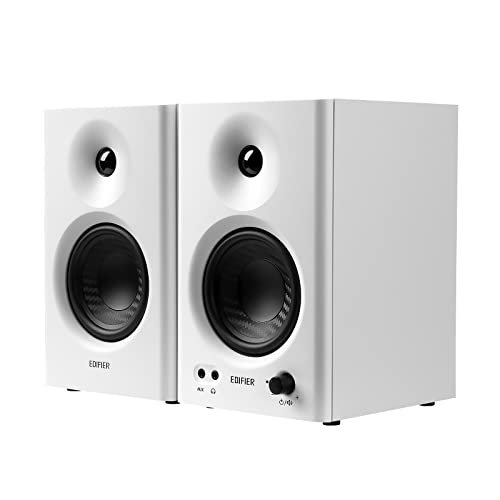
- Near-flat tuning for music creation
- TRS, RCA, AUX, and headphone connections
- Switchable monitor and music modes
Best For: Home studios and desktop music creators
Small-Studio Simplicity

- Compact 3.5-inch desktop monitors
- Tone knob and location switch
- Includes isolation pads and cables
Best For: Desks, small studios, and casual listening
Connected Monitoring Flexibility

- Hi-Res audio with 52Hz–40kHz response
- Bluetooth multipoint and wired inputs
- App EQ plus Monitor, Music, and Custom modes
Best For: Connected home studios and near-field listening
Balanced Desktop Reference

- 50W Class AB stereo amplification
- TRS, RCA, and auxiliary inputs
- High- and low-frequency room tuning
Best For: Home studios and flexible desktop listening setups
Compact Yamaha Accuracy
Yamaha HS4 Powered Studio Monitor

- 4.5-inch woofer and 1-inch dome tweeter
- Room Control and high-trim adjustments
- XLR/TRS, RCA, and stereo-mini inputs
Best For: Small music-production and video-editing workstations
Small-Space Starter Monitors

- 50W built-in stereo amplification
- Compact 3.5-inch woofer design
- TRS, RCA, auxiliary, and headphone connections
Best For: Desktop multimedia, gaming, and entry-level production
Wide-Sweet-Spot Precision – JBL 305P MkII Pair
The JBL 305P MkII pair is a strong choice for studio monitors when you want clear stereo imaging, a broad listening sweet spot, and room-adjustment controls. Its 5-inch woofer, Slip Stream port, and dual 41-watt Class-D amplifiers suit music production, podcasting, and cinematic sound design.
Best For: Producers, podcasters, and creators who need accurate nearfield monitoring in a desktop studio.
Pros:
- Image Control Waveguide provides precise imaging and a wide sweet spot.
- Boundary EQ and HF Trim help tailor the sound to the room.
- Balanced XLR and 1/4-inch TRS inputs support common studio connections.
- Sold as a pair with a stated five-year warranty.
Cons:
- They are wired monitors and require AC power.
- The 5-inch woofer may offer less low-end authority than larger monitors.
- The speakers are not water resistant.
The 305P MkII pair balances practical room tuning with focused, spacious monitoring. It is especially appealing when consistent stereo imaging matters more than adding a larger low-frequency driver.
Uncolored Monitoring – Yamaha HS5 Pair
The Yamaha HS5 pair is designed for studio monitors buyers who prioritize sonic purity over an embellished presentation. Each monitor combines a 5-inch woofer and 1-inch dome tweeter with bi-amplified power and balanced XLR or TRS inputs.
Best For: Music producers and engineers seeking a straightforward nearfield reference for mixing and studio monitoring.
Pros:
- Emphasizes the original sound without intentional coloring.
- Bi-amplified 70-watt system supports high-performance monitoring.
- 54 Hz to 30 kHz frequency response covers a broad range.
- Accepts balanced or unbalanced XLR and TRS connections.
Cons:
- The 5-inch design may not satisfy users seeking especially deep bass.
- These are wired monitors rather than wireless speakers.
- The supplied specifications describe them as not water resistant.
The HS5 pair is a sensible fit for listeners who want a clean reference rather than a heavily colored sound. Its compact driver configuration and balanced inputs make it practical for a focused monitoring setup.
Expanded Low-End Workspace – PreSonus Eris E7 XT
PreSonus Eris E7 XT 2-Way Active Studio Monitor with EBM Waveguide (Pack of 1)
Check Price On AmazonThe PreSonus Eris E7 XT is a larger-format option among studio monitors, using a 6.55-inch woven composite driver and a 1.25-inch silk-dome tweeter. Its EBM waveguide is designed for a wide sweet spot, while multiple acoustic controls help adapt the monitor to the room.
Best For: Producers who want a larger monitor with deeper low-frequency capability and flexible acoustic tuning.
Pros:
- 6.55-inch low-frequency driver supports deeper lows than smaller models.
- 100-degree horizontal by 60-degree vertical EBM waveguide offers a wide sweet spot.
- Level, HPF, LF Trim, HF Trim, and Acoustic Space controls aid room setup.
- Includes Studio One Prime and the Studio Magic plug-in suite.
Cons:
- This listing is for one monitor, so a stereo pair requires two units.
- The larger cabinet may need more desk or stand space.
- It has a one-year manufacturer warranty.
The Eris E7 XT stands out when you need more driver area and room-control flexibility than compact studio monitors provide. Confirm that the single-monitor package matches your stereo setup plans before buying.
Compact Desktop Flexibility – M-AUDIO BX3 Pair
The M-AUDIO BX3 pair brings studio monitors functionality to smaller desktop setups. Its 3.5-inch Kevlar woofers, silk-dome tweeters, front headphone access, and multiple rear inputs make it useful for music production, podcasting, gaming, streaming, and general computer audio.
Best For: Desktop creators who need compact, versatile speakers with easy headphone and source connectivity.
Pros:
- Compact 3.5-inch Kevlar woofers suit space-conscious desktops.
- Includes 1/4-inch, 1/8-inch, and RCA inputs for flexible connections.
- Front headphone and auxiliary access supports convenient late-night use.
- Includes cables, foam feet, and MPC Beats software.
Cons:
- The smaller woofers provide less low-end reach than larger studio monitors.
- One speaker is passive and must connect to the active speaker.
- The system is intended for wired use and is not water resistant.
The BX3 pair is a practical entry point for desktop studio monitors when convenience and connectivity are priorities. It is better suited to nearfield computer listening than to filling a large room with bass-heavy sound.
Balanced Desk Monitoring – Edifier MR4
The Edifier MR4 is a practical choice for creators seeking compact studio monitors with a near-flat response and flexible wired connectivity. Its 4-inch composite woofers, silk-dome tweeters, MDF structure, and separate high- and low-frequency controls support both production work and everyday listening.
Best For: Home studios, music creators, and desktop listeners who want flexible connections and selectable monitor or music modes.
Pros:
- Near-flat tuning is designed for music production and monitoring.
- Includes balanced TRS, RCA, AUX, and front headphone connections.
- Offers separate high- and low-frequency controls plus monitor and music modes.
- MDF construction helps reduce resonance.
Cons:
- These are corded speakers without waterproofing.
- The 4-inch woofers may be less suitable for listeners seeking very deep bass.
The MR4 stands out among compact studio monitors for combining creator-focused tuning with convenient everyday controls and several input options.
Small-Studio Simplicity – Mackie CR3.5
The Mackie CR3.5 is a compact pair of studio monitors sized for desks and small studios. With 3.5-inch woofers, a tone knob, a location switch for bass adjustment, and included isolation pads and cables, it is designed for a straightforward setup.
Best For: Desktop producers, small home studios, and listeners who want simple controls for monitoring and casual playback.
Pros:
- Sold as a complete pair for desk and small-studio use.
- Tone knob allows voicing adjustments without menus.
- Location switch helps correct bass placement against a wall or in open space.
- Includes isolation pads and the cables needed to get started.
Cons:
- 3.5-inch woofers provide a smaller format than larger studio monitors.
- Connectivity is limited to RCA and TRS inputs.
The CR3.5 prioritizes easy placement and uncomplicated operation, making it a sensible option when desk space and setup simplicity matter.
Connected Monitoring Flexibility – Edifier MR3
The Edifier MR3 combines studio-monitor functions with Hi-Res audio certification and Bluetooth connectivity. Its 3.5-inch mid-low drivers, 1-inch tweeters, multiple wired inputs, selectable listening modes, and app-based EQ make it adaptable for production, editing, and daily use.
Best For: Home studios and near-field listeners who need Bluetooth alongside balanced TRS, RCA, AUX, and headphone connections.
Pros:
- Hi-Res Audio certified with a stated 52Hz–40kHz flat response.
- Supports Bluetooth multipoint plus balanced TRS, RCA, and AUX inputs.
- Offers Monitor, Music, and Custom modes with app-based EQ adjustments.
- MDF cabinetry is designed to reduce distortion.
Cons:
- Bluetooth range is listed at up to 10 meters.
- The 3.5-inch mid-low drivers may not suit listeners wanting a larger low-end presentation.
The MR3 is a versatile pick among studio monitors, especially for users who want accurate monitoring features without giving up wireless playback and app control.
Balanced Desktop Reference – PreSonus Eris E4.5
The PreSonus Eris E4.5 is a flexible pair of studio monitors for music production, hi-fi listening, and multimedia setups. Its 4.5-inch woven-composite woofers, silk-dome tweeters, room-tuning controls, and multiple input options make it a practical choice for a desk, bookshelf, or turntable system.
Best For: Home studios and desktop listeners who want adjustable, room-filling sound with broad connectivity.
Pros:
- 50 watts of Class AB amplification provides clear, balanced volume.
- Balanced TRS, RCA, and front-panel auxiliary inputs support professional and consumer sources.
- High- and low-frequency controls help tailor the sound to your room.
- Front headphone output and integrated headphone amplifier make private monitoring convenient.
Cons:
- The pair uses one active speaker and one passive speaker, so placement requires the included speaker cable.
- Bluetooth is not listed among the supplied connectivity features for the monitors themselves.
The Eris E4.5 stands out as an adaptable all-purpose option: it offers more connection flexibility and tuning control than a basic desktop speaker set, while remaining compact enough for near-field listening.
Compact Yamaha Accuracy – Yamaha HS4 Powered Studio Monitor
The Yamaha HS4 is a compact pair of powered studio monitors designed for music production and video editing. With 4.5-inch woofers, 1-inch dome tweeters, room controls, and XLR/TRS, RCA, and stereo-mini inputs, it fits neatly into a small DAW or media workstation.
Best For: Compact production desks and editing stations that need multiple wired input options.
Pros:
- Two-way design combines a 4.5-inch cone woofer with a 1-inch dome tweeter.
- Room Control and high-trim controls allow basic response adjustment.
- XLR/TRS combo, RCA, and stereo-mini inputs accommodate varied sources.
- Includes speaker cable, stereo mini-to-RCA cable, and anti-slip pads.
Cons:
- The supplied output specification is 26 watts and above, which may be less suitable for very large rooms.
- The compact cabinet and 60 Hz–22 kHz stated response may not satisfy users seeking deep sub-bass.
The HS4 is a sensible space-conscious choice for near-field work. Its input selection and tuning controls make it easier to integrate into a modern workstation without adding extra equipment.
Small-Space Starter Monitors – PreSonus Eris 3.5
The PreSonus Eris 3.5 is a compact pair of active studio monitors for desktops, bookshelves, gaming, movies, streaming, and entry-level music production. Its 3.5-inch woven-composite woofers, 1-inch silk-dome tweeters, tuning controls, and front headphone jack keep a small setup versatile.
Best For: Desktop users who want studio-style sound in a compact stereo pair for everyday media and creative work.
Pros:
- 50 watts of built-in amplification delivers clear, dynamic sound.
- Balanced TRS, RCA, and front-panel auxiliary inputs connect to computers, interfaces, consoles, phones, and turntables.
- High- and low-frequency controls help adapt the monitors to different rooms.
- Front headphone output supports convenient private listening.
Cons:
- The 3.5-inch woofers are less suited to listeners who need substantial low-end extension.
- The supplied frequency response is listed as 80 Hz–20 kHz, so a subwoofer may be desirable for bass-heavy work.
The Eris 3.5 makes the most sense when desk space and versatility matter more than large-speaker scale. It is an accessible way to add active studio monitors to a computer, gaming, or multimedia setup.
How We Picked These Studio Monitors
We selected monitors across several practical categories, including compact desktop speakers, entry-level near-field pairs, and larger models designed for more headroom and extended low-frequency response. We considered driver size, active amplification, connection options, adjustment controls, cabinet design, and intended listening distance.
Because room acoustics strongly affect monitor performance, we also prioritized models with useful placement or tuning controls where available. The list includes pairs as well as clearly identified single-monitor listings, so check the package contents before ordering.
Quick Comparison
| Best For | Recommended Options | What to Look For |
|---|---|---|
| Budget desktop production | M-Audio BX3, PreSonus Eris 3.5, Mackie CR3.5 | Compact footprint and convenient inputs |
| Balanced home-studio monitoring | JBL 305P MkII, Yamaha HS5, PreSonus Eris E4.5 | Accurate near-field response and room placement |
| More low-end reach | PreSonus Eris E7 XT | Larger woofer and increased output |
| Flexible everyday listening | Edifier MR3 | Bluetooth plus wired connectivity |
| Small but capable setup | Edifier MR4, Yamaha HS4 | Compact dimensions with studio-focused voicing |
Key Buying Factors for Studio Monitors
Woofer Size and Output
Three- to four-inch monitors suit small desks, bedrooms, and short listening distances. Five-inch models are a versatile choice for many home studios, while seven-inch monitors can provide stronger bass and higher output but need more space and careful positioning.
Accuracy Versus Convenience
Dedicated Studio Monitors are designed for revealing frequency problems rather than adding dramatic coloration. Bluetooth and multimedia features are useful for general listening, but prioritize balanced wired performance if mixing accuracy is your main goal.
Connections and Controls
Check whether the inputs match your audio interface, mixer, computer, or other source. Balanced TRS or XLR connections can help reduce noise in longer cable runs. Volume, high-frequency, low-frequency, and acoustic-space controls are valuable when your room or desk placement is less than ideal.
Room Size and Placement
Near-field monitors should generally form an equal-sided triangle with your listening position and sit at ear level. Keep them away from walls when possible, use isolation pads or stands, and avoid choosing a larger model solely for extra bass in a small untreated room.
Who Should Buy Which Studio Monitors?
Choose a compact pair such as the M-Audio BX3, Mackie CR3.5, PreSonus Eris 3.5, Edifier MR4, or Yamaha HS4 if you have limited desk space or produce at modest volume.
Choose a five-inch class monitor such as the JBL 305P MkII or Yamaha HS5 for a more conventional home-studio setup and a useful balance of detail, output, and manageable size. The PreSonus Eris E4.5 is another practical middle ground for smaller rooms.
Choose a larger monitor such as the PreSonus Eris E7 XT if you need greater output and deeper bass, provided your room can accommodate it. Choose the Edifier MR3 if Bluetooth and everyday listening flexibility matter alongside wired monitoring.
Finally, remember that monitor placement and room treatment can make as much difference as the speaker itself. Buy the model that fits your room, listening distance, and workflow—not simply the one with the largest driver.