Finding the right synthesizer under $1,000 means balancing sound design, keyboard size, connectivity, workflow, and portability. This roundup compares ten affordable options spanning analog, digital, FM, and hybrid approaches.
Whether you are building a first hardware setup, adding hands-on control to a studio, or need a compact instrument for live performance, these picks cover a wide range of creative needs without moving into premium pricing.
Best 10 Synthesizers Under 1000 Picks for 2026
Analog Polyphony Pick

- Warm four-voice analog sound
- 200 presets and flexible sound editing
- Built-in polyphonic step and motion sequencer
Best For: Hands-on analog synthesis and compact live or studio setups
Production Workstation Pick

- 128-note polyphony for complex performances
- USB audio and MIDI work without drivers
- Motif engine supports layered, zoned sounds
Best For: Computer-based production and versatile live arrangements
Live Performance Pick

- Over 3,800 ZEN-Core sounds
- Portable 61-note keyboard with synth action
- USB-C, WAV import, and eight-track sequencing
Best For: Gigging keyboardists needing broad stage-ready sounds
Expressive Monosynth Pick

- Two wavefolding VCOs plus sub-oscillator
- 32 keys with velocity and aftertouch
- 64-step sequencer and extensive CV/MIDI connectivity
Best For: Expressive analog basses, leads, and sequence-based performances
Experimental Hybrid Pick
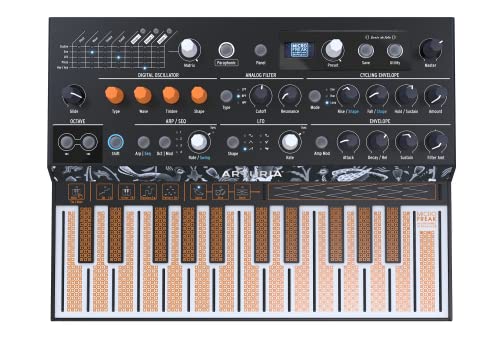
- 17 digital oscillator modes with analog filter
- 25-key PCB keyboard with poly-aftertouch
- USB, MIDI, and CV connectivity
Best For: Experimental sound design and compact hybrid setups
Hands-On Analog Sequencer

- Monophonic analog design for bass and leads
- Bite-focused filter with added drive
- 16-step editing and motion sequencing
Best For: Direct analog sequencing and performance
Portable Vintage-Style Pick

- JUPITER-8-inspired eight-voice architecture
- K-25m keyboard dock and built-in speakers
- Effects, sequencing, USB-C, and MIDI
Best For: Portable vintage-style performance setups
Analog Polyphonic Powerhouse

- Eight-voice analog polyphony
- Dual VCOs per voice
- Arpeggiator, sequencer, and 400 memories
Best For: Classic analog chords, basses, and leads
Portable FM Playground

- Six-operator FM engine
- Built-in speaker and battery
- Bluetooth, USB, and 3.5mm MIDI
Best For: Portable practice and beginner-friendly FM sound design
Pocket FM Workstation

- 12-voice, six-operator FM synthesis
- Up to 12-hour rechargeable battery
- Sequencer, arpeggiator, and six effects
Best For: Portable production, practice, and live electronic performance
Analog Polyphony Pick – Korg Minilogue
For musicians searching for synthesizers under 1000, the Korg Minilogue offers hands-on analog sound design in a compact 37-key format. Its four-voice polyphony, 200 presets, built-in sequencing, and tape-style delay make it practical for both studio work and live performance.
Best For: Beginners and experienced players who want warm analog tones, polyphonic playing, and an integrated sequencer.
Pros:
- True analog sound with warm, punchy character
- Four-voice polyphony and 200 presets support varied arrangements
- Polyphonic step and motion sequencer can record, save, and recall sequences
- Compact design includes slim keys, tape-style delay, and an oscilloscope display
Cons:
- Four voices may be limiting for dense, sustained arrangements
- Its 37-key format provides less playing range than larger keyboards
The Minilogue is a strong all-around choice when tactile analog controls and built-in performance tools matter more than extensive keyboard range or high polyphony.
Production Workstation Pick – Yamaha MX49
The Yamaha MX49 is a practical option among synthesizers under 1000 for players who need broad digital sounds and computer integration. Its Motif sound engine, 128-note polyphony, USB audio/MIDI, and support for stereo audio plus 16 channels of MIDI make it suited to production and live arrangements.
Best For: Home producers and performers who want a lightweight 49-key instrument with extensive digital sequencing and USB connectivity.
Pros:
- 128-note polyphony helps support live playing and full 16-track sequences
- Class-compliant USB provides plug-and-play audio and MIDI connectivity
- Motif sound engine supports layering, zoning, switching, and control of up to eight elements
- Virtual Circuit Modeling recreates vintage effects and signal processors
Cons:
- The supplied notes do not describe a built-in sequencer or onboard speakers
- Its engineered-wood construction and 12.5-pound weight may be less convenient than ultralight controllers
The MX49 favors versatility and computer-based production over purely analog sound design, making it a capable choice for keyboardists building arrangements around USB-connected gear.
Live Performance Pick – Roland JUNO-D6
For players comparing synthesizers under 1000 for gigs, the Roland JUNO-D6 focuses on quick access to stage-ready sounds and a portable workflow. Its 61-note synth-action keyboard, ZEN-Core engine, USB-C connectivity, user WAV import, and eight-track sequencer cover a wide range of performance and songwriting needs.
Best For: Gigging keyboardists who need pianos, organs, synths, sequencing, and mobile-friendly connectivity in one keyboard.
Pros:
- Over 3,800 onboard sounds include acoustic and electric pianos, organs, and synths
- 61-note keyboard offers more range than compact synth-action models
- USB-C supports audio/MIDI connections and mobile battery power
- Eight-track sequencer, sample import, and expandable Roland Cloud library add flexibility
Cons:
- It uses synth-action keys rather than weighted piano-style action
- Sound Packs and Wave Expansions require the Roland Cloud ecosystem
The JUNO-D6 is especially compelling for performers who prioritize sound variety, fast operation, and portability over a traditional analog signal path.
Expressive Monosynth Pick – Moog Messenger
The Moog Messenger is a focused choice among synthesizers under 1000 for players who want powerful monophonic analog tones and direct knob-per-function control. Its two wavefolding VCOs, sub-oscillator, flexible ladder filter, expressive 32-key keyboard, and 64-step sequencer provide substantial sound-shaping depth.
Best For: Bass players, lead-synth performers, and producers who want expressive Moog-style analog synthesis with modern sequencing and connectivity.
Pros:
- Two continuously variable-shape VCOs include sync, frequency modulation, and a sub-oscillator
- Ladder filter offers low-pass, band-pass, and high-pass responses with resonance bass compensation
- 32 full-size semi-weighted keys include velocity and aftertouch
- 64-step sequencer, arpeggiator, CV patch points, MIDI, and USB-C support flexible setups
Cons:
- Monophonic operation is not suited to playing chords
- The 5.14 kg body is less portable than some compact synthesizers
- Its feature-rich design may be more than beginners need for simple sounds
The Messenger stands out for expressive leads, basses, and evolving sequences, especially when hands-on analog control and external CV integration are higher priorities than polyphony.
Experimental Hybrid Pick – Arturia MicroFreak
For shoppers comparing synthesizers under 1000, the Arturia MicroFreak stands out as a compact instrument for unconventional sound design. Its digital oscillator offers 17 modes, paired with a resonant analog filter, while the touch-sensitive 25-key PCB keyboard adds individual pressure and aftertouch control.
Best For: Experimental producers, sound designers, and players who want hybrid synthesis, deep modulation, and CV connectivity in a lightweight format.
Pros:
- Combines physical modeling, wavetable, vocoder, and other oscillator modes with an analog filter.
- 25-key touch keyboard supports poly-aftertouch and pressure sensing.
- Includes a modulation matrix, automation recording, Spice and Dice functions, USB, MIDI, and CV outputs.
Cons:
- The flat PCB keyboard may feel less traditional than a moving-key design.
- Its advanced modulation and sequencing features may be more suitable for experienced users.
The MicroFreak is a strong choice when versatility and experimentation matter more than conventional keyboard feel. Its compact size, broad oscillator selection, and modular-friendly connections make it particularly adaptable for studio and hardware setups.
Hands-On Analog Sequencer – Korg Monologue
Among synthesizers under 1000, the Korg monologue is a focused monophonic analog option for basses, leads, and sequenced patterns. Its redesigned filter, added drive, expanded LFO, and 16-step controls emphasize direct, hands-on programming.
Best For: Producers and performers who want a straightforward monophonic analog synth with real-time step editing and motion sequencing.
Pros:
- 2-pole filter is designed for added bite, while the drive control supports richer bass and cutting leads.
- Expanded LFO capabilities provide higher rates and deeper modulation.
- 16 step buttons support fast real-time edits, with parameter-lock-style motion sequencing.
Cons:
- Monophonic architecture limits it to one note at a time.
- Its feature set is more focused than the broader hybrid or polyphonic instruments in this roundup.
The monologue makes sense for players who value immediacy and a dedicated sequencing workflow. It is especially well suited to punchy bass lines, cutting leads, and evolving parameter movement without unnecessary complexity.
Portable Vintage-Style Pick – Roland JUPITER-08
For buyers searching synthesizers under 1000 with a portable performance setup, the Roland JUPITER-08 combines JUPITER-8-inspired sounds with modern features. It includes the K-25m keyboard dock, built-in speakers, onboard effects, sequencing, and USB-C audio/MIDI connectivity.
Best For: Players who want a compact standalone synth with vintage-style character, built-in speakers, and flexible modern connections.
Pros:
- Eight-voice, two-part architecture can expand to 32 voices using the poly mode parameter.
- Includes a 17-type MFX engine, delay, dedicated reverb, and shimmer mode.
- Comes with a K-25m keyboard dock, built-in speakers, USB-C audio/MIDI, and traditional MIDI I/O.
Cons:
- Its mini format and 5.1-pound weight may not replace a full-size keyboard setup.
- The instrument emphasizes analog-style vintage characteristics rather than a fully analog architecture.
The JUPITER-08 is appealing when portability and immediate performance features are priorities. Its included keyboard dock, effects, speakers, and expanded connectivity make it a convenient choice for mobile use, sketching, and compact live setups.
Analog Polyphonic Powerhouse – PRO-800
The Behringer PRO-800 is a strong choice for musicians searching for synthesizers under 1000 with classic analog character. Its eight-voice polyphony, dual VCOs per voice, and authentic VCO, VCF, and VCA designs are suited to rich chords, basses, leads, and detuned textures.
Best For: Players who want an affordable, classic-style analog polyphonic synthesizer for studio sound design and performance.
Pros:
- Eight-voice polyphony supports full chords and layered parts.
- Pure analog signal path with two VCOs per voice delivers fat, detuned tones.
- Includes unison mode, arpeggiator, sequencer, and 400 program memories.
- Offers multiple saw, triangle, and pulse oscillator shapes.
Cons:
- Its Eurorack-format design may require additional setup depending on your workspace.
- The supplied notes do not specify an included power or mounting arrangement.
The PRO-800 stands out when authentic analog architecture and polyphonic playability matter more than portability. It is particularly compelling for producers who want substantial vintage-style synthesis features in a dedicated instrument.
Portable FM Playground – M-VAVE FM Synthesizer
For shoppers comparing synthesizers under 1000, this compact M-VAVE FM synthesizer offers a convenient way to explore classic digital FM sounds. It combines six-operator synthesis, 128 presets, built-in effects, sequencing, and battery-powered operation in a portable unit with a built-in speaker.
Best For: Beginners, mobile producers, and performers who want an all-in-one FM synth for travel, practice, or quick music sketches.
Pros:
- Six operators and 32 algorithms provide a broad range of FM textures.
- Portable battery-powered design includes a built-in speaker and 27 silicone keys.
- Offers 128 presets, six effects, an arpeggiator, and a 16-step sequencer.
- Supports USB MIDI, Bluetooth MIDI, and 3.5mm MIDI input simultaneously.
Cons:
- The compact 27-key layout is less suitable for full-size keyboard performance.
- Its plastic and silicone construction may feel less substantial than a larger studio synthesizer.
This model prioritizes accessibility and portability over traditional full-size controls. Its combination of FM editing, onboard rhythm tools, wireless connectivity, and battery operation makes it a practical sketching instrument.
Pocket FM Workstation – M-VAVE FM-1 Orange
The M-VAVE FM-1 Orange is worth considering among synthesizers under 1000 if you need a highly portable production setup. It pairs six-operator FM synthesis and 12-voice polyphony with preset editing, sequencing, effects, Bluetooth MIDI, and a rechargeable battery rated for up to 12 hours.
Best For: Mobile creators, bedroom producers, and live performers who want a compact FM workstation with flexible connectivity.
Pros:
- Six operators, 32 algorithms, 128 presets, and 145-parameter tone editing support detailed sound design.
- Up to 12-voice polyphony accommodates both melody and chord playing.
- Includes a seven-mode arpeggiator, 16-step sequencer, and six built-in effects.
- Compact 251g body offers a built-in speaker, headphone output, USB-C, and Bluetooth MIDI.
Cons:
- The 27-key silicone keyboard is compact rather than full-sized.
- Its small form factor may be less comfortable for extended hands-on programming.
The FM-1 Orange is a particularly complete portable option, integrating sound generation, sequencing, effects, audio playback, and multiple MIDI paths. It makes the most sense when mobility and an all-in-one workflow are priorities.
How We Picked the Best Synthesizers Under 1000
We selected instruments across several categories rather than ranking them by price alone. The lineup includes polyphonic and monophonic analog synthesizers, digital and FM instruments, portable models, and larger keyboards suited to performance or production. We considered sound-engine flexibility, playable range, sequencing and arpeggiation, preset access, hands-on controls, portability, connectivity, and overall usefulness for the money.
Because synthesizers serve different purposes, the best choice depends on how you plan to make music. A compact monosynth can be ideal for bass and leads, while a 61-note workstation-style keyboard may be more practical for full arrangements and live playing.
Quick Comparison
- Best for analog polyphony: Korg minilogue or Behringer PRO-800.
- Best for broad keyboard performance: Roland JUNO-D6 or Yamaha MX49BK.
- Best for experimental sound design: Arturia MicroFreak.
- Best for focused bass and lead sounds: Moog Messenger or Korg monologue.
- Best for portable experimentation: Roland JUPITER-08 or an M-VAVE FM model.
Key Buying Factors for Synthesizers Under 1000
Polyphony and Keyboard Range
Monophonic instruments play one note at a time but often provide a direct, expressive workflow for basses and leads. Polyphonic models are better for chords, pads, and layered parts. Also check the key count: 25- or 37-key designs save space, while 49- and 61-key keyboards offer more range for two-handed playing.
Sound Engine and Controls
Analog oscillators and filters are valued for immediate, hands-on tone shaping. Digital and FM engines can provide more complex textures, presets, effects, and broader sonic variety. Look for dedicated knobs, modulation options, patch storage, and an interface you will actually enjoy using.
Sequencing, Connectivity, and Portability
A built-in sequencer or arpeggiator can make a compact synth much more productive. Confirm whether the instrument includes MIDI, USB, audio outputs, Bluetooth, or battery operation if those features matter to your setup. Portable models are convenient, but smaller keyboards and speakers may involve compromises in playability or output flexibility.
Who Should Buy Which Synthesizers Under 1000?
Choose the Korg minilogue or PRO-800 if you want affordable polyphonic analog chords, pads, and classic subtractive synthesis. Choose the JUNO-D6 or MX49BK if you need a broader performance keyboard with extensive sounds and a larger playing range.
Choose the MicroFreak for unconventional digital textures and experimental sequencing. Choose the Moog Messenger or Korg monologue for focused monophonic basses, leads, and tactile sound design. Choose the JUPITER-08 or M-VAVE models when portability, compact practice, and mobile-friendly music making are priorities.
Before buying, confirm current pricing, included accessories, power requirements, and the connections required by your setup. The most useful instrument is the one that fits both your music and your available space.