If you need a simple way to add high-capacity storage to a desktop, workstation, or home media setup, USB-C multi-bay enclosures are a practical alternative to full network storage gear.
Below, we focus on the best options for speed, compatibility, RAID support, and real-world value so you can choose the right enclosure for backups, editing, or expansion.
Best 10 USB C Nas Enclosures Picks for 2026
Best All-in-One RAID Option
UGREEN 5-Bay USB-C DAS Enclosure

- 8 RAID and storage modes
- Up to 160TB across five bays
- Smart cooling with status LEDs
Best For: Large-capacity users who want RAID flexibility
Best Quiet Plug-and-Play Pick
TerraMaster D4-320 4-Bay Enclosure

- 10Gbps USB 3.2 Gen 2
- Hot-swappable, tool-free trays
- Quiet cooling with no RAID
Best For: Users who want simple, quiet four-bay storage
Best Hardware RAID Choice
- Hardware RAID with 5 modes
- USB-C for Mac, Windows, Linux
- Lockable bays and NAS backup use
Best For: RAID-minded users and QNAP backup setups
Best Trayless Everyday Dock
Sabrent 4-Bay USB-C 10Gbps Enclosure
- Independent controllers per bay
- Trayless hot-swap with locks
- 10Gbps USB-C, no RAID
Best For: People who want a rugged JBOD-style dock
Top High-Speed Two-Bay Pick
TERRAMASTER D2-320 USB RAID Enclosure 2-Bay

- 10Gbps USB 3.2 Gen 2 Type-C
- RAID 0, RAID 1, JBOD, Single
- Tool-free trays with temperature-controlled fan
Best For: Fast local storage with RAID flexibility
Best Cloning Dock
ORICO USB C 5 Bay Hard Drive Docking Station

- 1:4 offline hard drive duplication
- Up to 100TB across five bays
- USB-C and USB-A cable support
Best For: Cloning and bulk drive expansion
Best 5-Bay Premium DAS
SABRENT 5-Bay USB-C 10Gbps 3.5in Hard Drive Enclosure & DAS Dock

- Five independent 3.5-inch drive bays
- 10Gbps USB-C with trayless hot-swap
- Quiet PWM cooling with per-bay power switches
Best For: Power users needing premium five-bay DAS access
Quad-Bay USB-C Storage Dock
WAVLINK 4-Bay 10Gbps Enclosure with HDMI

- Four-bay support for 3.5-inch and 2.5-inch SATA drives
- 10Gbps USB-C 3.2 transfer speed with HDMI output
- Dual fans, aluminum shell, and independent bay switches
Best For: buyers who want a 4-bay USB-C enclosure with HDMI and active cooling
High-Capacity USB-C DAS
ORICO 4-Bay 10Gbps Aluminum Enclosure

- Up to 88TB per unit and 264TB with daisy-chain expansion
- USB-C plug-and-play support for Windows, macOS, and Linux
- Aluminum body with 80mm fan for cooling and stability
Best For: people building a large-capacity USB-C storage setup with room to expand
Flexible Mixed-Drive Enclosure

- Supports both 3.5-inch and 2.5-inch SATA HDDs/SSDs
- 10Gbps USB-C 3.2 with HDMI display output
- Dual fans, aluminum shell, and independent power switches
Best For: users who need a mixed-drive USB-C enclosure with storage and display features
Best All-in-One RAID Option – UGREEN 5-Bay USB-C DAS Enclosure
If you want usb c nas enclosures for flexible local storage, the UGREEN 5-bay unit stands out as a feature-rich DAS rather than a NAS. It supports eight storage modes, 5Gbps USB-C connectivity, and up to 160TB total capacity, making it a strong fit for users who want to reuse multiple SATA drives in one place.
Best For: Users who want maximum RAID flexibility and large-capacity multi-drive storage.
Pros:
- Supports 8 modes, including RAID 0/1/3/5/10, PM, Large, and Clone.
- Holds up to five 2.5/3.5-inch SATA HDDs or SSDs, with up to 160TB total capacity.
- USB 3.2 Gen 1 Type-C connection works with Windows, macOS, and Linux.
- Smart cooling adjusts fan speed based on drive temperature.
Cons:
- It is a DAS, so the drives cannot be added to or managed as part of a NAS storage pool.
- Changing RAID modes requires reformatting, so backups are essential.
Overall, this is the most versatile choice here if your priority is storage modes, capacity, and RAID-based protection in a USB-C enclosure.
Best Quiet Plug-and-Play Pick – TerraMaster D4-320 4-Bay Enclosure
For buyers comparing usb c nas enclosures, the TerraMaster D4-320 is a straightforward 4-bay DAS focused on speed and simplicity. It uses USB 3.2 Gen 2 for up to 10Gbps throughput, supports hot swapping, and skips RAID entirely for users who want individual drives to stay independent.
Best For: People who want a quiet, easy-to-use four-bay enclosure with fast USB-C performance.
Pros:
- USB 3.2 Gen 2 connection supports up to 10Gbps transfer speeds.
- Plug-and-play design with no drivers required on Mac, Windows, or Linux.
- Hot-swappable and tool-free for quick drive changes.
- Quiet operation with sound-absorbing panels and a temperature-controlled fan.
Cons:
- No RAID function, so it is not intended for mirrored or parity-based setups.
- Only four bays, which limits total expansion versus larger enclosures.
If you want a simple USB-C storage box that emphasizes speed, convenience, and low noise, the D4-320 is an easy recommendation.
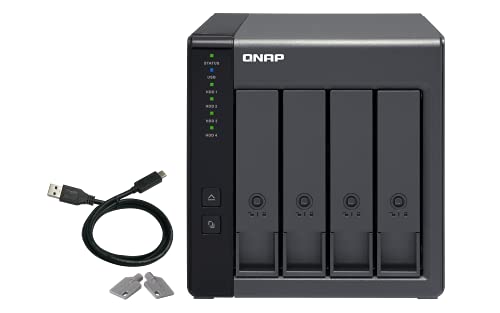
Best Hardware RAID Choice – QNAP TR-004 4-Bay USB-C DAS
QNAP TR-004 4 Bay USB Type-C Direct Attached Storage (DAS) with hardware RAID (Diskless)
Check Price On AmazonIf you are shopping usb c nas enclosures and want hardware RAID support, the QNAP TR-004 is a practical 4-bay DAS with a USB Type-C connection. It supports RAID 0, 1, 5, JBOD, and individual disks, and it can also be used as external storage for NAS backup or capacity expansion on compatible QNAP systems.
Best For: Users who want a RAID-capable USB-C enclosure for backup or QNAP expansion.
Pros:
- Hardware RAID support includes RAID 0, 1, 5, JBOD, and individual disks.
- USB Type-C connection works with Windows, macOS, and Linux.
- Can be used as external storage for NAS backup or to expand compatible QNAP NAS capacity.
- Lockable drive bays add a security-oriented touch.
Cons:
- Compatibility is limited with some older QNAP models and non-updatable NAS units.
- It cannot be combined into a connected NAS storage pool or used for NAS apps.
The TR-004 makes the most sense if you value hardware RAID and are comfortable working within QNAP’s supported use cases.
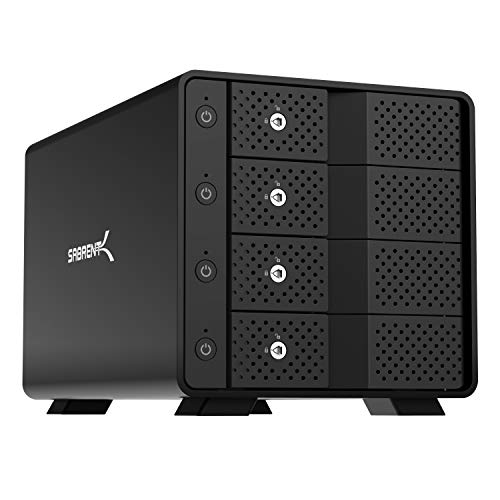
Best Trayless Everyday Dock – Sabrent 4-Bay USB-C 10Gbps Enclosure
Among usb c nas enclosures, the Sabrent DS-SC4B is built for users who want independent drive access with simple, reliable daily use. It offers four 3.5-inch bays, 10Gbps USB-C performance, and per-bay controllers so each drive keeps its own connection instead of sharing RAID logic.
Best For: Users who want a durable trayless four-bay dock with independent drives.
Pros:
- Each bay has its own ASMedia ASM1351 controller for stable, independent drive access.
- 10Gbps USB 3.1 Gen 2 Type-C connection with support for Windows, macOS, and Linux.
- Trayless hot-swap design with per-bay switches, activity LEDs, a locking key, and Kensington slot.
- Aluminum-and-metal build with active cooling for 24/7 operation.
Cons:
- This is DAS/JBOD storage, not hardware RAID.
- Heavier and larger than some simpler four-bay enclosures.
For buyers who want a sturdy, security-conscious multi-drive dock without RAID complexity, the Sabrent is a well-rounded option.
Top High-Speed Two-Bay Pick – TERRAMASTER D2-320 USB RAID Enclosure 2-Bay
If you’re comparing usb c nas enclosures but want a direct-attached unit instead of a network box, the TERRAMASTER D2-320 is built for fast local storage and flexible RAID use. It connects over USB 3.2 Gen 2 at up to 10Gbps and supports RAID 0, RAID 1, JBOD, and Single, making it a practical fit for backups, mirrored storage, or speed-focused work.
Best For: Users who want a compact USB-C two-bay enclosure with RAID options and strong transfer speeds.
Pros:
- USB 3.2 Gen 2 Type-C connection with up to 10Gbps transfer speed
- Supports RAID 0, RAID 1, JBOD, and Single for flexible storage setups
- Tool-free tray design with push-lock drive retention
- Intelligent temperature-controlled fan for quieter cooling
Cons:
- It is a DAS, not a NAS, so it connects directly to one computer
- Only two drive bays, so expansion is limited
- Drives are not included
For buyers who want a straightforward USB-C enclosure with real RAID flexibility, this TerraMaster model stands out more for speed and simplicity than for network features. It’s a strong fit when your priority is local access, mirrored backups, or fast direct storage.
Best Cloning Dock – ORICO USB C 5 Bay Hard Drive Docking Station
For buyers browsing usb c nas enclosures who really need a high-capacity dock instead, the ORICO 5-bay station is focused on offline duplication, broad drive support, and easy expansion. It uses a USB 3.2 Gen 1 Type-C connection and can handle up to five SATA drives, which makes it especially useful for backup workflows and large media libraries.
Best For: Users who want a 5-bay USB-C dock for cloning, backups, and large-capacity drive expansion.
Pros:
- Supports 1:4 offline duplication without a computer
- Up to 5 x 20TB for 100TB total capacity expansion
- USB 3.2 Gen 1 Type-C to C connectivity plus C-to-A support
- Aluminum-alloy body with vertical design for heat dissipation
Cons:
- It is a docking station, so it is not a network-attached NAS
- USB 3.2 Gen 1 is slower than 10Gbps USB 3.2 Gen 2 models
- Compatible devices and details indicate a more desktop-focused setup
This ORICO model makes sense when your main goal is duplication and bulk storage rather than network sharing. If you need an easy way to manage multiple SATA drives from a USB-C port, it offers a lot of capacity and a very practical dock-style layout.
Best 5-Bay Premium DAS – SABRENT 5-Bay USB-C 10Gbps 3.5in Hard Drive Enclosure & DAS Dock
If you want usb c nas enclosures coverage but actually need direct-attached storage, the SABRENT 5-Bay DAS Dock is the most feature-rich option here. It offers five independent 3.5-inch bays over a 10Gbps USB-C connection, with trayless hot-swap access, per-bay power switches, and cooling designed for heavier transfer loads.
Best For: Power users who want a five-drive USB-C DAS with independent drive access and premium cooling.
Pros:
- Five independent bays with dedicated controller support
- 10Gbps USB-C connection with USB 3.1 Gen 2 support
- Trayless hot-swap design with per-bay power switches
- Quiet PWM 120mm fan for temperature-controlled cooling
Cons:
- It is a DAS, not a NAS, and does not include hardware RAID
- Drives are not included
- Large and heavy compared with smaller two-bay enclosures
This SABRENT unit is a strong pick when you want maximum direct-access flexibility without moving to a network appliance. It is especially appealing for users who value stable per-drive connections, easier maintenance, and a more premium five-bay build.
Quad-Bay USB-C Storage Dock – WAVLINK 4-Bay 10Gbps Enclosure with HDMI
If you want usb c nas enclosures that do more than just hold drives, this WAVLINK 4-bay model is built for high-capacity local storage, fast transfers, and desk-friendly expansion. It supports both 3.5-inch and 2.5-inch SATA drives, reaches up to 10Gbps over USB-C 3.2, and adds HDMI output for a more flexible workstation setup.
Best For: Users who want a 4-bay USB-C enclosure with HDMI output, hot-swap convenience, and built-in cooling.
Pros:
- Supports four SATA bays for 3.5-inch and 2.5-inch drives, with up to 128TB capacity.
- USB 3.2 Type-C connection delivers up to 10Gbps transfer speeds.
- Dual fans and aluminum construction are designed for better cooling during heavy use.
- Independent bay power switches make drive swapping more convenient.
Cons:
- 2.5-inch drives need additional mounting brackets, which are not included.
- HDMI output depends on host USB-C video support and the correct USB-C to C cable.
- Best fit for desktop-style setups rather than a compact portable enclosure.
This is a strong pick if you need a USB-C enclosure that combines storage expansion with extra display and peripheral options. The mix of hot-swap flexibility, cooling, and 10Gbps speed makes it practical for demanding everyday workflows.
High-Capacity USB-C DAS – ORICO 4-Bay 10Gbps Aluminum Enclosure
For usb c nas enclosures focused on raw capacity and simple expansion, this ORICO 4-bay DAS leans into large-volume storage with a clean USB-C setup. It supports 3.5-inch SATA HDDs, offers up to 88TB in a single unit, and can daisy-chain up to three devices for much larger storage builds.
Best For: Users who need a high-capacity 4-bay USB-C enclosure for large media libraries and multi-device expansion.
Pros:
- Up to 88TB in one enclosure, with daisy-chain expansion to 264TB.
- Plug-and-play design works without drivers on Windows, macOS, and Linux.
- Independent disk slots with eject support make single-drive replacement easier.
- Aluminum shell, 80mm fan, and ventilation are built for stable operation.
Cons:
- Designed for 3.5-inch HDDs only, so it is not as flexible for mixed-drive use.
- Bulk storage setup is less portable than smaller USB-C enclosures.
- Daisy-chaining adds complexity if you only need one enclosure.
This ORICO model is best when capacity matters more than extras. If you want a USB-C enclosure that scales well for large file sets and keeps setup straightforward, it has a very practical feature set.
Flexible Mixed-Drive Enclosure – WAVLINK 4-Bay 88TB USB-C Dock
If you are comparing usb c nas enclosures for mixed drive support, this WAVLINK 4-bay option stands out because it handles both 3.5-inch and 2.5-inch SATA HDDs and SSDs. It delivers 10Gbps USB-C 3.2 connectivity, supports up to 88TB, and adds HDMI output for setups that need storage and display in one unit.
Best For: Buyers who want a 4-bay USB-C enclosure for mixed SATA drives, fast transfers, and workstation-style connectivity.
Pros:
- Supports both 3.5-inch and 2.5-inch SATA HDDs/SSDs across four bays.
- Up to 88TB total capacity with 10Gbps USB-C 3.2 data transfer.
- Dual cooling fans and aluminum shell help with heat management.
- Independent on/off switches make hot-swapping more convenient.
Cons:
- 2.5-inch drives require extra mounting brackets that are not included.
- HDMI output only works when the host USB-C port supports video output and the correct cable is used.
- The feature set is geared more toward desk use than simple storage-only builds.
This is a good choice if you want the flexibility to mix drive types without giving up speed or cooling. Its combination of USB-C, HDMI, and hot-swap-friendly bay controls makes it versatile for a busy workspace.
How We Picked the Best USB C Nas Enclosures
We prioritized build quality, bay count, SATA compatibility, USB-C speed, RAID flexibility, cooling, and power delivery. For buyers comparing USB C Nas Enclosures, the most important question is not just capacity, but how well the enclosure handles sustained workloads and drive safety over time.
We also favored models that balance ease of setup with practical features such as tool-free access, temperature-controlled fans, hardware RAID, and support for both 2.5-inch and 3.5-inch drives where applicable.
Quick Comparison
In general, 2-bay models are better for compact backups and mirrored storage, while 4-bay and 5-bay units suit larger media libraries, photo archives, or expansion-heavy workflows. If you want simplicity, a direct-attached enclosure with basic RAID is usually the easiest path. If you need more room to grow, a higher-bay enclosure gives you more flexibility at the cost of size, power use, and price.
Best Use Cases by Size
- 2-bay: personal backups, small office storage, and starter RAID setups
- 4-bay: creative work, shared libraries, and balanced capacity-to-cost value
- 5-bay: larger archives, heavier expansion, and higher total capacity needs
Key Buying Factors for USB-C NAS Enclosures
Check drive support first. Some USB C Nas Enclosures work with both HDDs and SSDs, while others are optimized for 3.5-inch hard drives. Next, confirm the interface speed: 10Gbps USB-C is ideal for modern external storage, but actual performance still depends on the drives you install.
RAID support matters if you want redundancy or better read performance. Hardware RAID is generally simpler for users who want an appliance-like experience, while software-managed or basic JBOD-style setups may suit advanced users who want more control. Also look at cooling design, because multi-drive enclosures can run warm during long transfers. A quiet, effective fan and good ventilation are worth paying for.
Finally, consider total capacity, drive tray design, and power delivery. A larger enclosure may cost more upfront, but it can be more economical than replacing a smaller unit later.
Who Should Buy Which USB C Nas Enclosures?
If you want the easiest backup path, choose a 2-bay model with RAID 1 support. If you are building a media or editing library, a 4-bay enclosure is often the sweet spot for capacity and affordability. If you expect your storage needs to grow quickly, a 5-bay option gives you more headroom and fewer upgrade headaches.
For most buyers, the right choice comes down to how much space you need today and whether you value simplicity, redundancy, or maximum expansion more.