Reliable video distribution is essential when a church sends one camera or production feed to multiple destinations, such as livestream encoders, confidence monitors, projection systems, and recording equipment.
These 10 video distribution amplifiers for church streaming cover SDI, HDMI, composite video, BNC, and network-based workflows. The best choice depends on your signal type, output count, resolution, cable distances, and whether you need simple duplication or broader AV-over-IP flexibility.
Best 10 Video Distribution Amplifiers for Church Streaming Picks for 2026
Professional SDI Backbone

- Eight reclocked SDI outputs
- Auto-switches SD, HD, and 3G-SDI
- Supports embedded audio and ASI
Best For: Churches with multi-device SDI streaming systems
Scalable Network Video

- Distributes HDMI over Ethernet
- Supports up to 50 displays with decoders
- Enables routing and video-wall layouts
Best For: Churches building expandable networked display systems
Analog AV Expansion

- Splits composite video and stereo audio four ways
- Built-in signal amplification
- Metal housing with included AC adapter
Best For: Churches maintaining legacy RCA-based AV systems
Best 8K HDMI Pick
Compact 1x2 HDMI 2.1b Distribution Amplifier
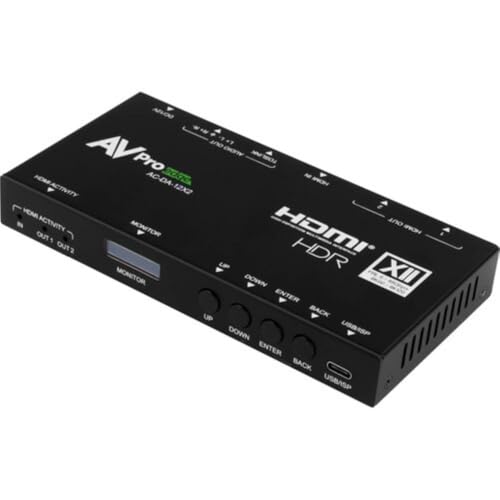
- Up to 8K60 resolution
- 48 Gb/s HDMI 2.1b bandwidth
- EDID and multichannel audio support
Best For: Two-display, high-resolution HDMI church streaming systems
Best Analog CCTV Option
1x4 BNC Coaxial Video Splitter
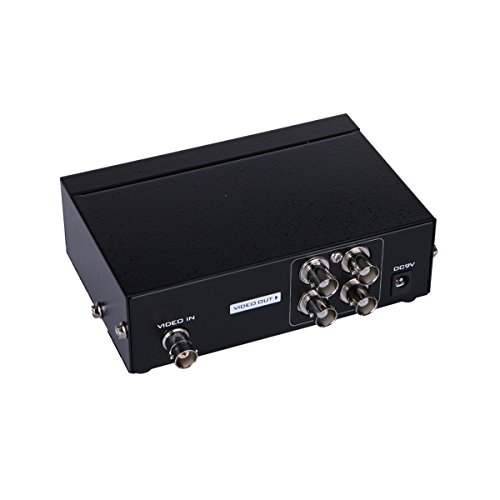
- One BNC input and four outputs
- Supports up to 1080p at 60Hz
- Works with PAL, NTSC, and SECAM CVBS
Best For: Legacy analog church camera and monitoring systems
Best SDI Long-Run Choice
3G/HD/SD SDI 1x4 Distribution Amplifier

- Four outputs with SDI signal reclocking
- Supports up to 1080p60
- Long runs up to 400m for SD
Best For: SDI church production systems with extended cable runs
Compact Analog Splitter

- One BNC input and four outputs
- Compact plastic enclosure
- Designed for basic analog video distribution
Best For: Small BNC-based church video systems
Long-Run SDI Distribution
AVMATRIX SD1191 1x9 SDI Splitter

- One SDI input feeds nine outputs
- Supports SD, HD, and 3G-SDI up to 1080p60
- Reclocks and equalizes signals for longer runs
Best For: Multi-destination SDI church production systems
Eight-Way Analog Monitoring

- One analog source feeds eight displays
- Active buffering helps stabilize multi-screen feeds
- Metal housing supports continuous operation
Best For: Analog BNC monitoring and surveillance-style systems
Professional SDI Backbone – 8-Output SDI Distribution
For churches using SDI cameras and infrastructure, the Blackmagic Design Mini Converter SDI Distribution is a compact way to send one SD-, HD-, or 3G-SDI source to multiple destinations. It provides eight reclocked outputs and supports embedded audio, ancillary data, and ASI.
Best For: Churches that need dependable SDI signal distribution across several pieces of live-streaming or broadcast equipment.
Pros:
- Distributes one SDI input to eight reclocked SDI outputs.
- Automatically supports a broad range of SD and HD video formats.
- Supports embedded audio, ancillary data, and ASI.
- Includes a redundant SDI input for mission-critical applications.
Cons:
- Designed for SDI workflows rather than HDMI or analog RCA systems.
- Requires a 12-volt power supply.
This is the strongest fit for a church with an SDI-based production system and several downstream devices. Its eight outputs and automatic format switching make it a practical distribution point for live events.
Scalable Network Video – 1080p HDMI-over-IP Encoder
The AV Access HDIP100E is an HDMI-to-IP encoder for churches that want to distribute 1080p video over standard Ethernet infrastructure. It can support expandable multi-screen systems, but this encoder must be paired with compatible HDIP100D decoders, which are sold separately.
Best For: Churches planning flexible HDMI distribution to multiple displays, overflow rooms, or video-wall installations over a network.
Pros:
- Uses standard Ethernet switching instead of long HDMI runs.
- Supports systems scaling to up to 50 displays with additional decoders.
- Can support video walls up to 8×8 and flexible source-to-screen routing.
- Offers app-based monitoring, routing, and multi-device control.
Cons:
- This listing includes the encoder only; compatible decoders are required.
- Limited to 1080p video output and LPCM stereo audio.
- Requires a suitable network and compatible AV-over-IP components.
For a church expanding beyond a single destination, this encoder offers more routing flexibility than a fixed HDMI extender. Budget for the required decoders and network hardware when planning the system.
Compact Audio Routing – Rolls DA134 4-Channel Amplifier
The Rolls DA134 is a small stereo distribution amplifier for sending line-level audio to multiple destinations. While it is not a video unit, it can complement video distribution amplifiers for church streaming by distributing audio from a laptop, iPad, iPod, or another line-level source.
Best For: Churches that need to distribute stereo program audio to up to four channels or downstream audio devices.
Pros:
- Provides four-channel stereo audio distribution.
- Supports mono or stereo operation.
- Includes front-panel volume controls and stereo pass-through.
- Compact metal design includes the Rolls PS27s power supply.
Cons:
- Does not distribute video signals.
- Its listed warranty is 90 days.
- Intended for true line-level audio rather than speaker-power amplification.
Use the DA134 as an audio companion to a church’s video distribution setup, not as a video distribution amplifier itself. Its pass-through and four-channel design are useful when several audio feeds must remain organized.
Analog AV Expansion – Powered 4-Way RCA Splitter
The DTECH FJ104-US is a powered composite video and stereo audio splitter that duplicates one three-RCA source to four outputs. For churches using older analog equipment, it can distribute a source to multiple TVs, monitors, speakers, or capture devices.
Best For: Churches with legacy composite video and RCA audio equipment that need a simple one-input, four-output distribution point.
Pros:
- Splits one composite video and stereo audio signal to four outputs.
- Built-in signal amplification helps support longer connections.
- Durable metal housing includes anti-skid feet and LED status indication.
- Includes a 9V AC power adapter and requires no extra software.
Cons:
- Uses analog RCA composite connections rather than SDI or HDMI.
- Does not provide modern high-definition video distribution.
- Requires external AC power.
This is a practical choice only when a church’s streaming or display chain still relies on composite RCA connections. For newer HD systems, SDI or HDMI-over-IP distribution will generally be a better match.
Best 8K HDMI Pick – Compact 1×2 HDMI 2.1b Distribution Amplifier
For church streaming setups that need to share one modern HDMI source with two displays, this 1×2 HDMI 2.1b distribution amplifier supports resolutions up to 8K60 and provides 48 Gb/s of video bandwidth. Its EDID management and multichannel digital-audio support can help accommodate different display configurations.
Best For: Churches distributing a high-resolution HDMI feed to two compatible displays or destinations.
Pros:
- Supports video resolutions up to 8K60.
- Offers 48 Gb/s video bandwidth for HDMI 2.1b sources.
- Includes extended EDID management and multichannel digital-audio support.
- Mounting brackets and a 12V power supply are included.
Cons:
- Provides only two HDMI outputs.
- Requires a 12V DC power supply.
- Both connected displays need to support the intended HDMI format.
This is the strongest fit of the three for a newer HDMI-based church streaming system, particularly when 8K capability and flexible display negotiation matter. It is less suitable for installations built around BNC or SDI cabling.
Best Analog CCTV Option – 1×4 BNC Coaxial Video Splitter
Churches using analog cameras or legacy coaxial video can use this BNC distribution amplifier to send one CVBS signal to four destinations. It supports up to 1080p at 60Hz, uses a plug-and-play design, and is housed in metal for continuous operation.
Best For: Analog PAL, NTSC, or SECAM camera and monitoring systems using BNC connections.
Pros:
- Splits one BNC input to four BNC-compatible outputs.
- Supports video up to 1080p at 60Hz.
- Plug-and-play installation requires no additional configuration.
- Includes a US power adapter, user manual, and one-year warranty.
Cons:
- Not compatible with SDI or digital signals.
- Limited to analog CVBS formats such as PAL, NTSC, and SECAM.
- Does not provide the higher-resolution flexibility of modern HDMI 2.1 equipment.
This model is a practical choice when a church already has an analog BNC infrastructure and needs four simultaneous monitoring outputs. Confirm that cameras are set to CVBS mode before installation, since SDI and digital sources are not supported.
Best SDI Long-Run Choice – 3G/HD/SD SDI 1×4 Distribution Amplifier
For church streaming environments built around SDI, the AVMATRIX SD1141 distributes one HD, SD, or 3G-SDI input to four outputs and reclocks each output. It supports signals up to 1080p60 and is designed for longer cable runs, making it useful when cameras and production equipment are separated across a venue.
Best For: SDI-based church production systems requiring four outputs and extended transmission distances.
Pros:
- Accepts HD/SD/3G-SDI signals and supports up to 1080p60.
- Provides four SDI outputs with signal reclocking.
- Rated transmission distances reach 400m for SD, 200m for HD, and 120m for 3G-SDI.
- Includes a detachable wall-mounting bracket and three-year warranty.
Cons:
- Uses SDI connectors rather than HDMI or BNC analog video.
- Does not support the 4K or 8K resolutions offered by newer HDMI systems.
- Requires a 17V DC input.
Signal reclocking and stated long-distance reach make this a compelling option for larger sanctuaries, control rooms, or camera runs using SDI. It is best matched to 1080p-era workflows rather than ultra-high-resolution HDMI distribution.
Compact Analog Splitter – Speco VIDDIST 1-in/4-out
Speco VIDDIST 1 in/4 Out Video Distribution Amplifier 1 Input to 4 Output Video Bnc Splitter
Check Price On AmazonFor church streaming setups that distribute a standard BNC video source to several destinations, the Speco VIDDIST provides four outputs from one input in a compact enclosure. Its straightforward analog design suits simple monitoring or routing tasks where four feeds are sufficient.
Best For: Small church video systems using BNC-connected analog equipment and up to four destinations.
Pros:
- One BNC input feeds four BNC outputs.
- Compact 4-1/2-inch-wide plastic housing.
- Simple distribution-amplifier format for basic analog video routing.
Cons:
- Limited to four outputs.
- Uses BNC video connections and is not identified as an SDI or digital HD device.
- Plastic construction may be less suitable for demanding installations than a metal enclosure.
The VIDDIST is a practical, space-conscious choice for smaller analog church systems. Confirm that your source and displays use compatible BNC video signals before choosing it for a streaming workflow.
Long-Run SDI Distribution – AVMATRIX SD1191 1×9 SDI Splitter
For church streaming systems built around SDI, the AVMATRIX SD1191 distributes one source to nine outputs and supports SD, HD, and 3G-SDI signals up to 1080p at 60 Hz. Its reclocking and equalization features are useful when a service video signal must travel across longer cable runs.
Best For: Churches that need nine SDI destinations and longer cable runs in a multi-camera or production setup.
Pros:
- One input provides nine outputs.
- Supports SD, HD, and 3G-SDI signals up to 1080p60.
- Built-in reclocking and equalization support signal transmission over longer runs.
- Includes a detachable wall-mounting bracket and 12V adapter.
Cons:
- Designed for SDI workflows rather than standard analog composite BNC systems.
- Requires a 12V DC power supply.
- May offer more capacity than a small church system needs.
The SD1191 is the strongest fit here for a larger SDI-based church production system. Its nine outputs and signal-restoration functions can simplify distribution to cameras, converters, monitors, or other SDI equipment.
Eight-Way Analog Monitoring – TNP 1-in/8-out BNC Amplifier
The TNP BNC Video Distribution Amplifier is a practical option for church streaming support systems that use standard analog composite video. It duplicates one source across eight outputs, while its active circuitry buffers the signal for more stable multi-screen monitoring than a passive split.
Best For: Analog BNC monitoring setups connecting a DVR, camera, multiplexer, or composite source to eight displays.
Pros:
- Distributes one analog source to eight outputs simultaneously.
- Active amplification and buffering help reduce signal loss and distortion.
- Metal housing is intended to support heat dissipation and continuous operation.
- Plug-and-play setup requires no software or configuration.
Cons:
- Not designed for SDI or digital HD formats.
- Limited to standard analog BNC composite equipment.
- Its eight-output design may be unnecessary for smaller systems.
Choose the TNP when your church uses legacy composite video and needs several monitoring feeds. It offers more outputs than the Speco, but it is not the right match for an SDI-based production chain.
How We Picked These Video Distribution Amplifiers for Church Streaming
We selected models across the connection types commonly found in church production systems: SDI for longer professional cable runs, HDMI for modern cameras and displays, composite video for legacy equipment, analog audio distribution, and network-based video transport. We also considered output count, format support, installation simplicity, and the practical needs of worship spaces.
A distribution amplifier should duplicate a source signal consistently without introducing unnecessary conversion or quality loss. Because church systems often combine new and older equipment, this roundup includes both compact consumer-style splitters and purpose-built professional distribution amplifiers.
Quick Comparison
| Need | Best-fit connection | What to prioritize |
|---|---|---|
| Professional camera and switcher feeds | SDI | 3G/HD/SD support, reclocking, and output count |
| Modern displays and short runs | HDMI | Resolution, HDMI version, HDCP compatibility, and cable length |
| Older cameras or CCTV equipment | Composite/BNC | Correct video standard, powered operation, and connector compatibility |
| Separate analog audio feeds | Audio distribution | Balanced or unbalanced I/O, channel count, and noise performance |
| Network-based distribution | AV over IP | Network bandwidth, latency, encoder compatibility, and receiver requirements |
Key Buying Factors for Video Distribution Amplifiers for Church Streaming
Match the Signal Format
Start with the output from your camera, switcher, or playback device. SDI, HDMI, composite, and analog audio are not interchangeable without converters. For a current broadcast workflow, SDI models are often the most practical when equipment supports them.
Count Every Destination
List all required endpoints, including the streaming encoder, projector, multiview monitor, recording device, lobby display, and overflow room. Choose enough outputs for today’s setup and leave room for expansion. A one-to-four or one-to-eight unit may be more useful than chaining several small splitters.
Check Resolution and Distance
Verify support for your actual video standard, such as 1080p or a supported SDI rate. HDMI is more sensitive to cable length and quality, while SDI is generally better suited to longer professional runs. Distribution does not automatically solve an incompatible resolution or weak cable installation.
Consider Reliability and Control
For weekly services, look for a dedicated power supply, sturdy connectors, clear status indicators, and simple operation. If the amplifier will be rack-mounted or left permanently installed, confirm its physical dimensions and ventilation needs.
Who Should Buy Which Video Distribution Amplifiers for Church Streaming?
Choose an SDI distribution amplifier if your church uses professional cameras, an SDI switcher, or long cable runs between the sanctuary and technical areas. Choose an HDMI splitter for a compact setup built around modern HDMI cameras, computers, or displays. Composite or BNC models make sense when upgrading legacy surveillance, analog cameras, or older video infrastructure would be more expensive than distributing the existing signal.
An analog audio distribution amplifier is better when the requirement is routing audio rather than video. Churches planning a scalable networked system should consider an AV-over-IP encoder, but budget for compatible receivers, managed-network capacity, and technical setup. Whichever type you choose, confirm connector standards and test the complete chain before relying on it for a live service.