The right looper can help church musicians build layered worship arrangements, support spontaneous transitions, and create fuller sound without adding more players to the platform. The best choice depends on your instrument setup, required control, recording time, and comfort with live performance workflows.
We compare 10 loop stations ranging from compact single-track pedals to advanced multi-track and tabletop units, with practical guidance for choosing a reliable fit for rehearsals, services, and worship teams.
Best 10 Loop Stations for Church Musicians Picks for 2026
Best Overall

- 32-bit audio processing
- 13 hours of stereo recording
- 57 rhythms and 99 phrase memories
Best For: Worship musicians needing polished audio and compact, flexible looping
Best Simple Option
RC-20XL Looper Guitar Effects Pedal

- 16 minutes of recording time
- 11 loop-saving slots
- Undo and tempo adjustment
Best For: Players wanting uncomplicated looping for basic accompaniment
Best for Dual-Track Worship
BOSS RC-500 Dual-Track Loop Station

- Two-track looping
- 13 hours of stereo recording
- XLR, 1/4-inch, and USB connectivity
Best For: Layered worship arrangements requiring independent loop tracks
Best Value with Drums

- Looper and drum machine in one pedal
- 160 minutes across 40 slots
- 110 grooves with tap tempo and fade-out
Best For: Budget-conscious worship musicians needing rhythms and ample storage
Flagship Layering Power
- Six simultaneous stereo phrase tracks
- Extensive input and track effects
- Nine assignable footswitches
Best For: Complex live worship arrangements and experienced looping musicians
Tabletop Worship Arranger

- Five stereo phrase tracks with faders
- Two XLR inputs with phantom power
- 99 memories for performance setups
Best For: Vocal-led worship and hands-on tabletop looping
Simple Worship Looping

- Beginner-friendly core looping controls
- 12 minutes of stereo recording
- Compact pedal with battery operation
Best For: Solo worship musicians and basic accompaniment loops
Professional Worship Looping

- Dual-track looper with advanced audio processing
- 57 rhythms, 16 drum kits, and 99 phrase memories
- USB, MIDI, and external control support
Best For: Layered worship performances with rhythm accompaniment
Hands-Free Multi-Track Worship

- Three stereo tracks with dedicated footswitches
- Track faders and expression-pedal effects control
- 99 memories and up to three hours of recording
Best For: Multi-layer guitar and vocal worship arrangements
Compact Tabletop Worship Looping

- Two simultaneous stereo phrase tracks
- Four input and four track effects
- 64 memories with MIDI and optional pedal support
Best For: Hands-on tabletop looping with expressive effects
Best Overall – BOSS RC-5 Loop Station
For church musicians seeking compact, professional loop stations for church musicians, the BOSS RC-5 combines high-quality audio processing, generous storage, onboard rhythms, and flexible connectivity in a pedalboard-friendly design. Its single-track workflow is well suited to building layered accompaniment during worship sets.
Best For: Worship musicians who want polished audio, portable operation, and extensive rhythm and loop storage.
Pros:
- 32-bit AD/DA conversion and 32-bit floating-point processing support high-quality sound.
- Offers 13 hours of stereo recording and 99 phrase memories.
- Includes 57 rhythms with A/B variations and seven drum kits.
- Provides MIDI, USB, footswitch, and expression-pedal connectivity.
Cons:
- Single-track looping is less flexible than a dual-track design.
- Optional PSA adapter is needed for extended powered sessions.
The RC-5 is a strong all-around choice when sound quality, portability, and creative control matter more than independent track operation.
Best Simple Option – RC-20XL Looper Guitar Effects Pedal
The RC-20XL is a straightforward choice for church musicians who want essential looping without a large feature set. It provides up to 16 minutes of recording, loop storage, tempo adjustment, and undo functionality for simple accompaniment and practice applications.
Best For: Musicians who prefer a basic looper with essential controls and saved-loop capability.
Pros:
- Provides 16 minutes of recording time.
- Includes 11 slots for saving loops.
- Offers undo functionality and loop tempo adjustment.
Cons:
- Has less recording capacity than the newer loop stations in this roundup.
- The supplied notes do not list onboard rhythms, MIDI, or USB connectivity.
Its simpler design can work well for basic worship arrangements, though musicians building more complex live setups may want a newer model with expanded connectivity and rhythm features.
Best for Dual-Track Worship – BOSS RC-500 Dual-Track Loop Station
The BOSS RC-500 is designed for church musicians who need more arrangement flexibility from their loop station. Its two-track format, 13 hours of stereo recording, onboard rhythms, color display, and XLR and 1/4-inch inputs make it suitable for building layered worship parts and handling varied sources.
Best For: Worship performers who need dual-track looping and multiple input options.
Pros:
- Two-track looping supports more flexible live arrangements.
- Provides 13 hours of stereo recording time.
- Includes onboard rhythm tracks and a multi-color backlit display.
- Offers XLR, 1/4-inch, and USB connectivity.
Cons:
- Its larger 6.69-by-5.43-inch footprint takes more pedalboard space.
- At 950 grams, it is heavier than a compact single-pedal looper.
The RC-500 is a capable pick for worship sets that require separate loop tracks and broader input connectivity, provided the larger format fits your setup.
Best Value with Drums – Donner Circle Looper
The Donner Circle Looper gives church musicians a combined looper and drum machine for building rhythmic worship accompaniment. It offers 40 memory slots, 160 minutes of total loop capacity, 110 drum grooves, tap tempo, fade-out, and USB import/export in a compact pedal.
Best For: Budget-conscious musicians who want extensive loop storage and built-in rhythm variety.
Pros:
- Combines stereo looping with 110 drum grooves across 11 styles.
- Stores up to 160 minutes across 40 memory slots.
- Includes a screen, tap tempo, fade-out, and USB import/export.
- Automatically saves recorded files when powered off.
Cons:
- A 9V center-negative 500 mA power adapter is not included.
- The external footswitch is supported but not included.
The Circle Looper is appealing when rhythm options and memory capacity are priorities, but plan for the additional power supply and optional footswitch costs.
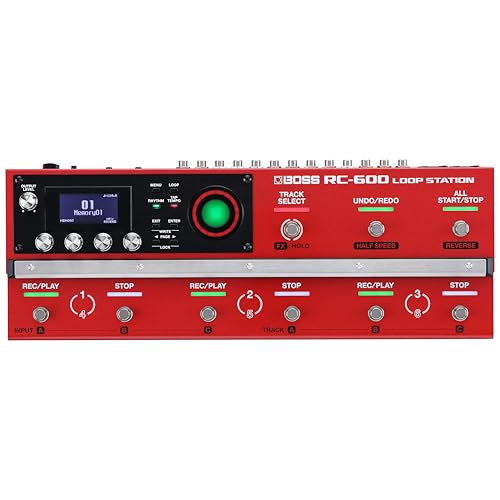
Flagship Layering Power – BOSS RC-600
For church musicians building detailed live arrangements, the BOSS RC-600 offers six simultaneous stereo phrase tracks, extensive effects, and flexible foot control. It is a strong choice when worship performances require multiple layered parts and hands-free operation.
Best For: Experienced church musicians, worship bands, and multi-instrumentalists creating complex live loops.
Pros:
- Records and edits up to six stereo loops in real time.
- Provides 49 Input FX and 53 Track FX types, with up to four effects usable in each section.
- Includes nine freely assignable footswitches and three pedal modes.
- Uses 32-bit AD/DA conversion and 32-bit floating-point processing.
Cons:
- Its extensive controls and customizable functions may require more setup than a basic looper.
- The floor unit weighs 8.2 pounds and has a large footprint.
The RC-600 is best suited to musicians who will take advantage of its deep control options and six-track architecture. For simpler worship accompaniment, its advanced feature set may be more than necessary.
Tabletop Worship Arranger – BOSS RC-505mkII
The BOSS RC-505mkII is a tabletop option for church musicians who prefer visible, hands-on control while creating layered performances. Five stereo phrase tracks, independent faders, microphone inputs, and flexible routing support vocal- and instrument-led worship setups.
Best For: Vocalists, worship leaders, and tabletop performers who want direct control over layered loops and effects.
Pros:
- Offers five simultaneous stereo phrase tracks with dedicated controls and volume faders.
- Includes two XLR microphone inputs with phantom power.
- Provides 49 Input FX types and 53 Track FX types.
- Stores up to 99 memories with phrase tracks, effects, playback settings, and control assignments.
Cons:
- Its tabletop design is less suited to foot-operated performance control.
- The unit is broad, measuring 23.4 inches wide.
Choose the RC-505mkII when hands-on mixing and microphone connectivity matter more than a conventional pedal layout. Its faders and memory system are especially useful for repeatable worship sets.
Simple Worship Looping – BOSS RC-1
The BOSS RC-1 is a straightforward starting point for church musicians seeking an uncomplicated looper for guitar, bass, keyboard, or another instrument. Its record, overdub, playback, undo, and redo functions cover the essentials without the complexity of a larger multi-track station.
Best For: Beginners, solo worship musicians, and players who need a compact looper for basic accompaniment.
Pros:
- Provides simple recording, overdubbing, playback, undo, and redo controls.
- Offers 12 minutes of stereo recording time.
- Includes a clear 24-segment loop indicator showing the current mode.
- Runs on an included 9-volt battery or an optional PSA-series AC adaptor.
Cons:
- It does not provide the multiple independent tracks or extensive effects found on larger models.
- The AC adaptor is sold separately.
The RC-1 is a practical choice when ease of use and compact pedalboard placement are priorities. Musicians planning intricate, effects-heavy worship arrangements will likely need a more advanced loop station.
Professional Worship Looping – BOSS RC-500
For church musicians seeking loop stations for church musicians, the BOSS RC-500 offers a powerful dual-track setup with high-quality audio processing, onboard rhythms, and flexible control options. Its backlit display and extensive phrase storage make it well suited to structured worship performances and layered live arrangements.
Best For: Worship leaders and instrumentalists who need advanced looping, rhythm accompaniment, and expandable foot or MIDI control.
Pros:
- Dual-track looping with 32-bit AD/DA conversion and 32-bit floating-point processing.
- Includes 57 preset rhythms, 16 drum kits, and A/B variations for accompaniment.
- Stores up to 99 phrase memories and offers up to 13 hours of stereo recording.
- Supports USB file management plus external footswitch, expression pedal, and MIDI control.
Cons:
- Advanced controls and connectivity may require a learning period.
- Power supply is required, and the MIDI adaptor cable is available separately.
The RC-500 is a strong choice when a church musician wants substantial looping depth without moving to a larger multi-track floor unit. Its rhythms, memory capacity, and control options support repeatable worship arrangements.
Hands-Free Multi-Track Worship – BOSS RC-300
The BOSS RC-300 is a practical option among loop stations for church musicians who want several independently controlled stereo tracks. Dedicated footswitches, track faders, an expression pedal, and microphone connectivity make it suited to hands-free live worship arrangements.
Best For: Performers building layered guitar, vocal, and instrument parts across three separately controlled tracks.
Pros:
- Provides three stereo tracks with dedicated footswitches and controls.
- Offers a dedicated fader for each track and real-time effects control through the expression pedal.
- Stores up to three hours of internal recordings across 99 onboard memories.
- Includes a microphone input cable and a broad selection of built-in effects.
Cons:
- Its larger multi-track layout may be more than needed for simple looping.
- Recording capacity is shorter than the RC-500’s stated 13-hour capacity.
Choose the RC-300 when independent track management matters more than compactness. It gives worship musicians clear hands-free control over multiple layers, though its feature-rich layout may take space and practice.
Compact Tabletop Worship Looping – BOSS RC-202
The BOSS RC-202 brings professional looping to a compact tabletop format. For church musicians exploring loop stations for church musicians, its two simultaneous stereo phrase tracks, hands-on controls, and real-time effects can support layered performances while leaving both hands available for an instrument.
Best For: Keyboardists, guitarists, and other performers who prefer tabletop control with expressive effects and MIDI expandability.
Pros:
- Provides two simultaneous stereo phrase tracks with dedicated controls and status indicators.
- Includes four input effects and four track effects for live sound shaping.
- Stores 64 phrase memories across eight banks, with two tracks per memory.
- Supports optional footswitches, expression pedals, MIDI, and real-time loop saving.
Cons:
- Its tabletop design is less immediately foot-operated than a traditional pedal.
- It does not list onboard rhythm kits or preset rhythms in the supplied specifications.
The RC-202 is a flexible choice for musicians who want fingertip access to looping and effects while playing. It works especially well in setups where a tabletop unit and optional external controls fit the worship rig.
How We Picked These Loop Stations for Church Musicians
We focused on features that matter during worship performance: intuitive recording and overdub controls, dependable footswitch operation, useful loop memory, audio quality, rhythm support, connectivity, and the ability to recover quickly from a mistake. We also included different form factors and price levels because a solo acoustic player has different needs from a full worship team or looping specialist.
Simple models can be ideal when you need hands-free layering without menu diving. More advanced units are better suited to musicians who need multiple sections, independent tracks, external control, microphones, MIDI, or detailed arrangement options.
Quick Comparison
| Best For | Recommended Type | Why It Matters |
|---|---|---|
| Simple vocal or guitar layers | Compact single-track pedal | Fast setup and minimal distractions |
| Solo worship leaders | Looper with rhythm support | Adds structure and percussion to sparse arrangements |
| Multi-section songs | Multi-track floor unit | Provides greater control over verses, choruses, and bridges |
| Looping specialists | Advanced floor or tabletop station | Offers deeper routing, effects, and performance control |
Key Buying Factors for Loop Stations for Church Musicians
Track and Memory Capability
Consider whether you need one continuous loop or separate parts for intro, verse, chorus, and bridge. More tracks and memories make complex arrangements easier, but they can also increase setup time and learning requirements.
Foot Control and Live Usability
Controls should be easy to identify and press while singing or playing. Dedicated stop, undo, redo, and track controls are especially valuable in services, where a poorly timed tap can interrupt the arrangement. Clear indicators or color displays help when stage lighting is limited.
Inputs, Outputs, and Routing
Check whether the unit supports your instruments, microphone, stereo rig, or mixer connection. Stereo outputs can preserve keyboard and effects-based textures, while multiple inputs and routing options help separate vocals, instruments, and backing parts.
Rhythm, Tempo, and Synchronization
Built-in drum patterns can keep a solo performance moving, but they are not essential for every church musician. If your team already has a drummer or click track, prioritize recording and control features. MIDI or synchronization support becomes useful when integrating backing tracks, keyboards, or other electronic gear.
Reliability and Learning Curve
Choose a pedal that fits your rehearsal time and technical confidence. A feature-rich station is only useful if you can operate it consistently under pressure. Practice the complete signal chain, including power, cables, amplification, and reset procedures, before using it in a service.
Who Should Buy Which Loop Stations for Church Musicians?
Choose a compact single-loop pedal if you want reliable layering for acoustic guitar, electric guitar, or vocals with minimal preparation. A model with built-in rhythms is a strong choice for solo worship leaders who need a steady foundation without a drummer. Musicians arranging complete songs should look for multiple tracks, phrase memories, and dedicated controls for changing sections.
Advanced floor units are best for experienced performers who need hands-free control, multiple inputs, detailed routing, or synchronized equipment. Tabletop stations can work well for vocalists, keyboardists, and loop-focused performers who prefer direct access to many controls. Finally, consider your church’s sound system and rehearsal workflow: the best looper is the one your team can connect, operate, and troubleshoot confidently every week.