Jackery Explorer 240D Power Bank review searches usually come from buyers who want portable backup power without carrying a bulky station.
This model makes sense if you value compact size, DC output, and simple grab-and-go charging.
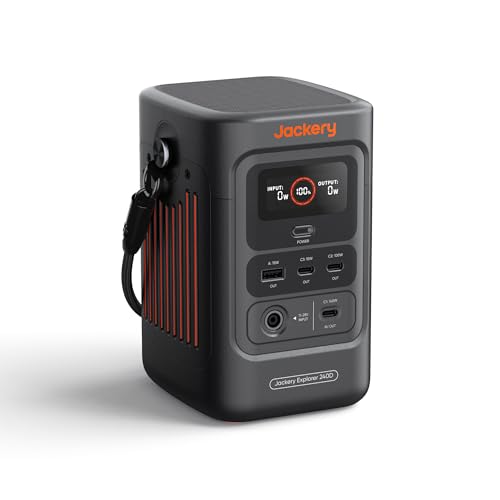
Explorer 240D Review Summary
The Jackery Explorer 240D is a sensible buy for campers, travelers, and anyone who wants a lightweight backup power source for phones, tablets, laptops, and other DC-powered essentials.
It is not trying to be a whole-home solution or a heavy-duty AC workhorse; instead, it focuses on portability, fast recharging, and a straightforward set of outputs that fit everyday emergency and outdoor use.
What stands out most is the balance between capacity and size.
Jackery lists 256Wh of energy, 200W of pure DC output, three USB-C ports, one USB-A port, and a compact 4.85-pound body.
That combination makes the Explorer 240D easier to keep in a car, pack for a trip, or grab during a power outage than many larger portable stations.
The included 2-in-1 USB-C strap cable also reinforces the idea that this product is meant to move with you, not sit in one place.
This is a strong fit for buyers who want lightweight emergency power with modern USB-C convenience.
It is less suitable for anyone who expects AC outlets, high-wattage appliance support, or a larger off-grid battery bank.
In short, the Jackery Explorer 240D review comes down to a simple question: do you want a compact DC power bank that is easy to carry and easy to recharge?
If yes, it looks well matched.
Review Scorecard
| Category | Score | Rationale |
|---|---|---|
| Portability | 9/10 | Jackery lists 4.85 lb weight and a compact form, which is excellent for travel and camping. |
| Charging Flexibility | 8/10 | Supports AC-DC dual input, solar, car charging, and USB-C use. |
| Output Versatility | 7/10 | Four ports are useful, but the system is DC-focused rather than AC-heavy. |
| Battery Longevity | 9/10 | The listed LiFePO4 battery and 10-year lifespan claim are major strengths. |
| Emergency Readiness | 8/10 | Fast recharge and multiple input options make it practical for outages. |
| Everyday Usability | 8/10 | The strap cable, digital display, and compact layout support simple carry-and-use behavior. |
| Value for the Use Case | 8/10 | Best value comes from portability and long service life, not maximum output. |
Key Features and Specifications of Explorer 240D
The Explorer 240D is built around a 256Wh battery and a 200W pure DC output ceiling, with up to 140W per port listed in the product details.
Jackery says it can power up to four devices at once through three USB-C ports and one USB-A port.
That mix is useful for modern electronics-heavy travel kits, especially when most of your devices charge over USB-C.
Key listed specifications include:
- 256Wh capacity
- 200W pure DC output
- 3 USB-C ports and 1 USB-A port
- 2-in-1 USB-C strap cable included
- 4.85 lb listed weight
- 4.73 x 4.19 x 6.69 in listed dimensions
- LiFePO4 battery chemistry
- Up to 6,000 charge cycles and a 10-year lifespan claim
- Operating range listed from -4°F to 113°F
- Charging options: USB-C, solar, car charging, and AC-DC dual input
- Jackery claims a 0% to 80% charge in one hour with the 100W charger
- Up to 100W solar charging support is listed
The best way to read these numbers is as a compact, travel-friendly power source rather than a high-output station.
The absence of AC outlets is an important design choice.
It keeps the unit focused on efficient DC and USB charging, which is often enough for phones, tablets, cameras, small accessories, and some laptops depending on their charging needs.
The LiFePO4 battery is one of the more compelling details.
Buyers who plan to store a power station for emergencies generally care about longevity and cycle life, and Jackery’s stated 6,000-cycle figure plus 10-year lifespan claim suggest this is meant for repeated, long-term use.
That matters more than headline wattage for people who expect occasional but dependable backup power.
Pros and Cons of Explorer 240D
Pros
- Very portable for the category. The listed 4.85-pound weight is a major advantage if you want something you can carry easily.
- Modern USB-C setup. Three USB-C ports plus one USB-A port fit current charging habits well.
- Multiple recharge paths. AC-DC dual input, solar, car charging, and USB-C help it adapt to different situations.
- Long-life battery chemistry. LiFePO4 and the 10-year/6,000-cycle claims are strong for longevity-minded buyers.
- Useful emergency profile. Fast charging and compact size make it easier to keep ready for outages or road trips.
Cons
- No AC outlets listed. Buyers who want to plug in household devices or appliances should look elsewhere.
- Output is limited. The 200W DC ceiling is enough for essentials, but not for demanding gear.
- Capacity is modest. 256Wh is practical, but it is not a high-capacity backup solution.
- Best for devices, not loads. This is more of a personal electronics power bank than a full portable generator replacement.
The biggest tradeoff is clear: the Explorer 240D gives up broad outlet variety in exchange for portability and focus.
That is a good deal for the right buyer and a poor one for the wrong buyer.
Who Should Buy Explorer 240D?
Buy this if you want a compact power source for camping, travel, road trips, or emergency charging and you mainly run USB-powered devices.
It should also appeal to people who prefer a lighter power station that is easy to store in a car, closet, or gear bin.
It is also a smart option if long-term battery durability matters to you.
The LiFePO4 chemistry, cycle-life claim, and flexible charging options all point toward a product designed for repeated use over time rather than occasional novelty use.
Skip it if you need AC outlets, higher-wattage output, or a station for tools and larger appliances.
If your priority is running more demanding equipment, this product’s DC-focused design will feel too narrow.
The Jackery Explorer 240D review is strongest when the buyer is clear about needing portability first and raw power second.
How Explorer 240D Fits Daily and Emergency Use
Travel and Commute Use
For travel, the Explorer 240D’s compact size is the headline advantage.
A portable power bank is easier to justify when it can live in a bag or trunk without becoming a burden, and Jackery’s size and weight claims support that use case well.
The included strap cable also helps here because it reduces the number of separate items you need to manage.
Camping and Outdoor Use
For camping, this product looks best when your gear is mostly USB-C or USB-A driven.
It should work well for topping off phones, lights, headlamps, tablets, and other small electronics.
The 100W solar charging support is especially relevant for longer outdoor stays, since it gives you a replenishment path away from wall power.
Outage Backup
For outages, the Explorer 240D is a practical “essentials only” backup.
It is not meant to replace a generator or power everything in the house.
It is meant to keep key electronics going, recharge portable devices, and make short disruptions easier to manage.
The one-hour fast charging claim is useful because a backup unit is only helpful if it is ready when the grid is not.
Battery Life and Maintenance
The LiFePO4 battery is a long-term ownership advantage.
Buyers who care about storage, repeated cycling, and staying prepared should appreciate the listed lifespan claim more than a short-term spec spike.
If you want something that you can keep around and trust over years, that matters.
Alternatives to Explorer 240D
If you want a similar portable-power experience but with a different balance of output, capacity, or outlet mix, these are worth comparing:
The Explorer 300 Plus is the closest comparison if you want to stay within Jackery’s ecosystem but compare capacities and port layouts.
EcoFlow and BLUETTI are useful alternatives if you care more about broad portable power-station options than brand continuity.
Anker’s SOLIX line is worth checking if you want a compact, modern portable power product with a different design approach.
Is Explorer 240D Worth It?
Yes, if your goal is compact, reliable DC backup power and you do not need AC outlets.
The Jackery Explorer 240D makes the most sense for buyers who want portability, modern USB-C charging, multiple recharge options, and a long-life battery in a small package.
No, if you want a more traditional portable power station for larger devices or household-style use.
In that case, the Explorer 240D is probably too focused and too limited.
For the right buyer, though, it is a well-judged design with clear strengths and a clear purpose.