A good portable DAC can make wired headphones sound cleaner, fuller, and more controlled while adding useful amplification for demanding earbuds and headphones. USB-C models are especially convenient for modern Android phones, iPhones with USB-C, tablets, laptops, and handheld gaming devices.
We selected 10 portable DACs with USB-C input across compact adapters, balanced-output dongles, and higher-powered headphone amps. The right choice depends on your headphones, connector preferences, source device, and how much power and portability you need.
Best 10 Portable Dacs with USB C Input Picks for 2026
Balanced Power Pick

- Dual ESS Sabre DAC balanced circuit
- 4.4mm output with up to 241mW
- PCM 384kHz and native DSD256 support
Best For: Portable high-resolution listening with balanced headphones
Compact IEM Specialist

- Aluminum-alloy portable construction
- 3.5mm and 4.4mm outputs
- PCM 384kHz and DSD128 support
Best For: Compact IEM and mobile headphone setups
High-Power Desktop Mode

- Up to 550mW in desktop mode
- Dual CS43131 DACs and op-amps
- 3.5mm and 4.4mm outputs
Best For: Driving demanding headphones from mobile or PC sources
Clean Output Value

- Dual-chip 32-bit/384kHz decoding
- Up to 227mW at 32 ohms
- USB-C compatibility with USB-A adapter
Best For: 3.5mm headphone users wanting strong, clean USB-C audio
Best for Custom Tuning

- Dual CS43198 DAC architecture
- App-based parametric DSP adjustments
- 3.5mm and 4.4mm outputs
Best For: Listeners who want powerful, customizable portable audio
Best Ultra-Compact Dongle

- About 8.5g and pocket-friendly
- 32-bit/384kHz support
- Works with phones, computers, Switch, and PS5
Best For: Portable 3.5mm listening across multiple devices
Best for Dual Outputs
- 3.5mm and 4.4mm outputs
- 32-bit/384kHz PCM and DSD128
- Compact aluminum-alloy construction
Best For: IEM users needing flexible headphone connections
Best Feature-Rich Pick

- ESS ES9039Q2M DAC with four amplifier chips
- Dual USB-C ports and 3.5mm/4.4mm outputs
- Display, magnetic back, and volume memory
Best For: Feature-focused portable listening across phones, tablets, and consoles
Best Lightweight Dongle

- Dual CS43131 DACs support DSD256 and 32-bit/384kHz PCM
- Up to 170mW per channel at 32 ohms
- 60-step buttons, volume memory, and metal construction
Best For: Portable phone listening with strong output in a compact body
Best for Customization

- ES9039Q2M and XMOS processing support DSD512
- 32-band hardware PEQ and eight selectable filters
- Spatial audio for PC, PS5, and Switch
Best For: Critical listening and gaming with extensive sound-tuning controls
Balanced Power Pick – iFi Audio Go Link Max
The iFi Audio Go Link Max is a strong choice among portable dacs with usb c input if you want both 3.5mm and balanced 4.4mm headphone connections. Its dual ESS Sabre DAC design, high-resolution support, and compact 15 g build suit mobile listening without sacrificing output flexibility.
Best For: Listeners who want a lightweight dongle with balanced output and high-resolution PCM or DSD playback.
Pros:
- Dual ESS Sabre DACs use a balanced circuit design.
- 4.4mm output provides up to 241mW of power.
- Supports PCM up to 32-bit/384kHz and native DSD256.
- Flexible cable helps reduce stress on USB-C ports.
Cons:
- The 4.4mm balanced output requires compatible headphones or a cable.
- It is designed for USB-C devices, with the included adapter needed for USB-A connections.
With dynamic range enhancement, THD compensation, and plug-and-play operation, the Go Link Max is a versatile upgrade for phones, tablets, and other USB-C sources.
Compact IEM Specialist – Kiwi Ears Allegro Mini
The Kiwi Ears Allegro Mini is a compact option for shoppers comparing portable dacs with usb c input for IEMs, phones, and laptops. Its aluminum-alloy body includes both 3.5mm single-ended and 4.4mm outputs, while USB-C connectivity keeps setup simple with compatible devices.
Best For: IEM users and mobile listeners who want dual headphone outputs in a small aluminum chassis.
Pros:
- Offers both 3.5mm and 4.4mm headphone outputs.
- Supports PCM up to 32-bit/384kHz and DSD128.
- USB-C plug-and-play connectivity works with Android devices, laptops, and audio equipment.
- Low stated THD+N of 0.004% at 32 ohms.
Cons:
- Compatibility details specifically identify Android 5.1 and above rather than every mobile platform.
- Its listed DSD support is lower than some competing models.
The Allegro Mini emphasizes portability, clean output, and connection flexibility, making it a practical match for users who alternate between standard and balanced headphones.
High-Power Desktop Mode – FiiO/JadeAudio KA13
The FiiO/JadeAudio KA13 stands out among portable dacs with usb c input for its unusually powerful desktop mode. It combines dual CS43131 DACs and dual op-amps with 3.5mm and 4.4mm outputs, giving users a compact way to connect headphones to phones, PCs, and music players.
Best For: Users who need a small USB-C dongle capable of driving a wide range of headphones with high output power.
Pros:
- Desktop mode raises balanced output power to up to 550mW.
- Dual CS43131 DACs and dual SGM8262 op-amps support detailed playback.
- Includes both 3.5mm and 4.4mm outputs.
- Supports PCM up to 32-bit/384kHz and DSD256.
Cons:
- Desktop mode is a specific operating mode rather than the default portable setup.
- High output capability may be more than efficient IEMs require.
App connectivity adds control over RGB lighting, digital filters, and related settings, while the aluminum body keeps the feature set in a compact format.
Clean Output Value – BZINK BA36 USB-C DAC
The BZINK BA36 is a practical pick among portable dacs with usb c input for listeners who want a 3.5mm headphone adapter with substantial stated output. Its dual-chip design, aluminum shell, and broad USB-C device compatibility make it suitable for mobile listening, gaming, travel, and monitoring.
Best For: Users seeking a USB-C-to-3.5mm DAC with strong output, low stated noise, and wide device compatibility.
Pros:
- Dual CS43131 and SGM8262 chipset supports 32-bit/384kHz decoding.
- Up to 227mW at 32 ohms and support for 16–600 ohm headphones.
- Stated signal performance includes over 125dB SNR/DNR and -110dB THD+N.
- Includes a USB-A adapter and a 20-month warranty according to the supplied notes.
Cons:
- Provides a 3.5mm headphone connection rather than a listed 4.4mm balanced output.
- The supplied details list inconsistent warranty information, so buyers should confirm coverage.
For users who do not need balanced output, the BA36 offers a straightforward, plug-and-play route to higher-resolution audio from USB-C phones, tablets, and laptops.
Best for Custom Tuning – MOONDROP Dawn PRO 2
The MOONDROP Dawn PRO 2 is a strong choice among portable dacs with usb c input for listeners who want substantial output, dual headphone connections, and app-based sound customization. Its dual CS43198 DAC design, independent power regulation, and aluminum housing are aimed at detailed, efficient portable listening.
Best For: Enthusiasts who want customizable DSP and both 3.5mm and 4.4mm headphone outputs.
Pros:
- MOONDROP app offers adjustable filter type, frequency, gain, and Q settings.
- Dual CS43198 DAC chips support up to 32-bit/384kHz PCM and DSD256.
- Provides 4Vrms output and up to 124 + 124mW, with 100-level volume control.
- Aluminum-alloy housing uses strategically placed vents for heat dissipation.
Cons:
- Its larger feature set may be more than casual listeners need.
- Only one USB cable is listed as an included accessory.
The Dawn PRO 2 stands out when control and output flexibility matter as much as portability. It is especially appealing for users willing to spend time tuning their headphones through the MOONDROP app.
Best Ultra-Compact Dongle – FiiO KA11
The FiiO KA11 is a tiny option for shoppers comparing portable dacs with usb c input for phones, tablets, and computers. It combines a CS43131 DAC with a 3.5mm headphone output, high-resolution support, and enough rated power for most headphones in a lightweight dongle.
Best For: Travelers and everyday listeners who want a very small USB-C-to-3.5mm adapter with headphone-driving power.
Pros:
- Compact 44 x 9.7 x 10.5mm body weighs about 8.5g.
- Supports up to 32-bit/384kHz playback through its CS43131 DAC.
- Rated for 245mW at 16 ohms and 200mW at 32 ohms.
- Works with Android, iOS, Windows, and Mac, with UAC1.0 support for Switch and PS5.
Cons:
- Offers only a 3.5mm output.
- UAC1.0 mode requires switching through the FiiO Control app.
The KA11 prioritizes portability without limiting compatibility. It is a practical pick for replacing a missing headphone jack, especially if your headphones use a standard 3.5mm plug.
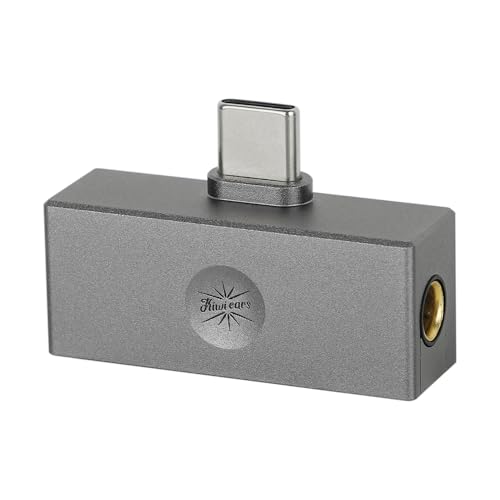
Best for Dual Outputs – Kiwi Ears Allegro Mini
The Kiwi Ears Allegro Mini is a compact option among portable dacs with usb c input, pairing USB-C connectivity with both 3.5mm and 4.4mm outputs. Its aluminum-alloy body, 32-bit/384kHz PCM support, and DSD128 capability make it suited to listeners who want flexible connections in a small format.
Best For: IEM and headphone users who switch between 3.5mm and 4.4mm cables and use modern Android devices or PCs.
Pros:
- Provides both 3.5mm single-ended and 4.4mm outputs.
- Supports PCM up to 32-bit/384kHz and DSD up to DSD128.
- Compact aluminum-alloy body is designed for portable use.
- USB-C connection supports plug-and-play use with Android 5.1-and-later devices.
Cons:
- The supplied compatibility details focus on Android devices and PCs rather than iOS.
- Its listed THD+N specification is measured at 32 ohms, so performance may vary with other loads.
The Allegro Mini is a versatile match for listeners with multiple cable types. Its dual-output layout gives it more connection flexibility than a basic 3.5mm dongle while retaining a portable aluminum design.
Best Feature-Rich Pick – Fosi Audio MD3
Fosi Audio MD3 Portable DAC Headphone Amplifier Magnetic USB C Mini Amp HiFi Black
Check Price On AmazonThe Fosi Audio MD3 is a compact choice for shoppers comparing portable dacs with usb c input and wanting more than a basic dongle. It combines dual USB-C ports, a display, magnetic phone attachment, and both 3.5mm and 4.4mm outputs in a 50g aluminum design.
Best For: Listeners who want a feature-rich portable DAC for phones, tablets, computers, and compatible consoles.
Pros:
- ESS ES9039Q2M DAC and four ES9603 amplifier chips support low distortion and high-resolution audio.
- Dual USB-C ports support charging and playback, helping preserve source-device battery life during use.
- Includes a 1.28-inch display, 100-level volume control, volume memory, and magnetic leather back panel.
- Offers both 3.5mm single-ended and 4.4mm balanced outputs for headphones, IEMs, and studio monitors.
Cons:
- The display and interactive features may be more than users need from a simple dongle DAC.
- Its 50g body is heavier than an ultra-minimal USB-C adapter.
The MD3 stands out for combining portable amplification with useful controls and a screen. Its broad device compatibility, dual USB-C design, and magnetic attachment make it especially practical for phone-based listening.
Best Lightweight Dongle – Fosi Audio DS2
The Fosi Audio DS2 is a lightweight option for shoppers seeking portable dacs with usb c input in a straightforward dongle format. Its dual CS43131 DAC design supports high-resolution playback, while separate 3.5mm and 4.4mm outputs suit a wide range of headphones and IEMs.
Best For: Mobile listeners who want strong output, physical volume buttons, and a small metal USB-C DAC.
Pros:
- Supports PCM up to 32-bit/384kHz and DSD256 for high-resolution playback.
- Dual CS43131 chips and up to 170mW per channel at 32 ohms provide substantial drive capability.
- Independent 60-step volume buttons and volume memory make level adjustments convenient.
- At 1.92 ounces, the CNC-machined metal body remains easy to carry.
Cons:
- It does not include the MD3’s display or dual USB-C charging-and-playback arrangement.
- Its listed outputs are headphone-focused, with no mention of a separate line output.
The DS2 focuses on core dongle-DAC performance: high-resolution decoding, strong amplification, simple controls, and broad phone and computer compatibility. It is a sensible fit when low weight matters more than extra interface features.
Best for Customization – Fosi Audio DS3
The Fosi Audio DS3 targets listeners comparing portable dacs with usb c input for critical listening, gaming, and detailed sound customization. This battery-free dongle combines an ES9039Q2M DAC, XMOS processing, 3.5mm and 4.4mm outputs, spatial enhancement, selectable filters, and a 32-band hardware PEQ.
Best For: Audiophile listeners and gamers who want extensive tuning options across phones, PCs, PS5, and Switch.
Pros:
- Supports up to 32-bit/768kHz PCM and native DSD512 through its ES9039Q2M-based architecture.
- XMOS dual-core processing is designed for bit-perfect, jitter-free playback without an external power brick.
- Built-in spatial enhancement, eight digital filters, and a 32-band hardware PEQ enable detailed customization.
- The 16g CNC aluminum body is compact, while balanced output reaches 220mW at 32 ohms.
Cons:
- Its advanced EQ and filter controls may be unnecessary for listeners seeking a plug-and-play basic DAC.
- It does not include a built-in microphone.
The DS3 is the most adjustment-oriented option in this group. Its console support, battery-free operation, spatial processing, and hardware-based tone controls make it a strong match for users who want to tailor both music and game audio.
How We Picked the Best Portable Dacs with USB C Input
We focused on models that connect directly through USB-C and are practical for mobile listening. Our comparison considered output options, claimed resolution support, amplification, compatibility, size, controls, and everyday convenience. We also included both simple 3.5mm dongles and more capable models with 4.4mm balanced outputs, since listeners have different headphones and budgets.
Specifications such as DSD or PCM support indicate compatibility, not guaranteed sound quality. Build quality, device recognition, power efficiency, and a good match with your headphones matter just as much.
Quick Comparison
| Best For | Look For | Why It Matters |
|---|---|---|
| Simple phone upgrade | Compact 3.5mm dongle | Easy plug-and-play listening |
| Power-hungry headphones | Higher output and balanced mode | More headroom and volume control |
| IEM users | Low noise and modest power | Helps prevent hiss and preserves sensitivity |
| Desktop and mobile use | Broad OS compatibility | One DAC works across phones and computers |
| Future flexibility | 3.5mm plus 4.4mm outputs | Supports more cables and headphones |
Key Buying Factors for Portable DACs with USB-C Input
Output and Headphone Compatibility
A 3.5mm output is the most universal option for wired earbuds and headphones. A 4.4mm balanced output can provide additional power and is useful when your headphones already use a balanced cable. It does not automatically improve every setup, so do not pay extra unless you need the connection or added output.
Power, Noise, and Battery Impact
More power benefits harder-to-drive headphones, but it can increase phone battery consumption. Sensitive IEMs generally need low background noise rather than maximum wattage. If you mainly use efficient earbuds, a smaller dongle may be more convenient than a high-output amp.
Resolution and Controls
High-resolution support is valuable when your music service and files use those formats, but it is not the only quality indicator. Check whether the DAC has volume buttons, gain settings, playback controls, or indicator lights that suit your routine. Some phones also require USB audio permissions or adapter settings.
Portability and Durability
Look for a flexible cable or sturdy USB-C plug, compact dimensions, and a housing that can tolerate daily pocket use. Confirm whether the unit includes the required cable or adapter, especially if you switch between USB-C and older devices.
Who Should Buy Which Portable Dacs with USB C Input?
Choose a basic 3.5mm model if you want the smallest, simplest upgrade for a phone, tablet, or laptop. Pick a dual-output DAC if you use both standard headphones and balanced-cable gear. IEM enthusiasts should prioritize a quiet output and manageable volume control over headline power figures. Listeners using full-size or demanding headphones should consider a higher-powered model, preferably with 4.4mm balanced support. For mixed home and mobile use, prioritize broad operating-system compatibility and convenient controls.