Managing two computers at one desk does not have to mean buying duplicate keyboards, mice, printers, or scanners. The best USB switch boxes for home offices let you share essential peripherals and change between systems with a button, desktop controller, or remote.
This roundup covers simple USB selectors, faster USB 3.0 and USB-C models, multiport options, and HDMI KVM switches. Use the buying guide below to match connection speed, device capacity, switching style, and display support to your workspace.
Best 10 USB Switch Boxes for Home Offices Picks for 2026
Best Multi-Device USB 2.0 Sharing
UGREEN 2-Computer 4-Port USB Switch

- Shares four USB 2.0 devices between two computers
- One-button switching with LED status indicator
- Driver-free support for major operating systems
Best For: Sharing several basic peripherals in a two-computer home office
Best Compact USB 3.0 Switch
Aluminum Bi-Directional USB Switch

- Supports one device between two computers or vice versa
- Up to 5Gbps USB 3.0 data transfers
- Compact aluminum design with blue LED
Best For: Switching one fast USB peripheral between computers
Best 5Gbps Multi-Peripheral Switch
BENFEI 2-Computer 4-Port USB 3.0 Switch

- Shares four USB devices between two computers
- Up to 5Gbps transfer speed with USB 2.0 compatibility
- Optional USB-C power input for high-draw devices
Best For: A dual-computer desk with several USB 3.0 peripherals
Best High-Capacity USB-C/A Switch
UGREEN 2-Computer 7-Port USB 3.2 Switch
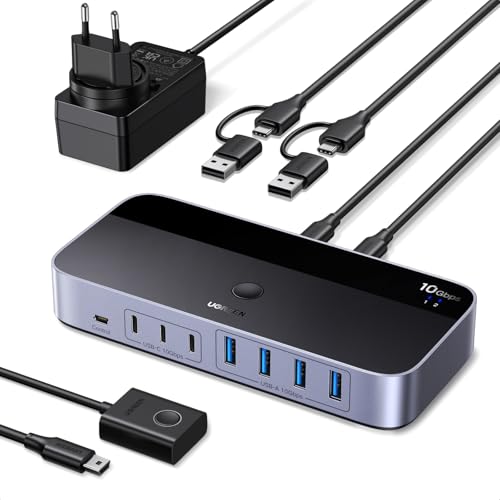
- Shares seven USB-A and USB-C devices
- Up to 10Gbps USB 3.2 Gen 2 transfers
- Includes power adapter for stable high-power use
Best For: Modern mixed-port workstations with many peripherals
Best 4K KVM Pick

- Shares a monitor, keyboard, and mouse
- Supports 4K at 60Hz
- Includes USB and HDMI cables
Best For: Two-computer home office setups with a shared HDMI display
Best Compact USB Switch

- Shares USB devices between two computers
- Supports up to 5Gbps data transfer
- Works with Windows, macOS, Linux, and Chrome OS
Best For: USB-only printer and peripheral sharing
Best Multi-Device USB Hub Switch

- Shares four USB devices between two computers
- Combines USB-C and USB-A ports
- Includes button and controller switching
Best For: Peripheral-heavy two-computer home office desks
Best High-Speed Hub Sharing

- Shares four USB devices between two computers
- Includes USB 3.0 and USB-C connectivity
- Remote or button switching with optional USB-C power
Best For: Sharing multiple peripherals between two computers
Best for Four-Computer Setups
DGODRT 4-in-4-Out USB 2.0 Switch

- Connects four computers to four shared USB devices
- Includes wired desktop controller and four cables
- Plug-and-play across major operating systems
Best For: Multi-computer offices using standard USB peripherals
Best Compact Two-Computer Option

- Shares two USB devices between two computers
- Provides USB 3.0 speeds up to 5Gbps
- Includes two 5-foot USB 3.0 cables
Best For: Two-computer desks sharing basic peripherals
Best Multi-Device USB 2.0 Sharing – UGREEN 2-Computer 4-Port USB Switch
For home offices that need to share several peripherals, this UGREEN model is a practical pick among USB switch boxes for home offices. It lets two computers share four USB 2.0 devices with one-button switching, without requiring drivers or network-sharing software.
Best For: Home-office users sharing a keyboard, mouse, printer, scanner, or other USB peripherals between two computers.
Pros:
- Shares up to four USB 2.0 devices between two computers.
- One-button switching and an LED indicator simplify everyday use.
- Works with Windows, macOS, Linux, and Chrome OS without drivers.
- Optional micro-USB power helps support higher-power devices.
Cons:
- Does not support monitors or video transmission.
- USB 2.0 is slower than newer USB 3.x switches.
- USB power cable and charger are not included.
This is a straightforward choice when peripheral sharing matters more than high-speed file transfers. Plan on adding power when several or higher-draw devices are connected.
Best Compact USB 3.0 Switch – Aluminum Bi-Directional USB Switch
This compact aluminum switch suits home offices that need a simple way to redirect one USB 3.0 peripheral. It can either connect two computers to one device or let one computer switch between two USB devices, with transfer speeds up to 5Gbps.
Best For: Users who want to share one printer, keyboard, mouse, scanner, or storage device between two computers.
Pros:
- Supports both 2-in-1-out and 1-in-2-out configurations.
- USB 3.0 enables data transfers up to 5Gbps.
- Aluminum housing and blue LED provide a compact, clear design.
- Plug-and-play compatibility with Windows, macOS, Linux, and Chrome OS.
Cons:
- USB 3.0 cables are not included.
- It shares only one peripheral at a time.
- No extra power supply is required or included, which may limit some setups.
Choose this model when speed and small size are more important than supporting multiple peripherals simultaneously. Its bidirectional design also gives it more flexibility than a single-purpose switch.
Best 5Gbps Multi-Peripheral Switch – BENFEI 2-Computer 4-Port USB 3.0 Switch
BENFEI’s switch is designed for home offices where two computers need access to several modern USB peripherals. Its four USB 3.0 ports support transfers up to 5Gbps, while a front button and LED indicator make switching between work and personal computers simple.
Best For: Dual-computer desks using multiple USB 3.0 peripherals, including keyboards, mice, printers, scanners, storage drives, or cameras.
Pros:
- Lets two computers share four USB devices.
- USB 3.0 supports up to 5Gbps and is backward compatible with USB 2.0.
- Driver-free compatibility includes Windows, macOS, Linux, and Chrome OS.
- Includes an 18-month warranty and an optional USB-C power input.
Cons:
- Requires USB-A-to-USB-A cables for connection.
- Power adapter is not included.
- It is for USB peripherals only and does not provide video switching.
This is a strong middle ground for a busy two-computer workspace: faster than USB 2.0 while still offering four shared ports. Add external power if your setup includes several high-consumption devices.
Best High-Capacity USB-C/A Switch – UGREEN 2-Computer 7-Port USB 3.2 Switch
For demanding home offices, this UGREEN unit offers one of the most versatile configurations among USB switch boxes for home offices. Two computers can share seven ports—four USB-A and three USB-C—with USB 3.2 Gen 2 speeds up to 10Gbps and included power hardware.
Best For: Mixed USB-A and USB-C workstations that connect many peripherals and transfer files frequently.
Pros:
- Shares up to seven USB devices between two computers.
- Combines four USB-A and three USB-C ports.
- Supports USB 3.2 Gen 2 speeds up to 10Gbps.
- Includes a power adapter and charging cable for more stable high-power operation.
Cons:
- Does not support video output or function as a monitor KVM.
- USB ports are primarily intended for data, so audio devices are not recommended.
- Requires Windows 10 or macOS 10.15 Catalina or newer according to the supplied compatibility details.
This is the best fit for a modern, crowded desk where port variety and speed justify a larger switch. Its included power adapter is especially useful for external drives and printers.
Best 4K KVM Pick – Two-Computer HDMI KVM Switch
For home offices that need to share a monitor, keyboard, and mouse between two computers, this 4K KVM switch offers a straightforward alternative to reconnecting peripherals manually. It supports UHD 4K at 60Hz, includes the required USB and HDMI cables, and switches computers with a push button.
Best For: Home office users who want to control two HDMI-equipped computers from one workstation.
Pros:
- Supports 4K resolution at 60Hz, along with 4K at 30Hz, 3D, and 1080p.
- Shares one monitor, keyboard, and mouse between two computers.
- Includes two USB cables and two HDMI cables.
- Driver-free compatibility is listed for Windows, macOS, Linux, and Chrome OS.
Cons:
- Designed for two computers and one shared HDMI display.
- Switching is controlled by a physical button rather than a remote.
- No external power supply is included or required according to the product notes.
This is the most suitable option here if display switching is part of your setup. It combines USB peripheral sharing with HDMI video switching, making it more versatile than a USB-only switch, while the included cables help simplify installation.
Best Compact USB Switch – USB 3.0 Bi-Directional Switch
This compact USB switch is a practical choice for home offices that need to share a printer or other USB peripheral between two computers. Its bi-directional design also lets one computer switch between two USB devices, while USB 3.0 supports data speeds up to 5Gbps.
Best For: Users who need simple, USB-only switching for printers, scanners, keyboards, mice, or storage devices.
Pros:
- Supports two computers sharing one USB device or one computer switching between two USB devices.
- Offers USB 3.0 transfer speeds up to 5Gbps and backward compatibility with USB 2.0 and 1.1.
- Includes two USB A-to-A cables.
- Aluminum housing is described as scratch-resistant and designed to aid heat dissipation.
Cons:
- Does not support HDMI or video output.
- Switches only one channel at a time; simultaneous A+B output is not supported.
- Provides two USB switching positions rather than multiple shared peripheral ports.
Choose this model when your priority is uncomplicated USB sharing rather than monitor control. Its small aluminum enclosure and bidirectional operation make it flexible for basic office peripherals, but it is not a substitute for a video-capable KVM.
Best Multi-Device USB Hub Switch – UGREEN 4-Port USB Switcher
For home offices with several shared accessories, this UGREEN USB switch provides four USB 3.0 device ports, including one USB-C port and three USB-A ports. It lets two computers share peripherals such as keyboards, mice, printers, headphones, and cameras, with switching available from the included controller or the unit’s button.
Best For: Two-computer workspaces that share multiple USB accessories and benefit from remote-style controller switching.
Pros:
- Allows two computers to share up to four USB devices.
- Includes one USB-C port and three USB-A ports for varied peripherals.
- Supports USB 3.0 speeds up to 5Gbps and plug-and-play operation.
- Offers both button and controller switching, plus an optional USB-C power connection.
Cons:
- It is not a KVM and does not support monitor connections or video transmission.
- Multiple devices may require optional power to help prevent disconnections.
- The USB-C port does not support video output or use with a display dock.
This is the strongest fit for a peripheral-heavy desk where four devices need to move between two computers. The port mix and controller add convenience, but shoppers specifically looking to switch a monitor should choose a KVM instead.
Best High-Speed Hub Sharing – BENFEI 4-Port USB 3.0 Switch
For home offices that need to share several peripherals between a work computer and a personal computer, the BENFEI is one of the more flexible usb switch boxes for home offices. It provides three USB 3.0 ports plus one USB-C port, with both button and remote switching.
Best For: Users sharing multiple modern USB devices between two computers.
Pros:
- Shares three USB 3.0 devices and one USB-C device between two computers.
- Supports data transfer speeds up to 5Gbps and is backward compatible with USB 2.0.
- Offers button or remote switching, LED status indicators, broad OS compatibility, and an optional USB-C power input.
Cons:
- Requires BENFEI USB A-to-USB A cables for connection.
- High-power devices may need an additional power supply.
The BENFEI stands out when port count, USB-C support, and fast transfers matter. Its remote control is especially convenient for a desk where the switch is out of reach.
Best for Four-Computer Setups – DGODRT 4-in-4-Out USB 2.0 Switch
If your home office uses several computers and mostly standard peripherals, this DGODRT model is a practical choice among usb switch boxes for home offices. It lets four computers share four USB 2.0 devices without repeatedly moving cables or configuring network sharing.
Best For: Home offices, meeting spaces, or workstations with up to four computers and four shared USB peripherals.
Pros:
- Supports four computers sharing four USB devices.
- Includes panel buttons, a wired desktop controller, and LED activity indicators.
- Plug-and-play compatibility with Windows, macOS, Linux, and Chrome OS.
Cons:
- USB 2.0 limits transfer speeds to 480Mbps.
- External 5V/1A power adapter is not included and may be needed for high-power devices.
This switch is a good fit when broad computer support and four-way device sharing are more important than USB 3.0 speed. It also includes four USB cables and a wired controller to simplify setup.
Best Compact Two-Computer Option – UGREEN 2-Port USB 3.0 Switch
The UGREEN 2-in-2-out switch keeps a two-computer home office setup simple: connect two USB peripherals, then change computers with one button. It is a streamlined pick among usb switch boxes for home offices, with USB 3.0 performance and two included five-foot cables.
Best For: Two-computer desks sharing a keyboard, mouse, printer, webcam, or similar USB devices.
Pros:
- Allows two computers to share two USB devices.
- Supports transfers up to 5Gbps and remains backward compatible with USB 2.0.
- Offers driver-free operation, one-button switching, LED status indication, and two 5-foot USB 3.0 cables.
Cons:
- It is not a KVM switch and cannot switch or transmit monitor video.
- Only two USB output ports are provided.
Choose the UGREEN when you need straightforward peripheral sharing rather than display control. Its compact two-device layout works well for a keyboard-and-mouse setup, while the 5Gbps specification keeps file transfers faster than USB 2.0 alternatives.
How We Picked the Best USB Switch Boxes for Home Offices
We focused on the features that matter most at a shared desk: the number of computers and USB devices supported, USB generation, connector types, switching method, compatibility, and setup practicality. The selection includes basic two-computer selectors, models with USB-C ports, four-computer options, and KVM units that also share a monitor.
We also considered whether a switch is better suited to low-bandwidth accessories such as keyboards and mice or to devices that benefit from USB 3.0 or USB 3.2 speeds, including storage drives and webcams. Always check the product listing for included cables, power requirements, and operating-system compatibility before ordering.
Quick Comparison
| Type | Best For | What to Check |
|---|---|---|
| USB 2.0 selector | Keyboard, mouse, printer, scanner | Lower transfer speeds |
| USB 3.0 switch | General peripherals and faster devices | Host and device port standards |
| USB-C and USB-A switch | Mixed modern setups | USB-C data support and cable type |
| USB 3.2 switch | High-speed storage and demanding accessories | Up to 10 Gbps support across the setup |
| HDMI KVM switch | Sharing USB devices and one monitor | Resolution, refresh rate, and HDMI version |
Key Buying Factors for USB Switch Boxes for Home Offices
Ports and Device Capacity
Count both sides of the setup. A two-computer, four-device switch is convenient for a keyboard, mouse, printer, and scanner, while a two-port model may be enough for basic input devices. If you use several accessories, look for four-output designs or a switch that accepts a powered USB hub.
USB Speed and Connector Compatibility
USB 2.0 is generally adequate for keyboards, mice, and many printers. Choose USB 3.0 or USB 3.2 for external storage, high-resolution webcams, and faster file transfers. USB-C ports are useful for newer laptops, but confirm that they carry data rather than power only. Your computer ports, cables, switch, and peripheral must support the desired speed.
Switching and Power
A physical button works well when the switch sits beside the monitor. A wired desktop controller or remote is more convenient when the box is hidden under a desk. Some demanding devices may need external power, especially when several peripherals are connected at once.
Display Sharing
A standard USB switch shares peripherals but does not switch video. If you want one monitor, keyboard, and mouse to work across two computers, choose a KVM switch and verify its maximum resolution, refresh rate, HDMI requirements, and display behavior after switching.
Who Should Buy Which USB Switch Boxes for Home Offices?
- Basic home-office users: Choose a compact USB 2.0 or USB 3.0 model for a keyboard, mouse, and printer.
- Mixed USB-A and USB-C setups: Pick a switch with both connector types, while checking the included host cables.
- Storage and webcam users: Favor USB 3.0 or USB 3.2 and avoid placing high-speed devices behind a USB 2.0 bottleneck.
- Multi-computer workstations: Look for four-computer support or a higher port count if several systems share the same accessories.
- Single-monitor desk setups: Buy an HDMI KVM switch when video switching is as important as USB peripheral sharing.